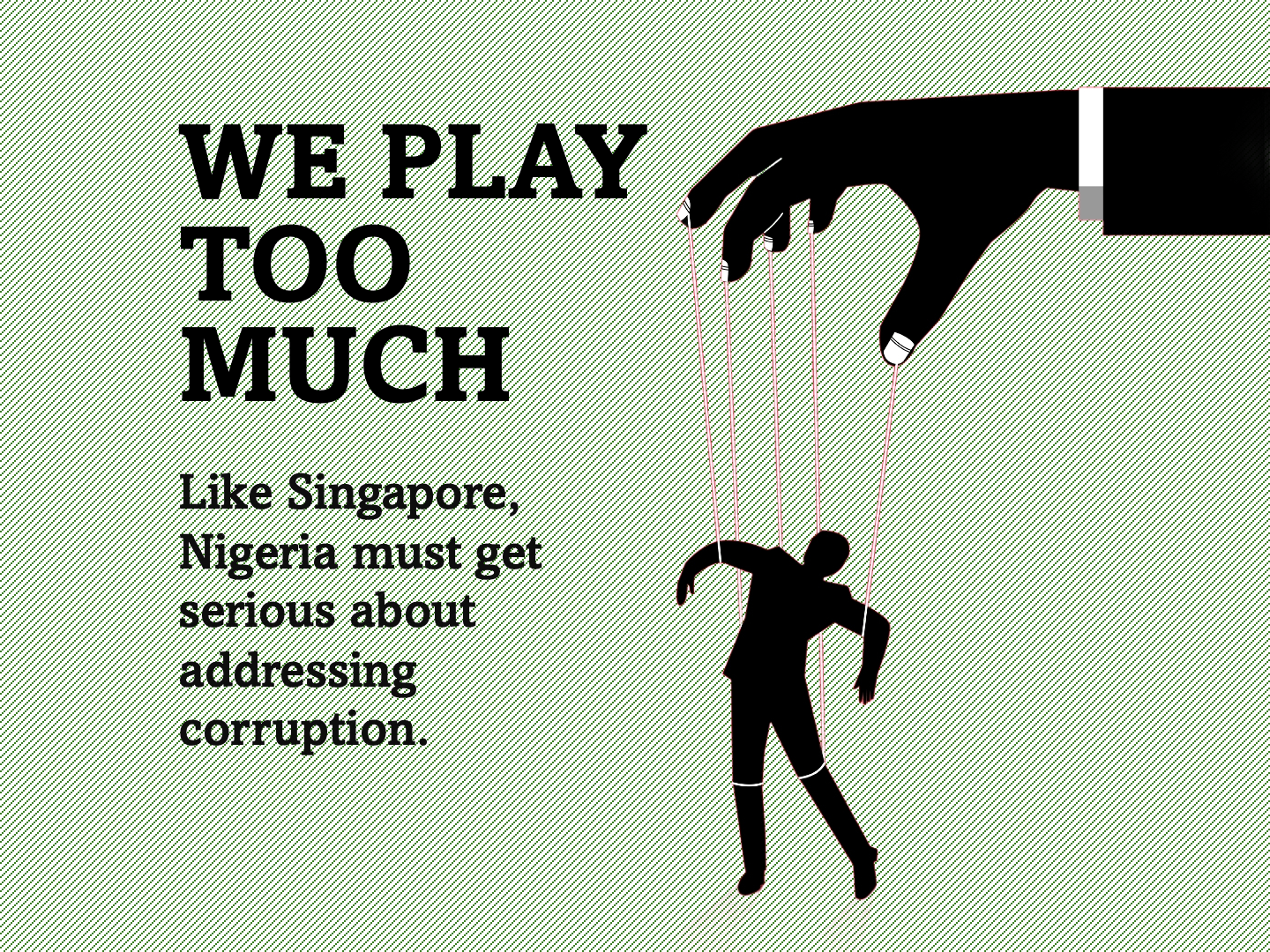
…Like Singapore, Nigeria must get serious about addressing corruption.
During a visit to Accra in 1994, there was a lot of talk about Nana Rawlings purchasing a jacuzzi worth around $10,000 in the United States. Even as Ghana’s First Lady, it was questionable how she could afford such a luxury. This raised concerns among the media and the public, especially considering Ghanaians’ economic difficulties due to the World Bank-induced Structural Adjustment Programme. People also couldn’t ignore the fact that 15 years earlier, Nana’s husband, Jerry John (“JJ”) Rawlings, had executed eight senior military officers and three former heads of state on corruption allegations. The press had fun drawing parallels between Nana’s purchase and the golden bed bought by the wife of Krobo Edusei, a Minister in Ghana’s First Republic. The military overthrew Ghana’s First Republic for alleged widespread corruption.
I debated the scandal extensively, particularly with my uncle’s housekeeper, who strongly supports “Junior Jesus” Rawlings. Our discussions mainly focused on the extent of a president’s authority over state resources. He believed that the “Father of Modern Ghana” deserved certain privileges. He thought it was unfair to criticise the president over an “ordinary bathtub.” Despite my best efforts, I couldn’t persuade him that the issue wasn’t about the size of the transgression but rather the indiscretion itself. He couldn’t understand that those who must wear long-flowing white gowns must avoid muddy paths. Public officials should uphold impeccable integrity, or else the country would suffer.
My mind went back to the debates in early October 2024 when a court in Singapore found Subramaniam Iswaran, a former Minister for Transport and Minister-in-charge of Trade Relations, guilty for unlawfully accepting gifts while in office. These gifts included flights, hotel stays, and tickets to musicals and football matches. Many African politicians and bureaucrats might find it amusing that someone could be jailed for such a “dash.” After all, those who use their teeth to divide the meat for the community should be allowed to swallow the juices. Fortunately, the Singaporean judge disagreed. Indeed, the judge rejected the prosecution’s recommendation of a maximum sentence of seven months because, in his opinion, people in senior government positions “must be expected to avoid any perception that they are susceptible to influence by pecuniary benefits.” The judge sentenced Iswaran to twelve months in prison.

Singapore is fortunate to have a founding president, Lee Kuan Yew, who strongly disdained corruption and implemented a zero-tolerance policy. He posited, “Corruption is not about systems; it’s about people. If the top person is clean, the system will be clean.” He also emphasised, “If you want to defeat corruption, be prepared to send your friends and relatives to jail.” As a result of these efforts, Singapore is ranked as the fifth least corrupt country in the world, according to the 2023 Corruption Perception Index. However, only four African countries are among the top fifty least corrupt countries: Seychelles (20), Cabo Verde (30), Botswana (39), and Rwanda (49). Nigeria is ranked 145 out of 180 countries.
Most African countries were not as fortunate as Singapore regarding their founding generation. For instance, Nigeria’s three founding fathers – Zik, Awo, and Sardauna – were each found guilty of corruption even before the country could stand up. The country’s first military coup resulted from widespread corruption, political instability, and mismanagement of resources. Lee Kuan Yew was unsurprised by Nigeria’s fate, as he often used the country as an example of bad leadership. He once remarked, “The problem with Nigeria is that they are rich, but their wealth has been squandered. The leaders did not have the discipline or knowledge to manage the economy for long-term development.” This mismanagement resulted in Nigeria’s Gross Domestic Product per capita in 2022 ($5,070) being about four times its value in 1960 ($1,307). This is a poor performance compared to the Seychelles – the least corrupt country in Africa – where the GDP per capita increased tenfold from $3,257 in 1960 to $31,055 in 2022.
Thankfully, history is not destiny. Numerous countries have transitioned from a corrupt past to a prosperous future, including China, Singapore, Rwanda, Georgia, Botswana, Estonia, and South Korea. Despite following different paths, these nations shared a common factor: strong leadership dedicated to establishing robust, independent anti-corruption institutions capable of ensuring accountability. Singapore’s decision to imprison Subramaniam Iswaran reaffirmed its unwavering anti-corruption stance. The legal system communicated the country’s zero-tolerance policy towards corruption by extending the jail term from seven to twelve months. Paraphrasing Leviticus 22:21, those who sacrifice for the people “must be without defect or blemish to be acceptable.”
Nigeria missed the above memo. The country’s leadership demonstrates a certain level of teenage unseriousness in addressing corruption despite annual losses to corruption and financial crimes averaging about $18 billion, equivalent to approximately 3.8% of the country’s 2022 gross domestic product. The Economic and Financial Crimes Commission (EFCC), Nigeria’s principal anti-corruption agency, recently announced the recovery of approximately N156.3 billion (roughly $100 million) from 3,175 convictions in the 12 months leading up to May 29, 2024. The EFCC Chairman commended this recovery as an “impressive performance,” although it represents less than 0.6% of Nigeria’s annual losses to corruption.
This glorification of small achievements is more worrying when one digs further into the numbers. Of the 976 convictions in 2020, only four are for “Abuse of Office,” totalling N20 million. Over 90% of the convictions that year were for internet (or “419”) scams. Indeed, the EFCC Chairman, who should be the nightmare of Nigeria’s corrupt elite, claims that the “involvement of youths in internet fraud continued to pose serious concerns to every stakeholder in the anti-graft war.” Nigerians must pay attention to what John F. Kennedy terms the “tyranny of small decisions,” which lead to the tragedy of large events.

One might be tempted to dismiss the above as mere “glorification of mediocrity” in a nation that has lost its taste for ambitious endeavours. However, the situation becomes more disquieting when one notes that several politicians EFCC accused of corruption have assumed senior government positions while their cases are still pending. This situation is like entrusting the accused goats with oversight of the yam barns. Unlike Nana Rawlings or Subramaniam Iswaran, none were raked over fire or imprisoned. Consequently, Nigeria’s dilemma goes beyond a bias toward mediocrity; it reflects a system that operates as intended. Those who express concerns about the country’s socio-economic landscape must reluctantly admit that the leaders, and possibly their constituents, have sown this wind, and the rest of us must accept the whirlwind.
But it doesn’t have to be so. Let’s start with the obvious: no nation is devoid of corruption. The difference is in the type of corruption and the nation’s attitude to this virus.
Yuen Yuen Ang’s groundbreaking work Unbundling Corruption: Revisiting Six Questions on Corruption, from 2020, defines four varieties of corruption: petty theft, grand theft, speed money, and access money. While all types of corruption are damaging, not all hinder economic activities. Some types enable or facilitate exchanges. For example, speed money occurs when non-elites pay small bribes to bureaucrats to bypass obstacles or expedite processes. Access money is a more sophisticated form of speed money where the elites offer high-stakes rewards to influential public officials to gain access to exclusive and valuable privileges.
However, some forms of corruption involve outright theft. Petty theft involves stealing, misusing public funds, or extortion among lower-level bureaucrats. In contrast, grand theft refers to embezzlement or misappropriation of large public money by political elites who control state finances. Grand theft, predominant in Nigeria, is considered the most severe form of corruption because the elite siphon funds from the system and hinder economic activities. Data presented in Ang’s paper shows that Nigeria also exhibits high degrees of all the other forms of corruption.
Those who recognise corruption as a serious issue approach it with the gravity it deserves. It is not a matter to be trivialised or deferred. Nothing is amusing about it. Regrettably, Nigerians and their governing bodies have failed to acknowledge this reality. Instead, they view it as a challenge that can be kicked down the road, neglecting to comprehend that it poses one of the most significant existential threats to the people.
Conversely, nations such as Singapore, which have reached this level of awareness, understand that even the “Father of the Nation” should not receive special privileges. A president’s spouse should be questioned if unable to account for their wealth, even if it’s just $10,000 for a jacuzzi. Government officials should be jailed if they fail to declare any gifts, no matter how small.
In a previous job with a bank in the United States, I invited a client, a senior government official, to join me for a baseball game. Through my bank, I had access to the luxury suite at the stadium, but the client declined and insisted on buying his own ticket. During the game, I offered to buy food and drinks, but he refused, explaining that if he accepted anything from me worth more than $20, he would have to report it. He didn’t have the time for such reporting and wanted to avoid additional scrutiny. He also didn’t want to risk forgetting to include a beer, which may have caused him to go to jail. I thought that was quite instructive. Even when the gift is as legitimate as hotdogs at a ball game, the stress and risk of reporting made this upstanding man pass on the offer. Africa can learn a lot from such a process.
Are Nigerians ready for this level of intolerance for corruption? Are their leaders equally prepared for transformative change? When posed with these questions, many may initially express their frustrations. They often highlight the impact of flawed elections, which allow corrupt leaders to maintain their grip on power. While this is a valid concern, numerous countries with corruption issues have successfully reduced public corruption despite imperfect electoral processes. Take, for example, the remarkable progress in nations like Georgia under Mikhail Saakashvili, Indonesia under Susilo Bambang Yudhoyono, China under Xi Jinping, Mexico under Enrique Peña Nieto, and Rwanda under Paul Kagame. These leaders are not choirboys. Despite their shortcomings, they initiated powerful anti-corruption efforts that yielded tangible and impressive results.
Why would leaders with questionable pasts support anti-corruption efforts? Several complex motivations behind this paradoxical behaviour include the need for political survival or legitimacy, economic challenges, international pressure, personal legacy, public demand, and civil society pressure. A common thread connecting these factors is that the people must ensure the elite are uncomfortable. The opposition, media, and civil society organisations must create discomfort, or the elite will continue with the status quo. These groups must demand and work with the government to create economic and political incentives favouring transparency and accountability. They must also demand legal, political, financial, and structural independence for their anti-corruption bodies.
Combating corruption presents a complex challenge, as no universally applicable remedies exist. There are no copy-and-paste options. Each nation must chart its own course in establishing anti-corruption frameworks tailored to its specific context. This endeavour necessitates formulating incentives and strategies compatible with the prevailing political and economic conditions. It is a formidable undertaking that requires steadfast dedication from the populace and their leaders. However, it will not be achieved by heavenly beings. Humans, who are flawed in many ways, must take on this challenge. Both the people and their leaders must acknowledge that if this cancer is not cut out, it will metastasise, and, at that point, all bets are off. This task demands more serious engagement than anything Nigerians have ever attempted. Success, while difficult, is possible.
Patrick O. Okigbo III
October 09, 2024
Patrick O. Okigbo III is the Founding Partner at Nextier. He shares his thoughts on Substack at BUILDING THAT SOCIETY (https://patrickokigbo3.substack.com).