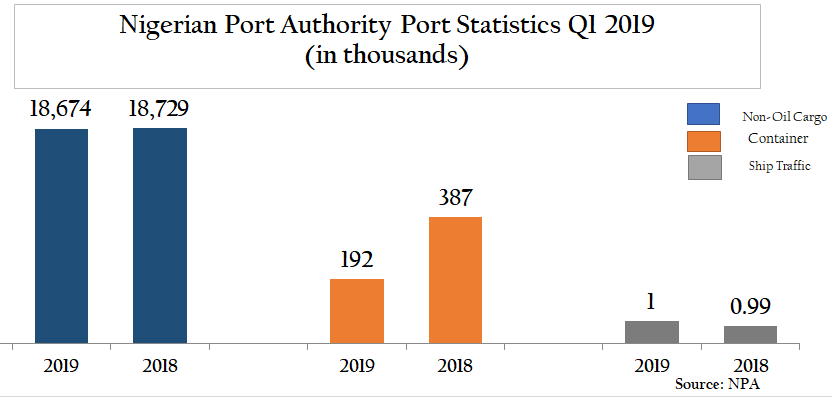
The volume of containerised cargoes imported into the country in the first three months (January to march) of 2019 dropped by 50.3 percent to stand at a total of 192,164 twenty-foot equivalent unit (TEUs), from 387,016 TEUs recorded same period in 2018, the latest port statistics released by the Nigerian Ports Authority (NPA) has stated.
According to the NPA, this volume amounted to a total of 2,818,990 metric tonnes of imported containerised goods while a total of 486,978 metric tonnes of containerised goods cargo were exported in the period under review.
Also, the volume of non-oil cargoes handled in the nation’s seaports in the period under review dropped by 0.3 percent to a total of 18,674,534 million metric tonnes.
A breakdown of this shows that a total of 11,212,281 million metric tonnes of non-oil cargoes were imported while 7,462,253 million metric tonnes of non-oil cargoes were exported in the first quarter of the year.

Surprisingly, in the period under review, the number of ship calls recorded in the nation’s seaports increased by 6.09 percent to stand at a total of 1,045 vessels with gross registered tonnage of 32,994,368 metric tonnes of cargoes as against the 985 ship calls with 31,693,650 metric tonnes of cargoes were discharged in the nation’s ports in the first quarter 2018.
A further breakdown shows that general cargo that was brought into the country stood at 1,379,894 metric tonnes while a total of 367,425 metric tonnes of non-crude oil general cargo was exported out of the country during the period under review.
NPA further disclosed that in terms of dry bulk cargo, a total of 1,888,446 metric tonnes were brought into the country while a total of 223,355 metric tonnes were exported within the period under review.
Importers also brought in a total of 5,124,951 metric tonnes of liquid imports while exporters took out a total of 6,384,495 metric tonnes of liquid export.
Speaking on the business activities at the ports in the first half of the year, Adekunle Oyinloye, group general manager of SIFAX Group, said terminals recorded a slight drop in the volume of business activities due to expansion of other ports and diversion of transit cargo to more efficient ports by cargo owners from landlocked countries.

He identified the bad state of the access roads to the Tin-Can Island Port, especially Apapa-Oshodi Expressway, as a major challenge as consignment spend days at the port than necessary.
Oyinloye called on the government to consider linking Tin-Can Port by rail to make evacuation of cargo a lot easier. “It has become saddening that some ports in West Africa have taken the shine off Nigeria despite the size of the Nigerian economy in the region. For instance, Lome Port has now become a hub,” he said.
Road congestion, he said, made it near impossible for cargo owners to take delivery of their consignments, adding that importers are now diverting transit cargoes to more efficient ports in the West African region.
Hadiza Bala-Usman, managing director of the NPA, has said that the nation’s seaports were losing ship and cargo traffic because of government policies that are discouraging importation.
“We have noted a reduction in traffic coming into our ports. We attribute this to the fact that Nigeria has been advocating for self-sustenance in terms of manufacturing and consuming what it produces,” said Bala-Usman during NPA’s 2019 budget defence before the House of Representatives Committee on Ports, Harbours and Waterways in Abuja earlier in the year.
Amaka Anagor-Ewuzie