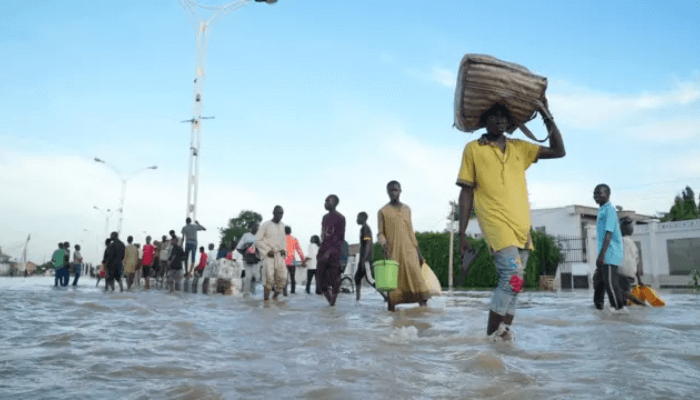
How time flies! September 10, 2024 was like yesterday, but it is already one full year. It’s a day Borno State would live to dread remembering, perhaps, to the end of time. It was a day of devastating floods!
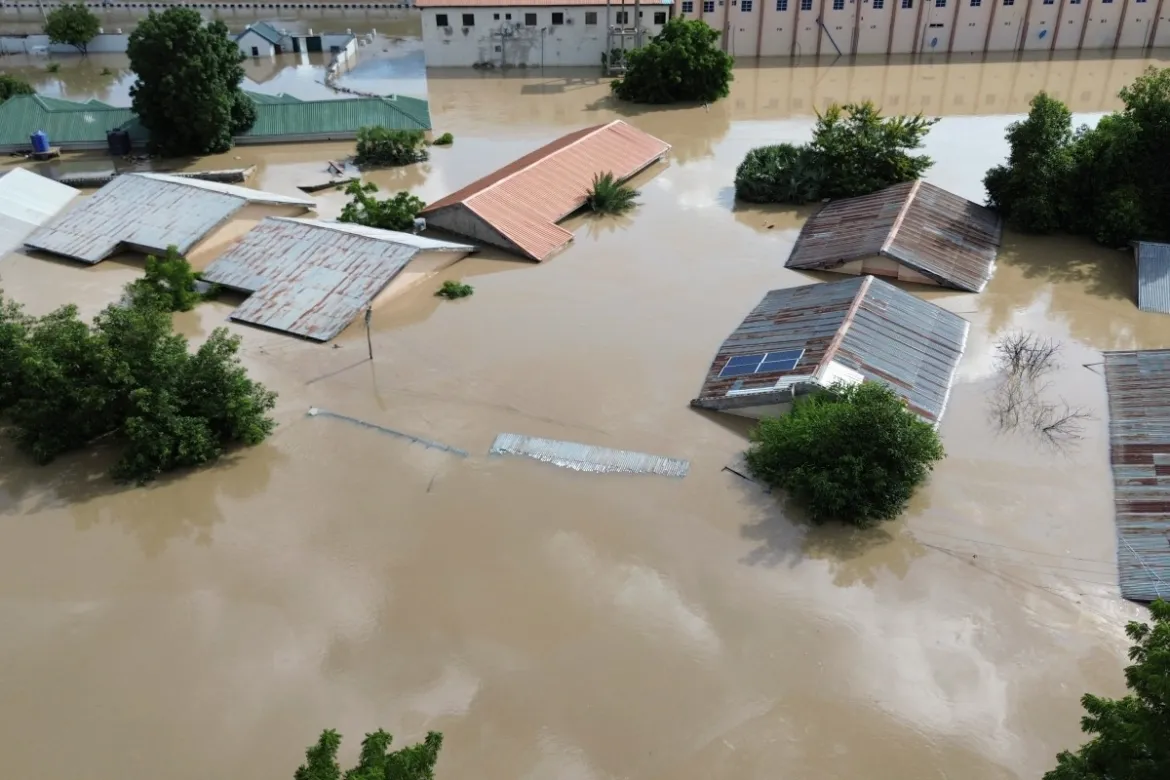
It was the day nature descended with its full wrath on Maiduguri in the form of a frighteningly massive flood that submerged about three-quarter of Maiduguri metropolis, the state capital, and the neighbouring Jere, and Mafa Local Government Areas, claiming over 150 lives, according to official sources, and crumbling properties worth yet-to-be-quantified billions of Naira.
The volume of water was unprecedentedly high. Consequently, embankment of forty-year-old facility, just about sixteen kilometers away from Maiduguri, which had served the metropolis and its adjoining Jere Local Government Area, with drinking water for over three decades, collapsed, causing a massive water seepage, with millions of cubic liters of water gushing with a frightful rage, swallowing every object, living or non-living, on its way all over the major part of the metropolis and Jere.
The calamitous impact of the flood, still remains incalculable. To this day, no official, or any other source, estimates are authoritative enough about the damage incurred.

But one fact remains dazzlingly clear-the flood caused a huge humanitarian crisis, just a class below that of the fifteen-year-old Boko Haram insurgency, which Borno is still struggling to recover from.
Majority of the victims of the natural disaster are still struggling to recover from the trauma and abject indigence it plunged them into, compounding the hopelessness of the major population already rendered vulnerable by Boko Haram terror.
The flood disaster wrecked the fledgling Borno economy struggling to find its feet from Boko Haram devastation, with the major part of the state’s business community, which suffered unquantifiable billions of Naira loss, still struggling to recover even if an inconsequential part of what it lost to start once again.
The major percentage of the deeply anguished vulnerable population promised support by the state government to enable them pick up the pieces of their lives and rebuild their lives have been plunged deeper into frustration and hopelessness by the failure of the government to fulfill the promise.
Speaking to BusinessDay, some of the survivors said the flood’s impact goes far beyond physical destruction. The emotional trauma continues to torment them. Many lost their loved ones, source of livelihood, businesses destroyed, houses ruined, unspecified number are out of business, as well as farmlands and livestock totally wiped off.

A book seller at popular post office area said the agony of sad day is fresh in his memory, “I lost text books and stationary worth millions of naira to last year’s flood,” Bukar Bunu recalled his ordeal.
He continued, “Everything seems like yesterday and the torrent water will continually remain with me for long time. I have received no penny from government and I am sure none among my colleagues in this areas received anything.”
Fati Abdullahi, another survivor, a mother of five who resides along old Maiduguri shared her heart-wrenching story. She couldn’t salvage anything from her home, but only received N300,000 from the flood committee.
The flood sacked her and her family from their home, forcing them to spend the night on the road.
“We later moved to Bakassi temporary camp where we spent seven days beside the road, and then found a place to stay for eight days.
“We received a support of 25kg of rice, one carton of spaghetti, two mats, mosquito net, and blanket. After that, when we returned home we got N300,000. We were disappointed the way the whole things played out,” she said.
Timothy Olanrewaju, another survivor, said he didn’t receive a penny in spite of the fact that his car was damaged, books, clothes, and other valuable items lost in a jiffy.
“The man in me vanished. Will I get drowned? Is there a spirit in this water eager to take life? These few questions ran in my mind. Then, I remembered the words of God: ‘For I know that my Redeemer liveth’ Job 19:25. These words became my source of courage. I held the gate pillar firmly and a strong rod provided the needed support.
“I heard someone shout ‘Please wait there, Sir! Don’t move!’ A young man appeared from the main road. He turned out to be my neighbour. He pushed through the heavy water, held my hands and led me through the massive waters that have submerged the once-beautiful houses on our streets.
“We walked up the road and joined hundreds of people; elderly, young ones, children, big, top civil servants, academicians, expatriates working with international humanitarian agencies and ordinary citizens already displaced We sat on the bare ground in an open place. It was a new life of displaced persons as we shared water, bread and encouraged one another, grateful that we were not consumed by the angry floods.”
While reflecting on the September 10th, Suraj Abdullahi Garba, the Zonal Coordinator of the National Emergency Management Agency (NEMA) in charge of Borno and Yobe States, described the last year’s flood as one of the worst and traumatized in recent times, displacing thousands of families across Maiduguri and leaving many dead.
“I’ve never experienced a situation of this magnitude in my entire life. It was really overwhelming. The town was almost cut into two. You can’t access a lot of places. Aside from that, even communication became a problem. Places we could drive to or move to in 15 to 20 minutes was taking us about two hours. It was chaotic situation but we are glad that we saved thousands of lives.
He explained that NEMA, in collaboration with state authorities and other partners, provided immediate relief in the form of food supplies, mats and temporary shelters.
“And there are lots of homes that were visited who have aged sick and people, and you find out that they were drinking water that was contaminated. And we have those that did not eat for more than almost 48 hours. Some people could not have access to what to eat. Also, the lives that were lost. I barely sleep, there was no time to sleep. It was traumatizing!”
He recalled: “What stood out, I think it has to do with the resilience of the people; the response, everybody had some feelings towards those that were affected. And overall, when you look at it, the support that was given by Nigerians. Everyone felt the pain. You know, of more people, most especially those that were affected and in their little ways, I think the support from Nigerians awesome and admirable.
“The logistics issue, yes, I wouldn’t say we’re not overwhelmed, but, as we rightly say, the joint collaboration with other partners, the military, the police, the Civil Defence and other key partners, I think, most especially even the youths, everybody tried to provide support to people. And it was really encouraging.”
Usman Aliyu, the director general Borno State Agency for the Great Greenwall, explained that the devastating flood was the evidence of an impact of climate change on the environment because there are lots of evidences which include another flash flooding, global warming, drastic changes in the rainfall pattern and intense heat.
“The impact of last year’s flood was climate change. This is to also to notify us that climate change is real unless if we will now act on impact of the climate change by mitigating it to a minimal level.
“You have seen the flash flooding and currently you will also see that even our Ngadabu River is about overflowing their bank; so, these are impacts and evidence of climate change for us. I think now is high time for us to come together, put our heads together and see how we can mitigate climate change; see how it will be resilient and adaptive to issues of climate change as well as other environmental problems,” he said.