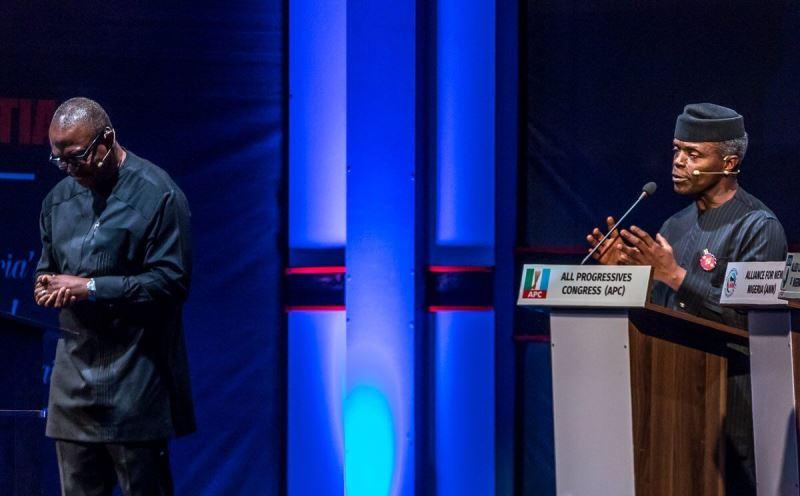
I watched with keen interest the Vice Presidential candidates’ debate organised ahead of the forthcoming elections in Nigeria. Obviously, the current government, to be candid, has not performed to the level of my initial expectations when it came into office. This is not to say they have done nothing worthy of commendation.
At least, some of our rail lines are working again. There are many other initiatives such as the N-power and soft loan programmes as well as the conscientious efforts to develop other infrastructure projects to which the government deserves some credit. If anything, the level of waste and profligacy of the penultimate government has been curtailed to a great extent. However, as many would agree, the process of change is moving at snail pace and while the good intentions of current actors cannot be denied, the speed we are running at is way too slow for (i) where Nigeria currently stands and where we want to be (ii) the rate of expansion of our burgeoning population now forecast to exceed 250 million by 2030 and (iii) the speed at which the rest of the world is moving at.
I am not a particularly strong supporter of some of the government’s policies including those on infrastructure. I ask myself if the government can really bankroll the infrastructural needs of Nigeria by taking on various loans from international finance institutions. The Vice President, Professor Yemi Osinbajo recently estimated Nigeria needs about $1 trillion to modernise its energy infrastructure alone. The country is estimated to require $450 trillion to execute on the National Integrated Infrastructure Master Plan (NIIMP). In my own estimations, there is only so much government can do and given the requirements, Nigeria needs to be moving with urgency. I am aware some measures have been taken to create certain structures through the Nigeria Infrastructure Fund and the resuscitation of the Infrastructure Bank. But these measures are just not enough. If we are looking to attract capital, we need to create the right legal framework and other measures necessary to guarantee attractive returns on investment. However what we truly need is a holistic infrastructure development strategy with creative policies as to limit our dependence on foreign capital to finance our infrastructure needs. This is a long term plan which cannot be done overnight.
Our policies on agriculture and development of local industries are not robust enough. Our agricultural policies are at best disjointed and we lack the necessary support industries such as steel and petrochemical industries, to mention a few, which are the essential requirements to drive a modern industrialised economy. It is only when the essential industries are in place, then the resulting multiplier effects could lead to the creation of an even larger service driven economy. However, this is a matter for another day.

There is a glaring absence, at this time, of any holistic, strategic and interconnected national development plan which accounts for all elements of monetary, fiscal, trade, foreign exchange, industrial, and capital formation and labour policies. Not to forget the legal, regulatory, constitutional and institutional framework necessary to achieve our aspirations. If those policies exist today in some form – maybe the national industrial revolution plan – then execution is lacking. There is need for joint concerted effort across all sectors, government levels and the private sector.
Why was I so keen on the debate? I was interested in knowing if there is truly an alternative in this election cycle. While I am mindful that perfection might just be a pipe dream or a mirage, it is important to at least assess and critically analyse our options albeit from the limited scope of a time bound debate. Given my doubts on what difference Atiku Abubakar can make as the President, I was more interested in knowing what his running mate, Peter Obi, could offer. I could hear a lot of numbers and statistics coming forth during the time he presented. However, beyond the numbers, which should be expected ahead of such a debate. I felt the comments shared were light on details and short of any concrete plan in place to make a change. It sounded all too familiar – back to 2015 again – the numbers game. The arguments in my mind felt somewhat peripheral, on-the-surface and lacking depth.
Further, I thought the comments on fuel subsidy was being in some ways economical with the truth and maybe playing to the gallery. It is true a more efficient system will provide additional savings but that distracts from the substance of the matter. Can Nigerians really bear a situation where subsidies are taken away? Let’s be factual, our refineries are at present not working. Other than the Dangote refinery complex now in construction, I doubt if any government can solve the fuel subsidy problem in the next four years absent a significant fall in international oil prices. Nigeria, today, cannot but import petrol and there is a set international price. Are Nigerians ready to pay that price? I am not sure. The multiplier effects via cost push inflation on all sectors of the economy might be too much to bear. There were more positive areas where Peter Obi performed well including highlighting his achievements in driving ICT development while he was governor of Anambra state. Nevertheless, his comments on Nigeria not signing the African Continental Free Trade Agreement (AfCFTA) were not encouraging especially regarding his view that we need not worry about China on the basis that we have cheaper labour.
So while I await the presidential debate – hoping that it will be a fruitful exercise, in my mind, the Atiku/Obi ticket is looking less appealing. Although, I also have doubts on if Buhari/Osinbajo team can move faster, avoid policy mistakes and somersaults, develop holistic national development policies and quite frankly show more religious tolerance and compassion for sensitive national issues. So here lies the great dilemma. Can this government deliver if returned to power? I felt the Vice President, Professor Yemi Osinbajo performed well in describing what the government has done so far but no matter how good it might be, it still falls short of what the populace expect in terms of economic development and the dividends of democracy.
Yet there is maybe an alternative if only parties like The Young Progressive Party (YPP) could be aligned with other parties like the Alliance for New Nigeria (ANN). The YPP’s vice presidential candidate performed reasonably well, in my estimations. At least she was frank on the need to know the true state of government affairs as regards the removal of fuel subsidies – a sensible conclusion I imagine. I believe the party has a well-rounded presidential candidate in Professor Kingsley Moghalu. I share similar views about other charismatic presidential candidates such as Fela Durotoye and Oby Ezekwesili. My concern is I do not think one man or woman can change Nigeria. You need partners at all levels of government – the legislature, states and dare I say the local governments. One can have the best of intentions but without a supporting team of like-minded individuals at all levels of government, this becomes very difficult to achieve. For a nation like ours, difficult decisions need to be made and in the process, many individuals might be offended and as expected there will be a significant level of resistance. No one person can withstand that level of opposition I believe; you only need to look at the running battles Buhari has faced with the legislature to have a clue and that is with a house majority. The key question is how a YPP executive government, for example, will perform with a legislative arm full of PDP and APC members? That government might not even live to see the end of its first six months.

This is why it would have been great if these patriotic Nigerians came together to form a single platform with strong candidates across all the arms of government. Only one person can be president but one person cannot get the job done. If we are truly seeking the transformation of our nation, then any position of service (state or federal) is not too small. Would it not be more powerful to have the legislative arm of government and state governments filled with strong like-minded candidates who can influence decisions and actions at all levels than to have a president only in name and lacking in power? After all, politics is a game of numbers. This is the pertinent issue that must be considered. We should not be having state elections in Osun and Ekiti without strong candidates from the YPP or ANN for example. We should not imagine that those who voted for APC or PDP at those elections will suddenly have a change of heart when it comes to the presidential election.
For the alternative, it might be too late to make a difference in 2019 but 2023 is just 4 years away. Politics and nation building is a long term process. We should move away really, from our kneejerk reactions and become more strategic. Although the 2019 elections are just ahead of us, I dare say now is the time to start thinking about 2023 and making strategic plans. Now is the time to start planning to have strong candidates in all future elections leading to 2023; candidates that can win and deliver.
Dapo Oguntade