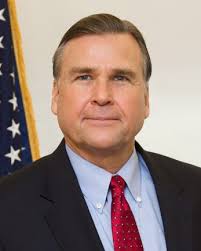
What was the strategic consideration behind the choice of the ancient and commercial city of Kano as the first point of call of W. Stuart Symington, the United State of America (USA)`s new ambassador in Nigeria?
This and other topical questions were what were agitating the minds of most residents of Kano when Symington made his maiden official visit to Kano State, last Wednesday, to meet Governor Umar Abdullahi Ganduje.
Most residents of the state were particularly, interested in knowing the mission of the new ambassador to the state, especially now when the new administration of President Donald Trump in Washington DC, is yet to clearly define the focus of it relationship with Africa, Nigeria inclusive.
However, despite the signal emanating from Washington which tends to suggest that President Trump would be less supportive of the traditional US relationship with Africa which is largely driven by grant of developmental aids, the new ambassador to Nigeria says his country is ready to take the existing cordial relationship between the two countries to higher level.
Speaking to BDSUNDAY on the side lines of the visit, Symington disclosed that America appreciate its relationship with Nigeria, and desired to also strengthen it as well as promote an interface between citizens of the two countries.
His words: “I have come to Kano for two reasons, first because it is so important for this country and the Nigerian country is important for my country and for the world. You asked the question why am I here?
“The question was why am I here? And the answer is, I am here because Kano is so important for Nigeria and because Nigeria is so important for the world.
“And the second reason I am here is the same reason I am going to all six regions of Nigeria because I want to learn from people in each place, so that I can understand the whole country and then look for ways the United States can work to help every part of Nigeria and every person here sees it.
“And the reason I am here right now is because your governor and your state are putting in their action but what I think is the most important of all principles, that is that justice in the whole country and strength in the whole country begins with how you treat every person.
“And so, it is out of interest, respect that I have come to learn from your governor. And with that, I will turn you over the governor,” he stated.
Commenting on the ambassador`s visit, Governor Ganduje described it as a welcome development for his administration.
“By seeing the Ambassador of the strongest country in the world here, you know there must be something very useful and very unusual. He is here to partner with us in order to improve justice, especially justice for the less-privileged people, who do not have money to hire lawyers to defend them.
“Sometimes, they can lose their rights and sometimes, they can even lose their lives, simply because they don’t have somebody to protect them legally; so he is here to partner with us to see how we can move the state forward,” he explained.
Further facts gathered by BDSUNDAY, when the ambassador met Governor Ganduje in the inner chamber of Government House indicate that Symington’s mission to the state was to inaugurate an intervention initiated by America embassy in Nigeria to boost access to Justice by ordinary citizens of the state.
According to Symington, the initiative was a collaboration with private lawyers and Civil Society Organisation to assist citizens living in poverty, who have been denied access to justice on the basis of their status within the society.
Expressing gratitude for the Justice support programme, Governor Ganduje however, wants the American government to widen its intervention to include assistance in tackling mounting poverty among the residents, which according to him, is one of the factors fueling socio-economic and security challenges in the state, and Nigeria at large.
Governor Ganduje wants the ambassador to encourage his home government to give special consideration to the state when designing other forms of intervention programmes because of the large number of living in the state.
Meanwhile, the United States Embassy in Abuja announced a $116, 000 grants through the Ambassadors Fund for Cultural Preservation program, for the preservation of cultural heritage in Nigeria.
Symington witnessed the signing of the Memorandum of Understanding (MoU) of the grant between the International Centre for the Study of the Preservation and Restoration of Cultural Property (ICCROM), the National Commission for Museums and Monuments (NCMM), and the Ahmadu Bello University (ABU) Zaria.
The grant will enable the institutions to improve the storage areas for the collections in 10 Nigerian museums.
In his remarks, Ambassador Symington said: “The people of United States and the government of United States are privileged to be with you today to support this effort.” Symington added, “I don’t think I’ve had a single conversation in which people haven’t said, ‘I love the people of Nigeria,’ and when I asked what is it about the people of Nigeria that you love, literally every person that I spoke to said, ‘I love our cultural diversity’.”
Symington also called on Nigerians to take charge of preserving their past. “Who is there to make sure a record is not lost or a memory is remembered and passed on? The answer is all of us … the universities, the museums, the people who do research, and those who tell the stories at home,” he said.
The Director-General of the NCMM, Yusuf Abdallah Usman, expressed his thanks for the U.S. Embassy’s sustained commitment to preserving Nigerian cultural heritage, citing past projects such as the restoration of the Kansakali Gate in Kano and preservation of Yoruba pottery at the National Museum of Unity in Ibadan.
This reorganisation project (RE-ORG Nigeria) will train staff from 10 partner museums to prepare storage facilities to accept new objects, preserve existing ones, and make artifacts available for exhibitions.
Catherine Antormachi represented ICCROM while Vice Chancellor Prof. Ibrahim Garba represented ABU Zaria at the signing ceremony.
In 2016, U.S. Ambassadors and Principal Officers worldwide submitted a total of 170 proposals for projects to preserve cultural sites, objects, and forms of traditional expression. Thirty-nine projects were chosen by the Ambassadors Fund, eight of those in Africa, including “RE-ORG Nigeria: Saving Museum Collections.”
The U.S. Ambassadors Fund for Cultural Preservation supports projects in more than 100 developing countries around the world. Projects include the restoration of ancient and historic buildings, assessment and conservation of rare manuscripts and museum collections, preservation and protection of important archaeological sites, and the documentation of vanishing traditional craft techniques and indigenous languages.