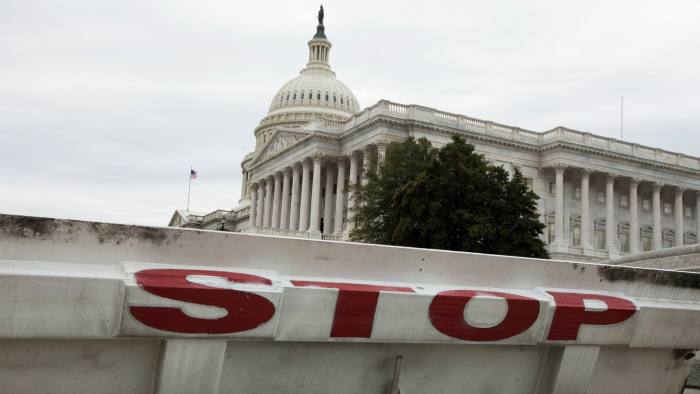
Investors, policymakers and even farmers are being deprived of key economic data as the partial US government shutdown moves into its third week. Funding for agencies deemed “non-essential” lapsed on December 22 amid a political stand-off over President Donald Trump’s proposed border wall. About 800,000 federal employees are affected. Essential or not, some of the agencies produce data vital to market participants — not only on Wall Street, but on Main Street. The longer the shutdown persists, the cloudier the world appears to these users. The shutdown is impeding the production of numbers about the US economy at a time when the Federal Reserve has said policy would be particularly “data dependent”.
Grain exports have become impossible to verify as the farm belt is desperate to assess China’s soyabean purchases. On Tuesday, the Census Bureau was scheduled to release November data on international trade in goods and services. The previous month’s report showed a US trade deficit at the widest level in a decade. Instead, the release has been postponed because the bureau, a division of the commerce department, has lost funding. The trade figures are source data for reports on US gross domestic product, the latest estimate of which was scheduled for January 30 release before the Bureau of Economic Analysis shut down.
The US agriculture department has postponed Friday’s scheduled release of four reports on grain stocks, crop production, winter wheat seedings and world supply and demand. The reports typically move Chicago’s futures markets. Sara Menker, chief executive at Gro Intelligence, an agricultural information company, said that farmers seeking compensation under federal crop insurance schemes needed the official crop production data to calculate payouts. “It impacts farmers’ planting intentions if they don’t get paid on time,” she says.
The department’s reports on export sales of grain were suspended just when China was restarting modest US soyabean purchases in a friendly gesture towards the White House. This week, US and Chinese envoys resumed talks on trade, six months after Beijing placed high tariffs on US soyabeans. “We’re in the midst of these US-China trade talks, and everybody’s on the edge of their chairs about hoped-for goodwill Chinese soyabean purchases during this period of negotiation,” says Richard Feltes, vice-president at RJ O’Brien, a Chicago-based commodities broker. “We regrettably are not getting that information.” Mr Feltes, a grain market specialist, added that the information blackout “provides an unfair information advantage to large exporters who now have inside information on whether or not those sales are taking place. For us standard market users, that aren’t involved in the export trade of key commodities, we don’t know if anything is going on or not.”

The Commodity Futures Trading Commission has stopped publishing weekly data on traders’ futures positions in interest rates, currencies, equity indices and commodities. The derivatives regulator’s “commitments of traders” reports are used as a weathervane of market sentiment. Robert Hillman, chief investment officer for investment group Neuron Advisers, said the data allow fund managers to identify which types of investment strategies would be vulnerable in a market shock. “That can give you an indication of risk and potentially alter our models of risk in the market,” he said, describing the shutdown as “a pain”. Bankers and lawyers are watching the shutdown for the impact it has on initial public offerings and other new share issuances.
There are no IPOs expected over the next few weeks, though there are 167 companies that have publicly declared their intention to list, according to MarketWatch. The lack of activity may reflect uncertainty in the industry about whether or not the Securities and Exchange Commission will be able to complete the necessary paperwork. “Any company hoping to launch this week is already being affected,” said Joseph Grundfest, a professor at Stanford Law School and former SEC commissioner. “Having no IPOs on the calendar is not normal.”
Mr Grundfest added: “When the SEC does reopen, it will be like a pig moving through a python. There will be a huge backlog of documents to get through — registrations, statements, action letters.” The partial shutdown has left many parts of government functioning, allowing some of the most critical data used to assess the economy’s health to continue to be produced.
The Energy Information Administration continues to compile energy statistics such as oil supply reports, for example. The Bureau of Labor Statistics produced the employment report for December last week, and key inflation gauges including the consumer price index are still expected to appear. In addition, private sector economic reports including consumer confidence and surveys of purchasing managers, are unaffected by the shutdown. While the shutdown is therefore making it somewhat harder to do monetary policy, “we are not completely flying blind here,” said Michael Feroli, US economist at JPMorgan.
A government shutdown in 2013 triggered greater anxiety among economists. Former Fed chairman Ben Bernanke was sufficiently worried about a delay to payroll figures produced by the Department of Labor that year that he asked if it would be possible for the central bank to pay for the report from its own budget. Government lawyers determined this would not be permissible, Mr Bernanke said in his book, The Courage to Act.