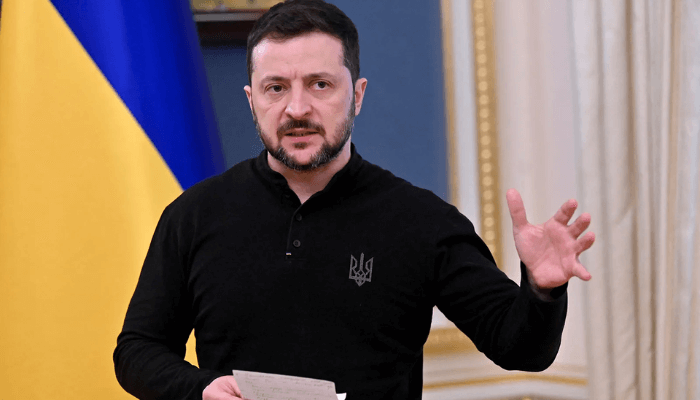
British microcomputers and other foreign-made components have been found in Russian missiles and drones used in recent deadly strikes on Ukraine, President Volodymyr Zelensky has claimed, renewing calls for tougher international sanctions on Moscow.
In a post on social media on Monday, Zelensky said investigators identified parts from allied countries — including the United Kingdom, United States, Germany, Japan, and South Korea — in weapons fired during Sunday’s massive assault, which killed several civilians in western Ukraine.
Read also:Russia rains drones and missiles on Kyiv, killing 12-year-old girl and three others
“Nearly 100,688 foreign-made parts were in the launched attack drones, about 1,500 in Iskanders, 192 in Kinzhal missiles, and 405 in Kalibrs,” he said. “Microcomputers for drone flight control are produced in the United Kingdom.”

The Ukrainian president described the discovery as evidence that Russia continues to access Western technology despite two years of sweeping trade restrictions and export bans. He urged allies to “shut down every scheme that circumvents sanctions”, warning that companies and countries that allow loopholes to persist were indirectly enabling Moscow’s war machine.
Ukraine has shared detailed information on each identified company and product with its partners, Zelensky added.
Read also:Russia rejects NATO attack claims, vows tough retaliation if provoked
British and American components identified
According to Zelensky, US companies supply converters for Russia’s Kh-101 cruise missiles and Shahed-type drones, sensors for unmanned aerial vehicles, and microelectronics used in missiles. British firms, he said, have been linked to the production of microcomputers used to guide drones.
The revelation is significant given the leading role both Washington and London have played in supporting Ukraine’s defence effort, providing weapons, intelligence, and billions in financial aid since the start of the full-scale invasion in February 2022.

Read also:Russias record strike hit Ukraine’s government building for the first time
The United Kingdom’s Department for Business and Trade (DBT) said it was taking the allegations “incredibly seriously”, stressing that it had already banned the export of thousands of goods to Russia, including all items that Ukraine had flagged as being used on the battlefield.
“We take reports of goods from UK companies being found in Russian weaponry incredibly seriously,” a government spokesperson said. “Any person or firm that does not comply with sanctions could face large financial penalties or criminal prosecution.”
More than £20bn ($26.9bn) of UK trade with Russia is now under sanction, the department said.
Despite some of the harshest sanctions in modern history, Russia has managed to maintain and even expand parts of its military production, often through complex supply chains and third-party intermediaries in countries not participating in Western sanctions.
Russia has become the most-sanctioned nation in the world, yet it has avoided economic collapse by redirecting trade, boosting defence spending, and finding new buyers for its energy exports — particularly in China and India.
However, signs of strain are emerging. In June, Russia’s Minister for Economic Development, Maxim Reshetnikov, admitted the economy was “on the brink of recession”, amid slowing industrial output and a mounting fiscal burden.
Tensions have also been rising over reports of closer cooperation between Moscow and Beijing. Ukrainian intelligence official Oleh Alexandrov claimed over the weekend that China has been helping Russia identify targets in Ukraine using satellite reconnaissance.
He said Kyiv had evidence of “a high level of cooperation” in mapping Ukrainian territory for strikes — an allegation the Kremlin has denied. Spokesperson Dmitry Peskov said Russia has its “own space capabilities” and does not rely on Chinese satellites.
Zelensky’s statement came as several European countries reported a surge in suspicious drone activity over military installations and civilian airports. Some governments have accused Russia of testing NATO’s air defences — a charge Moscow has dismissed as “baseless”.
Four members of one family, including a 15-year-old girl, were among those killed in Sunday’s strikes, which saw more than 500 missiles and drones launched overnight, mainly targeting the Lviv region in western Ukraine.