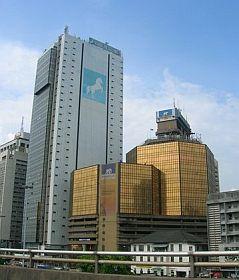
Union Bank of Nigeria’s rich history can be traced to 1917 when it was first established as Colonial Bank. In 1925 the bank became known as Barclays Bank DCO (Dominion, Colonial and Overseas) resulting from its acquisition by Barclays Bank.
Following Nigeria’s independence and the enactment of the Companies Act of 1968, the bank was incorporated as Barclays Bank of Nigeria Limited (BBNL, est. 1969).Between 1971 and 1979, the bank went through a series of changes including its listing on the NSE and share acquisitions/transfers driven by the Nigerian Enterprises Promotion Acts (1972 and 1977); this resulted in its evolution into a new wholly Nigerian-owned entity. To reflect the new ownership structure,and in compliance with the Companies andAllied Matters Act of 1990, it assumed the name Union Bank of Nigeria Plc. (UBN “the Bank” or “Union Bank”).
In 1993, in line with its privatisation/commercialisation drive, the Federal Government divested by selling its controlling shares (51.67%) to private investors. Thus, Union Bank became fully owned by Nigerian citizens and organizations all within the private sector. During the Central Bank of Nigeria’s banking sector consolidation policy, Union Bank of Nigeria Plc acquired the former Universal Trust Bank Plc and Broad Bank Ltd. and absorbed its one-time subsidiary, Union Merchant Bank Ltd.
On the 14th of August, 2009, the Central Bank of Nigeria (CBN) intervened in the management of the Bank by replacing the Executive Management Team with a five-man Interim Management Team to stabilize and recapitalize the Bank. Full recapitalization of the Bank was achieved in December 2011 with the injection of $500million into Union Bank by Union

Global Partners Limited (UGPL) after the Asset Management Company of Nigeria (AMCON) had provided capital in the sum of N46.93bn to bring the Bank’s Net Assets Value to zero.
Currently, the Bank is primarily owned by UGPL (65%) and AMCON (20%) and a diverse group of shareholders that account for the balance (15%). UGPL, a consortium of strategically aligned group of investors, is the Bank’s core investor group and consists of:
Gross Earnings increase validates interest income accretion
Gross earnings increased by 17.13 percent to N57.64 billion in June 2015 from N49.21 billion in 2014. The growth was driven by interest income on loans, e-Banking and other transactional fees. Interest income rose by 18.62 percent to N42.68 billion in the period under review from N35.98 billion the same period of the corresponding year (HI) 2014. Net interest income increased by 8.10 percent to N26.04 billion in the period under review compared with N24.45 billion June 2014. Net Operating Income was up 10 percent to N38.0 billion in June 2015 from N34.7 billion in 2014.
Improved operating efficiency leads to strong profitability

Union Bank’s profit before tax was up by 53 percent to N10.20 billion in June 2015, from N6.60 billion last year. Excluding the gain on the sale of subsidiaries, the bank delivered Profit before Tax of N6.70 billion, a 134 percent increase over the half year of 2014.
Group profit before tax gain on subsidiary sale increased to N7.10 billion in June 2015 as against N2.70 billion the previous year.
Profit after tax also followed the same growth trajectory as it increased by 54 percent to N10.1 billion in the period under review compared with N6.6 billion as at June 2014.
The Bank attributes the growth at the bottom-line to cost efficiency and its ability to deployment latest technology in cutting costs while boosting profit.
“The successful implementation and migration to a new banking platform, Oracle FlexCube UBS, has provided a more stable operating environment for us to serve customers and process routine transactions quicker and more efficiently, said Emeka Emuwa, Managing Director/CEO of the bank, while commenting on the 2015 half year results.
“In spite of economic headwinds and regulatory changes impacting the financial industry, Union Bank remains on a stable growth trajectory as we implement initiatives to grow our core banking segments,” said Emuwa.
The impressive results means the restructuring exercise undertaken by the Nigeria lender immediately after the banking crisis of 2009 has paid off. It also means investors will be attracted to the bank’s stocks given its high interest yielding assets.
Analysts say the Union Bank’s profit growth and assets quality beat market expectations given the stringent rules of the Central Bank of Nigeria (CBN). Lenders in Africa’s largest economy say these rules are causing liquidity squeeze in the foreign exchange market hence hurting profit.
For instance CBN raised the interest rate to 13 percent, from the 12 percent previously held. Additionally, the rule forcing bank to place 31 percent of its deposits with the regulator is hurting profit of banks and causing some foreign investors to shun Africa largest economy.
The Abuja based bank said the aim of the stringent policies are to reduce the amount of naira circulation and help protect its value.
Africa largest oil producer has been a one or two punch as a result of a 50 percent fall in price of oil and depleting external reserves. The naira has been devalued twice in the past two years.
Oil accounts for 70 percent of revenue and 95 percent of foreign exchange earnings.
Union Bank’s cost was efficient in cutting costs as cost to income ratio (CIR) reduced to 73 percent in the period under review compared with 81 percent as at June 2014. Total operating expenses dropped to N27.90 billion in June 2015 as against N28.1 billion last year.
A fall in CIR from one period to the next means costs are dipping at a lower rate than income, which could suggest that the bank has its eye on the ball in the drive to attract more business.
The Nigeria lender is using the resources of shareholders in generating higher profits as return on equity (ROE) moved to 9.64 percent in June 2015 from 6.93 percent as at June 2014.Earnings per share EPS moved to 59.5 kobo in 2015 as against 38.8 kobo in 2014. Net Interest Margin also followed the same growth trajectory as it increased to 8.94 percent in June 2015 8.97 percent as at June 2014.
Net Interest Income was up 7 percent to N23.1billion in 2015 from N21.6billion in June 2014 despite CRR increase by the CBN during the year 2014.
Expansion in loans and deposit boost balance sheet
For the half year through June 2015, Union Bank grew total assets by 8 percent to N1.1 trillion, from N1 trillion as at June 2014; the growth in total assets was supported by an increase in cash and cash equivalents and loans and advances.
Cash and cash equivalents jumped by 27.45 percent to N70.89 billion in June 2015 compared with N58.45 billion in June 2014. Net Loans and advances to customers increased by 20 percent to N374.50 billion in the period under review as against N312.50 billion last year. Deposit to customers were up by 4 percent to N549.60 billion in 2015 as against N527.6 billion as at December 2014.
Union Bank is aggressive about lending amid tight liquidity and macroeconomic headwinds as loans to deposit ratios moved to 69 percent in June 2015 compared with 64 percent as at December 2014. As part of its contribution towards the realization of federal government’s transformation agenda in the agricultural sector, Union Bank of Nigeria Plc said that it has commenced the disbursement of N30.5 billion, loan to various categories of farmers under the current farming season.
“For the second half of 2015, our focus remains on continuing to manage funding costs, reducing operating expenses and minimizing impairment costs through proactive risk management. We will also continue leveraging technology to enhance customer experience and reduce the cost of servicing customers,” said Emuwa.
BALA AUGIE