…Scrambles for alternative markets heighten
Nigeria faces the prospect of losing nearly $3 billion in crude oil exports to the United States this year as President Donald Trump’s military intervention in Venezuela opens the door to a significant reshuffling of America’s energy supply chains.
Nigeria, Africa’s biggest oil-producing country, which has maintained a steady crude export relationship with the U.S., shipped approximately 38 million barrels valued at $2.86 billion to American refineries between January and September of last year.
That market position now appears vulnerable as Trump announced Venezuela would deliver between 30 and 50 million barrels of oil to the United States following the removal of former President Nicolás Maduro.

“This oil will be sold at its market price, and that money will be controlled by me, as President of the United States of America, to ensure it is used to benefit the people of Venezuela and the United States,” Trump wrote on Truth Social, signalling Washington’s intention to directly manage proceeds from Venezuelan crude sales.
Aisha Mohammed, an energy analyst at the Lagos-based Centre for Development Studies, said this is a direct threat to Nigeria’s position in the U.S. market.
“Venezuelan crude, despite being heavier and more sulfurous, competes directly with Nigerian grades for Gulf Coast refinery capacity,” Mohammed said.
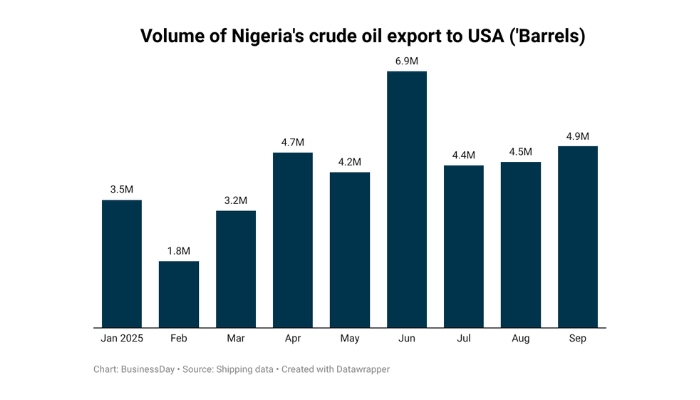
Latest shipping data seen by BusinessDay show that Nigeria exported 38.1 million barrels of crude to the US between January and September, generating $2.86 billion in revenue based on the country’s shipping data.
The monthly volumes demonstrate significant variability, ranging from a low of 1.8 million barrels in February to a peak of 6.9 million barrels in June, reflecting the intermittent nature of cargo loadings and refinery demand patterns.

The data also show that Nigeria’s exports averaged 4.2 million barrels monthly during this period, with values fluctuating between $142 million and $484 million depending on both volume and prevailing crude prices. June represented the strongest month, with nearly seven million barrels shipped worth $484 million, while February marked the weakest performance at just over 1.8 million barrels valued at $142 million.
This volatility underscores the challenge Nigerian producers face in maintaining consistent market access, a vulnerability that Trump’s Venezuela initiative could exploit.
The cumulative nine-month total of $2.86 billion represents a substantial revenue stream for Africa’s largest economy, making any displacement by Venezuelan crude a significant economic blow.
The timing couldn’t be worse for Nigeria, which has struggled to maintain production levels above 1.5 million barrels per day amid persistent pipeline vandalism, aging infrastructure, and underinvestment in its oil sector. The country’s ability to compete on price and volume with a potentially revitalised Venezuelan industry remains questionable.
While Trump’s plans face significant execution challenges, the mere prospect of Venezuelan crude flooding the U.S. market has already begun influencing trading patterns. Several U.S. refiners contacted by BusinessDay indicated they would reassess their West African crude purchases if Venezuelan supply becomes reliably available at competitive prices.
“The issue isn’t just the immediate 50 million barrels Trump is talking about,” said an oil trader based in London. “It’s the signal that Venezuelan oil is back in play for U.S. buyers after years of sanctions. That changes the strategic calculation for refiners with long-term supply contracts.”
Venezuela’s complicated comeback
Trump’s extraordinary claim of control over Venezuelan oil sales has drawn international condemnation, particularly from China, which has been Venezuela’s largest crude customer in recent years. Chinese foreign ministry spokesperson Mao Ning called the U.S. action “a typical act of bullying” and “a serious violation of international law.”
The geopolitical implications extend beyond the immediate supply question. Trump has reportedly demanded that Venezuela’s interim authorities, led by newly sworn-in President Delcy Rodríguez, grant the United States exclusive partnership rights on oil production and sever economic ties with China, Russia, Iran, and Cuba, according to ABC News citing unnamed sources.
If Venezuela complies, redirecting barrels previously destined for Asian markets, Chinese refiners may increasingly turn to West African suppliers, potentially offsetting some of Nigeria’s US losses.
“The question is whether increased Chinese demand can compensate for what we’re losing in America,” said Chioma Okafor, a petroleum economist at the University of Lagos. “Chinese buyers typically negotiate harder on price, and payment terms can be less favourable than what we’ve enjoyed with US refiners.”
The infrastructure reality
Energy analysts remain deeply skeptical about the timeline for meaningful increases in Venezuelan production. The country possesses the world’s largest proven oil reserves at an estimated 303 billion barrels, but decades of underinvestment, mismanagement, and sanctions have crippled its production capacity.
Trump claimed on Monday that U.S. oil companies could have Venezuela’s industry ‘up and running’ within 18 months, with major American petroleum firms planning meetings with the administration this week, according to CBS News.
However, experts who previously spoke to the BBC, suggested restoration could require tens of billions of dollars and potentially a decade to return to Venezuela’s historical output levels.
“Venezuelan crude is heavy and difficult to refine,” noted a Houston-based trading executive who requested anonymity. “Only specialised refineries can handle it efficiently, and those refineries need to make substantial investments to accommodate increased volumes.”
Currently, only Chevron maintains operations in Venezuela among major U.S. oil companies. Bill Turenne, spokesman, offered a carefully worded statement emphasising the company’s focus on safety and regulatory compliance, stopping short of endorsing Trump’s ambitious production targets.
ConocoPhillips, which exited Venezuela years ago and was awarded an $8.7 billion arbitration judgment against the Venezuelan government in 2019 for asset expropriations, said through Dennis Nuss, a spokesman, that speculation about future investments would be ‘premature.’ ExxonMobil did not respond to requests for comment.
Nigeria’s vulnerable export position
Nigerian officials have remained notably silent on Trump’s Venezuela announcement, though industry insiders suggest Abuja is monitoring developments closely. The Nigerian Upstream Petroleum Regulatory Commission (NUPRC) did not respond to requests for comment on potential market share losses.
Nigeria’s challenge extends beyond simple volume competition. Venezuelan crude, while heavier and more sulfurous than Nigerian light sweet grades like Bonny Light, can be priced attractively enough to offset processing disadvantages, particularly for Gulf Coast refineries equipped with coking units designed to handle heavy crude.
Some analysts said the competitive pressure may force Nigeria to offer deeper discounts to maintain market access, further squeezing government revenues at a time when the country faces mounting debt obligations and infrastructure needs.
“We cannot afford to be caught flat-footed,” said a former senior NNPC official who spoke on condition of anonymity. “If the US market contracts by even 30 percent, that’s nearly a billion dollars we need to replace elsewhere.”
Market impact and future outlook
The broader implications for global oil markets remain uncertain. If Venezuelan production increases materially over the next several years, as Trump envisions, the additional supply could pressure prices downward, benefiting consumers but challenging producers worldwide.
However, multiple factors could derail these plans. Political instability in Venezuela could resurface, Chinese countermeasures might complicate investment flows, and U.S. oil companies may demand political risk guarantees before committing capital.
For Nigeria, the immediate threat is not the physical displacement of crude volumes, which would take years to materialise, but rather the psychological shift among U.S. refiners who may begin diversifying away from West African crude in anticipation of Venezuelan supply returning to the market.