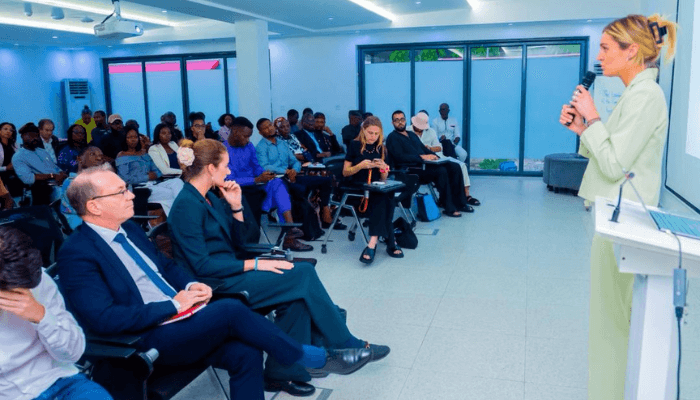
The Economic Department of the Embassy of France in Nigeria recently hosted a game-changing conference that brought together the crème de la crème of Lagos’ creative and innovation scene.
Titled “From Makers to Markets: Building Circular Innovation – A Conversation with Marjory Houlbert,” the event was a masterclass in rethinking waste and exploring the limitless possibilities of circular innovation in Lagos.
Designers, entrepreneurs, engineers, and sustainability advocates converged at Impact Hub Lagos to learn from French designer and researcher Marjory Houlbert, who’s making waves in the world of circular design.
Marjory’s presentation was a deep dive into the world of waste management and innovation, with a focus on Lagos’ unique challenges and opportunities.

Did you know that Lagos produces over 13,500 tonnes of waste daily, with plastics being a significant part of it?
Marjory’s talk highlighted the potential for makers and innovators to tap into this waste stream, transforming it into valuable resources that can drive creativity, entrepreneurship, and sustainability in the city.
With the French Tech Lagos community in attendance, the event showcased the growing interest in circular innovation and the potential for cross-border collaboration between France and Nigeria.
French designer and researcher Marjory Houlbert, whose practice evolves at the intersection of circularity, collaborative making and material experimentation, delivered an insightful presentation grounded both in her experience within French fablabs and in the environmental realities of Lagos.
Opening her talk with an overview of the city’s waste landscape, she highlighted that Lagos produces more than 13,500 tonnes of waste each day, with plastics (particularly LDPE, PP, PET and HDP) forming a significant part of the city’s highly available waste streams. Some of these plastics are recyclable, while others require more advanced transformation processes, creating both constraints and opportunities for makers and innovators.

Marjory went on to define what makes a fablab an essential catalyst for innovation. Drawing on examples from Fablab La Verrière and WoMa, she described these spaces as hybrid ecosystems where digital fabrication tools (such as CNC machines, 3D printers, presses, ovens and laser cutters) coexist with a vibrant community of designers, engineers, architects and researchers.
Beyond the equipment, she insisted, the real strength of a fablab lies in its ability to connect diverse expertises, accelerating problem-solving and enabling makers to move from early concepts to reliable, market-ready prototypes. To illustrate this dynamic, she presented Flowlen, an air purification system born within WoMa.
Through the combined contributions of a fabmanager, an electronics engineer, a developer and financial guidance, a simple concept evolved into a functional prototype capable of securing public funding and scaling toward industrial production.
This example underscored the power of collaborative making: when a community’s knowledge and tools converge, makers can transform ideas into tangible solutions with real-world impact.
Marjory then shifted to the topic of industrialisation, focusing on the case of Le Pavé, a French venture producing 100 percent recycled panels from HDPE and polystyrene recovered from recyclers such as Paprec, Veolia and Suez.
She detailed the transformation process, from melting to pressing to forming large, solid panels used in furniture, interior design and everyday objects, while emphasising the crucial role of consistent waste streams and strong B2B partnerships.
This example demonstrated how waste, when paired with technical expertise and industrial capacity, can become a viable and scalable material used across creative and architectural sectors.
In the final part of her presentation, Marjory proposed a prospective model for a Lagos-based fablab, integrating local recyclers, existing facilities, digital fabrication tools and a dedicated fabmanager.
Such an ecosystem, she argued, could allow Lagos makers to transform both plastic and organic waste into furniture, objects, textiles and new materials, creating local jobs, stimulating creative industries, and strengthening the city’s circular economy.
The conference highlighted the growing collaboration between France and Nigeria in advancing sustainable and innovative approaches to design, fabrication and material transformation.
By convening experts and local stakeholders around shared environmental challenges, the Embassy reaffirms its commitment to fostering dialogue, creativity and Franco–Nigerian cooperation in the circular economy.