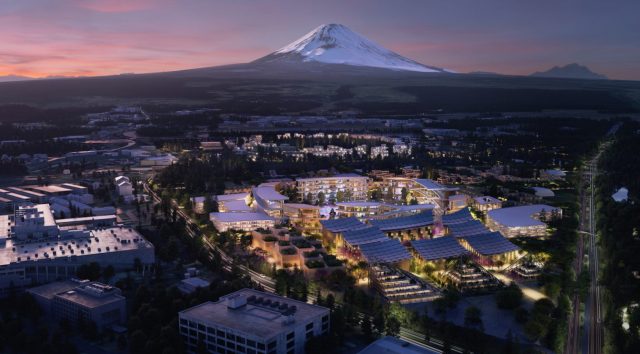
Plans are underway by Toyota to build a hydrogen-powered test city beginning next year at the base of Japan’s Mount Fuji to study the interactions of a number of cutting-edge technologies, including autonomous transportation, robotics and artificial intelligence.
The huge project, called Woven City, is being personally championed by Toyota CEO Akio Toyoda, who is currently discussing the plans with his team.
Woven City which will be roughly the size of Apple’s circular campus in Cupertino, California, is being designed by renowned Danish architect Bjarke Ingels, CEO of Bjarke Ingels Group and designer of Google’s new headquarters, 2 World Trade Center in New York City and a number of other high-profile projects globally.
The cost of the project was not revealed, but it is expected to be in the billions of dollars. Toyota says estimated 2,000 people employees and their families, retired couples, retailers, visiting scientists and industry partners are expected to inhabit Woven City initially when completed.

“Building a complete city from the ground up, even on a small scale like this, is a unique opportunity to develop future technologies, including a digital operating system for the city’s infrastructure,” Toyoda said in a written statement. “With people, buildings and vehicles all connected and communicating with each other through data and sensors, we will be able to test connected AI technology in both the virtual and the physical realms and also maximize its potentials.” The statement said.
Before now, Toyota has spent decades studying and promoting cutting-edge technologies in alternative energies, robotics and AI. Some of those technological advances make their way into practical applications in vehicles, such as the Toyota Mirai hydrogen-powered vehicle introduced in 2014, while other projects concentrate elsewhere.
Currently, Toyota researches and tests artificial intelligence, mobility, robotics and other technologies in labs around the world, Toyoda, the Toyota Motor Corporation chairman said.
“It occurred to us: What if we had the opportunity to do it all in one place?” he said. “In a real-life environment, instead of a simulated one? This was on our mind when we were making plans to close a factory in Japan and we were wondering what to do with this soon-to-be-available land near Mt. Fuji.”
Woven City will be built on a site Toyoda called “a prototype town of the future where people live, work, play and participate in a living laboratory.This will be a truly unique opportunity to create an entire community or city from the ground up,” he said, “and allow us to build an infrastructure of the future.”
The project is expected to be built in phases, with groundbreaking on the first phase slated to start in 2021.Toyota did not disclose a completion date, but Toyota executives said the goal is for people to move into the Woven City community within five years.

Toyoda said the automaker will seek out partnerships with “like-minded companies and individuals” who are interested in participating in the project.
Toyota also plans to “extend an open invitation to collaborate with other commercial and academic partners and invite interested scientists and researchers from around the world to come work on their own projects in this one-of-a-kind, real-world incubator.”
“We welcome all those inspired to improve the way we live in the future, to take advantage of this unique research ecosystem and join us in our quest to create an ever-better way of life and mobility for all,” Toyoda said.
MIKE OCHONMA