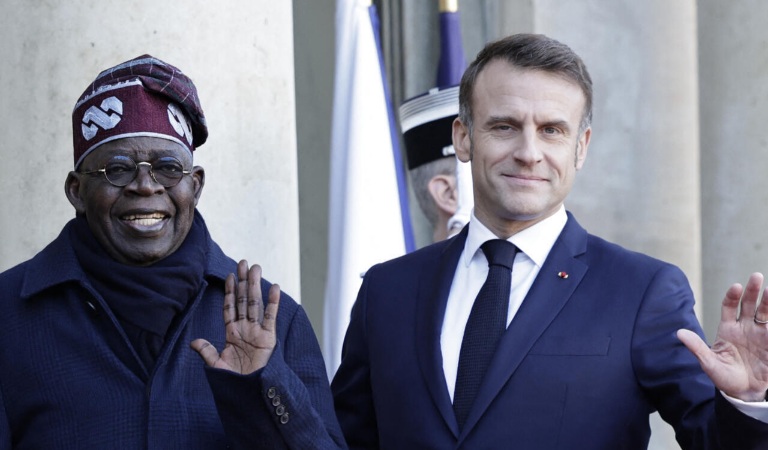
President Bola Tinubu and French President Emmanuel Macron on Sunday held talks on Nigeria’s worsening security crisis.
The telephone discussion between the two leaders coincided with a separate meeting in Abuja between Nuhu Ribadu, Nigeria’s National Security Adviser (NSA) and a visiting United States delegation led by Richard Mills, U.S. Ambassador to Nigeria, and senior congressional members.
Their talks focused on reported attacks on Christian communities, the broader security emergency, and strengthening bilateral counter-terrorism cooperation.
Macron, in a post on X, said he assured Tinubu of France’s solidarity “in the face of the various security challenges, particularly the terrorist threat in the North.”

Read also: Tinubu calls for global partnership to defeat terrorism
He added that France, acting on Tinubu’s request, would intensify support for Nigerian authorities and vulnerable populations affected by escalating violence.
“We call on all our partners to step up their engagement. No one can remain a spectator,” Macron wrote.
The French President’s comments follow a surge in kidnappings and armed attacks across northern Nigeria, including on schools and farming communities, which have drawn renewed international attention.
His message of solidarity also came days after Tinubu swore in Christopher Musa, a new Minister of Defence, with a mandate to deliver swift and measurable security outcomes.

On November 26, Tinubu declared a nationwide state of emergency on security, directing security agencies to expand recruitment, deploy thousands of additional personnel, and prioritise the protection of schools, farms, places of worship and vulnerable communities.
The heightened alert comes amid increasing foreign scrutiny, particularly from Donald Trump, U.S. President, who in early November re-designated Nigeria as a “Country of Particular Concern” over alleged violations of religious freedom.
Trump, who controversially accused Nigerian authorities of enabling “genocide” against Christians, also threatened military intervention, a claim Nigeria has firmly rejected.
The Federal Government has consistently dismissed allegations of Christian persecution as inaccurate and politically motivated, insisting that insecurity affects citizens across all religious and ethnic lines.
Amid the diplomatic tensions, security consultations between Abuja and Washington have accelerated.
On November 20, U.S. Secretary of War, Pete Hegseth met NSA Ribadu at the Pentagon to discuss coordinated strategies for addressing terrorism and communal conflict in Nigeria.
Ribadu confirmed on Sunday that he hosted a U.S. Congressional delegation in Abuja for a “fact-finding mission” following earlier engagements in Washington.
He said the discussions centred on “counter-terrorism cooperation, regional stability, and strengthening the strategic security partnership between Nigeria and the United States.”
He added that the presence of Mills underscored the importance both nations attach to the dialogue.
Riley Moore, one of the U.S. lawmakers, who joined the Abuja mission, described his visit as “very productive,” though he did not disclose the full purpose or the officials met.