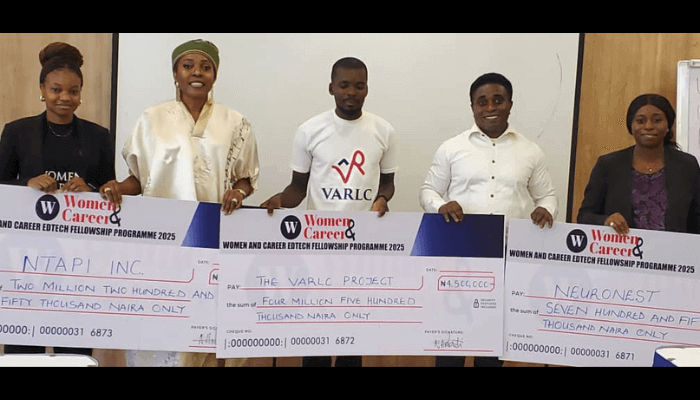
Three Nigerian education technology (EdTech) startups have secured a combined N7 million in seed funding from the non-governmental organisation Women and Career, to scale innovative learning solutions that leverage AI and peer-to-peer teaching.
The beneficiaries: The VARLC Project, Ntapi Inc, and Neuronest—emerged as winners of the 2025 Women and Career EdTech Fellowship Programme after completing a rigorous 12-week training aimed at equipping startups with the skills, tools, and networks to transform the education technology sector.
The first-prize winner, The VARLC Project, received N4.5 million to expand its peer-tutoring platform, which connects university students with high-performing peers to provide flexible, subscription-based learning opportunities. The platform allows top students to earn money by teaching and uploading lessons, providing equitable access to quality learning at each student’s pace.
Ntapi Inc, awarded N2.25 million, operates as an EdTech social network offering affordable and engaging educational content in multiple Nigerian languages. The platform enables learners to follow industry experts and educational influencers while creating opportunities for content creators in SMEs, corporations, and foundations.

Neuronest, which received N750,000, is an AI-driven adaptive learning platform designed to personalize K–12 education for neurodiverse learners, including children with ADHD and dyslexia. The platform tailors lessons to each student’s learning style, ensuring that every child can learn effectively.
During the compact award ceremony in Lagos, Khadijat Abdulkadir, CEO of INGRYD Academy, admonished the startups to enter into the entrepreneurial world with as much boldness as they would with caution because nobody succeeds without taking a risk.
She said: “In this field, you have to take risks. Get enough data on whatever field you want to play in. Not the data you will sell for money, but one that can help you to understand the field. So if you haven’t started the art of actually looking at your data or collecting clean and clear data, do that, because that’s your first point of getting to understand if your business is of value to the people you want to sell it to and, then also, you’d have to be mobile with your ideas.
“If you build something and discover you’re in an ecosystem where that’s not needed, close it down and move to what is relevant. Don’t be afraid to build for a different ecosystem. It’s not a crime to try stuff and it doesn’t work. You have to keep trying. It’s just that you must try them all very fast. Don’t try things for too long, if they’re not working”.
She also tasked them to be global in mind when designing their concepts even though they were starting locally, giving example that Facebook which has majority of its use cases in Nigeria and Africa was not designed in the continent. “If you need to build identification into your products, let it be simple that any social identity can enter into it. Don’t be like, it’s only BVN. In doing that, you’ve decided that if Nigeria doesn’t want your product, nobody else can have your product. That is a failure. So be very mindful when you’re in tech space because it means the whole world should have access to you. Tech is borderless.

“It means that your success is borderless. So as you go on to build your product and to use technology to scale your product, build for Nigeria, Ghana, Senegal and the outside world. Remember that Facebook was not built for Nigeria, yet, Nigeria is the home of Facebook. So where could be your home? However, don’t also start projecting which country will be your home. Just build a solid product that anywhere that it finds itself, it can become a use case. Even if it’s just one functionality that becomes a very significant use case for that country, you are succeeding” she added.
Mr Ifeanyi Akosionu, angel investor and founder/convener of The Angel-A Collective, also charged the young tech startups to be globally minded and never be in a hurry to think that their ideas have failed, even when initially not getting desirable tractions. He advised them to look for ideas that are not totally alien but relatively new to what is obtainable in any sector they want to play in, give it a thorough research, build it and stick with it, and that it must surely pick up and become successful.
Giving the participants further encouragement, Mr Emeka Amadi, the programme director of Women and Career, disclosed that the NGO was working behind the scene to get both financial and business collaboration support from notable companies, including Mastercard and CoCreation hub, CcHub.
“This fellowship is not just a programme; it’s a call to action to empower Edtechs with the tools to solve real problems in education through innovation. “We believe that EdTechs must be active contributors to the future of education and technology,” Amadi added.