If there is one exhibition to see this year, then it must be ‘Thoughts & Reflections’.
Call it the anticipated exhibition of the year, yes, it truly deserves that accolade because of the artist and personality involved.
Chike Cyril Aniakor, a renowned Nigerian professor, artist, art historian, author, and poet is rolling out colourful and creative drums in ‘Thoughts & Reflections’, his solo exhibition.
Professor Aniakor, a revered scholar of African aesthetics and an author of over 75 books and articles, is generously opening his creative treasures to the public in the solo exhibition, which holds at Thought Pyramid Art Centre, 18 Libreville, Crescent Wuse 2, Abuja.

Curated by Obi Nwaegbe, the exhibition, which opens on November 18, 2025, from 10am to 3pm and runs from November 19-22, 2025,10am to 7pm daily, will showcase 50 enthralling works by the distinguished professor.
Of course, many things make the exhibition a must-see. The first intrigue is that at 86 years, Professor Aniakor is not tired; his creative juices seem to even flow more than ever.
Born on August 21, 1939, Aniakor, a master draftsman, is displaying physical, mental and intellectual strength, despite his age, with the solo exhibition, which is being organised by The Colliery Foundation and supported by National Council for Arts and Culture (NCAC).
Many, his students, colleagues, collectors, government representatives, among others, are also excited at the upcoming exhibition of Professor Aniakor, whose artworks are held in major metropolitan museums including; the Smithsonian Institution, Nigerian National Gallery of Art, and the Museum fur Volkerkunde in Frankfurt.
In his curatorial statement on the exhibition, Obi Nwaegbe, explained that “Thoughts & Reflections” offers a journey into the artistic, intellectual, and spiritual cosmos of Professor Chike Cyril Aniakor, who he described as a master draftsman, distinguished art historian, and revered scholar of African aesthetics.

“This exhibition, and the catalogue that accompanies it, brings to light a philosophical and artistic sensibility honed over more than five decades of creative engagement,” Nwaegbe said in his curatorial statement.
Read also: Collecting Now 2: Honouring Nigeria’s cultural custodians at YSMA
He disclosed the essence of the exhibition, saying that through his art, writings, and teaching legacies, Aniakor has profoundly shaped the history and character of contemporary Nigerian art, especially through what is now formally recognized as the Nsukka School of Art.
“Spanning vibrant epochs of critical thought, postcolonial reawakening, and reflective solitude, this exhibition, which breaks the draught of solo exhibitions from the artist, serves as an emphatic gesture of honor: students, scholars, colleagues, and admirers return once again to the portal of his reflections,” the curator stated further.
He invites many to see the exhibition, promising them an exciting encounter with a man deeply committed to art as an expression of life and intellect, one whose practice encompasses drawing, poetry, criticism, and philosophical enquiry in equal measure.
“This is an invitation into the inner landscapes that have summoned him in turn, from Nsukka’s hills to the global stage of philosophical elucidation and public intellect.
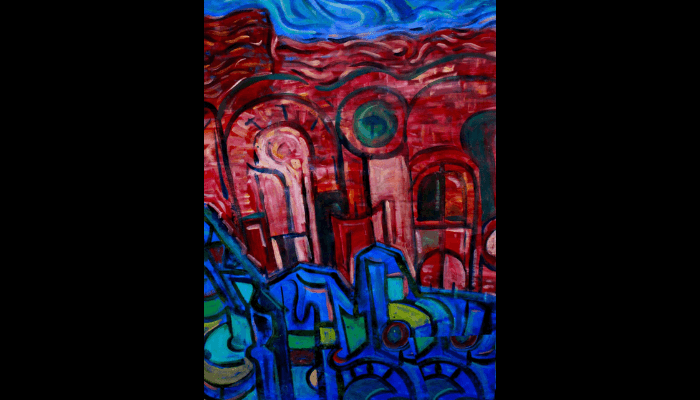
“The showcased works unfold a poetic and prolific mastery of line, where organic rhythm meets cultural integrity, and aesthetics coexist with social reflection”.
He insisted that Aniakor’s ‘Legacy of Line’ would be obvious at the exhibition, as well as Uli, a traditional Igbo art form of linear painting and mural making, which Aniakor is often described as a custodian of.
Delving more into the legacy of line, the curator noted that in Aniakor’s world, the line is not merely a ]compositional tool, but voice, echo, and pulse, a vital medium that translates histories, myths, trauma, and contemplation into visual form.
“In this exhibition, viewers will encounter a profusion of lines: thick, thin, spiral-like, angular, wavering or attenuated. They traverse entire surfaces, dissolving boundaries between figure and ground, merging textural richness with conceptual density. We end up with a visual language that is profoundly African and yet cosmopolitan in its scope,” he assured.
Another reason, according to him, is the fact that Aniakor sees art as self and society with a persistent questioning of human existence, its joys, anxieties, and contradictions central to his body of work.
Yet, the introspection suite, from which the exhibition draws its title, according to the curator, grapples with inward reflection and existential meditation.
The above is obvious in Aniakor’s works on display at the exhibition such as ‘Thoughts and Reflections’, ‘Inner Pains’, and ‘Inner Reflections’, which invite the viewer to pause, witness silent turbulence of the mind, recognize the human impulse and to examine one’s own life through images that interrogate our state of consciousness.
The works are also rooted in tradition, while reaching for new worlds.
“One of the most consistent narratives in Aniakor’s practice is his allegiance to cultural origins, not as a static point of departure, but as a living archive for reinvention, yet, nearly in the same breath, Aniakor pivots to collective truths,” he enthused.
Works such as ‘Womanhood’, ‘Couples’, or ‘Human Community’, point to the artist’s shift from solitary rumination to shared space. The works also reflect Aniakor as a scholar, teacher and griot, making it impossible to separate his art from his intellectual pursuit.
“He has always walked the dual path of artist and professor, effortlessly weaving theory and practice. His writings are infused with the same lyrical sensibility that animates his visual art—often oscillating between poetic metaphor and incisive argumentation”.
Also, in his foreword, Obi Asika, director general, National Council for Arts and Culture (NCAC), expressed his delight to present Aniakor’s landmark exhibition, which he said, celebrates one of Nigeria’s foremost modern artists and cultural scholars.
“Professor Chike Aniakor stands as a towering figure in the canon of Nigerian and African art —not just for his visual brilliance, but for his enduring commitment to preserving, interpreting, and elevating our cultural heritage,” Asika said.
The NCAC director general also expressed interest in Aniakor’s work, which he noted, spans decades of disciplined inquiry and creative mastery, drawing deeply from the well of indigenous knowledge systems, particularly the Nsibidi iconography, Igbo aesthetics, and the spiritual symbolism embedded in traditional forms.
“This exhibition is more than a retrospective; it is an invitation into the mind of a master thinker —a visual philosopher whose strokes of pen and brush capture not only beauty, but also memory, resistance, and renewal. “As an artist and academic, Aniakor has helped shape generations, both through his foundational role in the Zaria Art Society and his legacy as a teacher, mentor, and intellectual”.
Asika, however, commended Ejike Ekwenibe, whose inspired initiative brought the exhibition to life.
“His thoughtful engagement with the artist’s body of work, and his vision in presenting it with clarity and purpose, allows us all to connect more deeply with Aniakor’s message and meaning. “This collaboration stands as a testament to the power of curatorial excellence in amplifying artistic voices and preserving our cultural memory.
“In this pivotal moment of Nigeria’s cultural awakening, where our creative industries are gaining global recognition and our soft power is becoming a force for identity and diplomacy, the legacy of pioneers like Chike Aniakor provides us with roots and direction,” Asika noted further.
According to him, Aniakor’s work reminds viewers that art is not merely an object of admiration, but a vessel for knowledge, a site of dialogue, and a tool for transformation.
On his part, Prince Yemisi Shyllon, an astute art collector, described the exhibition as an ode to a master modernist.
He recalled his acquaintance with Professor Aniakor and his art back to the days of the AKA rave of the eighties and nineties. “As a modernist and protagonist of the Nsukka School, whose artistic ideologies bothered on the Uli line drawing and painting phenomenon, Aniakor has built an indelible reputation for himself and there is no better time than now for a comprehensive review and introspection over his life’s work starting from this exhibition,” Shyllon said.
According to him, ‘Thoughts & Reflections’ assesses aspects of Aniakor’s decade-long studio exercise, dealing with subjects of communality, gender balance, motherhood, climate change and a whole lot of other pertinent issues around the subjects of humanity and the environment.
But Aniakor’s display of mastery in draughtsmanship and application, he noted, is apparent, and the use of colour assumes a masterly certitude.
“There is no doubt that Aniako’s solo ‘Thoughts and Reflections’ showing is a strong testament to the spirit of resilience that sometimes comes with visionary creativity.
“As the African continent and its creatives continue to navigate the labyrinths of global art politics, Chike Aniakor is easily one of the flag bearers of the African creative renaissance.
We must revel in the gift of his existence, his vast scholarly repository, and his deep sense of history, which he deposits on his paper and canvas surfaces.
“A comprehensive retrospective is inevitable, because it may be difficult to make a summary of over two decades of recent studio work. “However, great dishes are served in small portions, so this exhibition is an appropriate start to a series of unfolding events that ought to be appreciated for the
refreshment that it offers,” he concluded.
Commenting on the upcoming exhibition in a rich statement he titled ‘One Thousand Leagues from Nsukka: Accolades for Professor Chike Aniakor’, Blaise Gundu Gbaden, a professor of Painting at Federal University of Lafia, and most importantly, a former student of Professor Aniakor, recalled his numerous encounters with Aniakor, who was a senior lecturer at University of Nigeria Nsukka then.
He expressed his excitement for not leaving Nsukka empty, saying, “I left with a league of one thousand soldiers to assist me on the journey through life.
“This was behest to me so I could reach wherever I so desire with a retinue of help”.
He also expressed the difficulty in writing about his mentor and teacher, asking, “How do you write about a sage, especially one who is a writer and one who has ministered at the feet of ancestral spirits for what seems like endless millennia, usurping powers meant for the gods of Igbo land and interpreting the dreams of the land to hungry shamans?
The above reflects his belief in the creative ingenuity of Professor Aniakor, which would be further showcased in works at the upcoming exhibition.
He also thanked the professor for his assistance, especially in the hand of a difficult lecturer during his university days, saying, “As a teacher, Professor
Chike Aniakor was captivating. You did not want to miss his lectures. He kept the class engrossed for the two hours for each lecture”.
Krydz Ikwuemesi, also of University of Nigeria, Nsukka, who confessed meeting Professor Aniakor for the first time in 1988 as an undergraduate, explained how the professor’s commitments against all odds has sustained the Uli heritage and art from waning over the years.
He went as far as choosing “Uli as a Creative Idiom in Contemporary Nigerian Art: a Study of Chike Aniakor, Obiora Udechukwu and Ray Obeta” for his Bachelors of Arts project in 1991, a development that enabled him to get closer to Professor Aniakor, understudy him, his art and the Uli heritage.
“Aniakor’s role in the Uli revival remains pivotal and it is on that I focus in this brief comment,” Ikwuemesi concluded.
Others also spoke volumes on the creative ingenuity and great personality of Professor Aniakor including Agwu Enekwachi, a writer, and historian.
He described Professor Aniakor as an artist and teacher of generations of students in universities in Nigeria and abroad.
According to him, the fact that Professor Aniakor is healthy and strong enough at 86 years, to make art and have a solo exhibition speaks to his tenacity, intentionality and will to live intensely by the minute.
“This exhibition will offer an opportunity for people to appreciate some of the subjects of the artist’s ruminations at this stage of his life,” he noted.
Again, the curator is urging viewers to visit to see the exhibition, engage with the works, and honor not only the mastery behind them, but also the humanity within them.
‘Thoughts and Reflections’ opens at Thought Pyramid Art Centre, 18 Libreville, Crescent Wuse 2, Abuja, on November 18, 2025, from 10am to 3pm and runs from November 19-22, 2025,10am to 7pm daily.