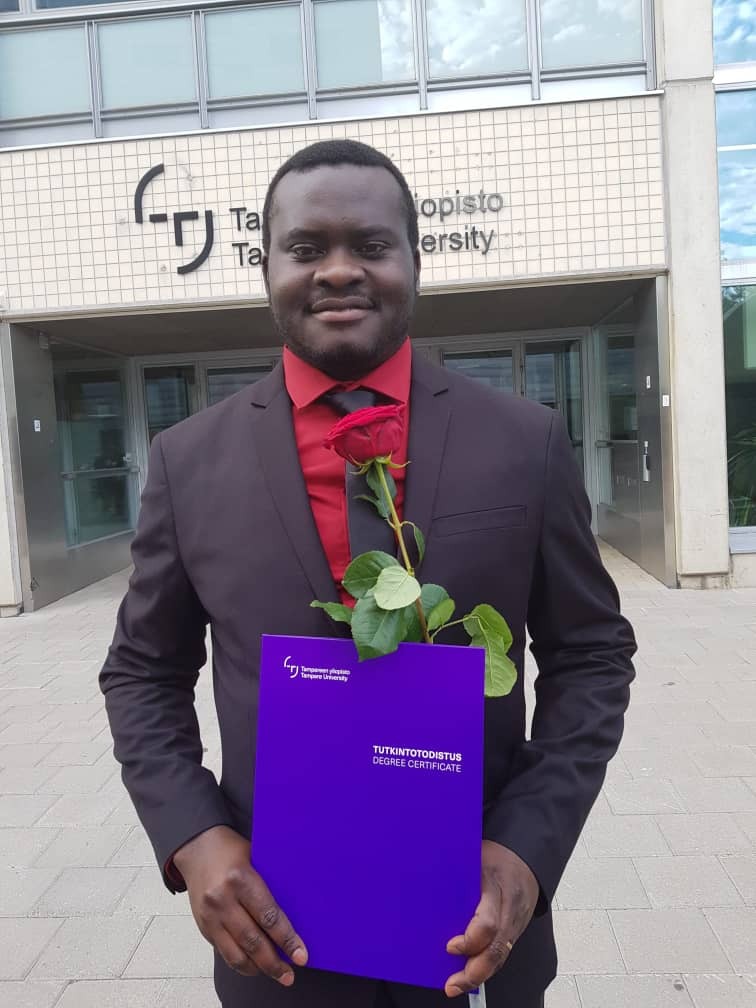
In the fast-paced world of global telecommunications, the year 2019 stands as a pivotal moment for African engineering. As the world teeters on the edge of the Fourth Industrial Revolution, Justin Zeyeum has emerged from Finland’s most prestigious academic corridors as a highly sophisticated, elite engineer poised to redefine the digital sovereignty of Central Africa.
This achievement places him at the vanguard of a new generation of engineers poised to redefine digital infrastructure, moving beyond legacy systems to the sophisticated world of 5G, cybersecurity and the Internet of Things (IoT).
Following his distinguished start in Helsinki, Justin has further elevated his technical mastery by completing a Master of Electrical Engineering with a major in Wireless Communications at the top-rated Tampere University in Tampere, Finland. Graduating Summer of 2019, Justin has solidified his status as a visionary architect of the next generation of connectivity.
While his earlier work focused on the hardware “heartbeat” of wireless communication through Voltage Controlled Oscillators, Justin’s Master’s research at Tampere shifted toward the critical frontier of network intelligence.

His thesis, “Effects of Time Synchronization Errors in IoT Networks,” tackled one of the most persistent bottlenecks in modern connectivity. In an era where the Internet of Things (IoT) demands nanosecond precision, Justin’s research addressed critical vulnerabilities in device coordination.
His findings were so profound that they were generally adopted for use by other researchers within the Tampere program, serving as a foundational blueprint for optimizing network reliability. By mastering the complexities of LoRaWAN, Sigfox, and Zigbee, Justin has bridged the gap between theoretical signal processing and the practical deployment of massive-scale sensor networks.
With a comprehensive technical arsenal, Justin’s expertise is not merely theoretical; it is built upon a rigorous curriculum that covers the entire spectrum of modern telecommunications including Next-Generation Infrastructure of 5G Mobile Communications, Digital Communication, and Multicarrier/Multiantenna Techniques, and the mastery of digital communication signal integrity and security.
There is a challenge of technology transfer that Justin must face, however. Despite his status as an elite engineer, Justin’s mission to repatriate this high-level expertise to Cameroon faces significant hurdles. While he envisions a national digital economy powered by Industry 4.0 utilising 5G for remote medicine, smart manufacturing, and e-governance which offers the opportunity for technology transfer is currently bottlenecked by the government of the day.
As a scholar from a persecuted region of Cameroon, Justin represents a paradox for the current administration: his high level of education and technical independence are often viewed as a threat rather than an asset. This “brain gain” is currently caught in a political vacuum, where the very innovation needed to secure Cameroon’s economic sovereignty is met with institutional resistance.

Undeterred, Justin is currently focusing his talents on the intersection of AI and security governance. He is working to strengthen wireless networks against the emerging threats of the 5G era, ensuring that the infrastructure of tomorrow is both resilient and autonomous.
Justin Njimgou Zeyeum is not simply an engineer; he is a technological statesman. In a world where connectivity is the engine of modern life, he stands ready to lead a Cameroonian renaissance—provided the nation is ready to embrace the excellence he offers.