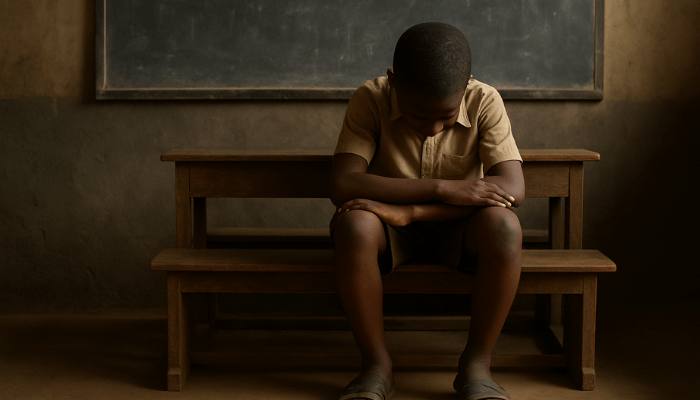
“Sir, I know I will never make it in life. My teacher already told me.”
The words came from a teenage boy after class, eyes firm, voice hollow. For a moment, time stood still. His teacher did not hit him. He did not suspend him. He simply spoke, and those words buried the boy’s dream.
That child did not drop out of school. He was still sitting in class. But in his mind, he had already failed, because a teacher said so.
A growing crisis we refuse to name

In Nigeria’s fragile education system, buckling under dilapidated infrastructure, unpaid salaries, and overcrowded classrooms, a quieter crisis festers: emotional abuse by teachers. It does not leave bruises. It does not make headlines. But it breaks children in ways even poverty cannot.
Too often, we hear stories like:
- “You’re a blockhead. Sit down!”
- “With this your dull brain, forget university.”
These are not isolated cases. From elite private schools in Lagos to rural classrooms in Katsina, too many Nigerian children are being shamed, insulted, and emotionally scarred by the very people meant to shape their minds.
Read also: Nigeria adopts accelerated basic education for 80m out-of-school children, adults
The power and danger of a teacher’s voice

Decades ago, Nigerian teachers were revered. To be called “Teacher” was to be respected, even feared. But today, in many classrooms, that power is being misused.
According to Droy Igbokwe, Professor of Educational Psychology at the University of Nigeria, Nsukka:
“Children develop self-concept largely from the feedback they receive. Verbal abuse from teachers has long-term consequences, from low academic motivation to depression and learnt helplessness.”
The Nigerian Union of Teachers (NUT), in a 2021 statement, admitted that the actions of a few abusive educators “undermine the nobility of the profession.” Yet, there remains no widespread mechanism for addressing psychological abuse in schools, no clear code of conduct, no anonymous reporting system for students, and no standard disciplinary pathway.
Teachers under pressure: But that’s not an excuse
To be clear, this is not an attack on teachers. Many Nigerian teachers are among the most resilient professionals in the country. They show up without salaries, teach without resources, and continue to inspire against all odds.
But some truths must be faced: being underpaid is not a license to be unkind. Carrying pain from home into the classroom and dumping it on children is not discipline; it is projection. And when words become weapons, we must draw the line.
“Teachers are not just knowledge bearers; they are emotional architects,” says Mr Yusuf Olatunji, an education reform advocate. “If they cannot build, they must not destroy.”
Beyond blame: Understanding the root of harm
Still, to only condemn teachers is to miss the complexity of the problem. Nigeria’s education system is not just underfunded; it is undercaring.
- Teacher training programmes rarely include emotional intelligence, child psychology, or trauma-informed education.
- Many teachers were raised on verbal and physical abuse and now perpetuate it unknowingly.
- There are no mental health support systems for teachers dealing with depression, burnout, or PTSD from their personal lives.
- Cultural norms still normalise shame as a teaching tool, making it harder for students to distinguish between correction and cruelty.
These systemic and cultural gaps are why even well-intentioned teachers sometimes become unintentional agents of harm.
Read also: What’s going on with education in Nigeria?
The hidden casualties
Nigeria already has the highest number of out-of-school children in the world: over 10.5 million, according to UNICEF. But what about those in school yet emotionally absent?
These are the silent casualties: students who stop trying because they fear humiliation… who hate school because it feels like a courtroom… who begin to believe that their poverty or accent or background makes them less human.
And all it takes is one sentence from a teacher to confirm their worst fear.
What must be done?
To rebuild trust in Nigerian classrooms, we must start from within. The government cannot do this alone. School proprietors, teacher training colleges, education ministries, parents, and the teachers themselves must act.
Here are the things we need to do:
- Emotional intelligence training in all Colleges of Education and B.Ed programmes;
- Clear national guidelines on verbal and psychological abuse in schools;
- Anonymous reporting systems for students and parents;
- Regular psychosocial support for teachers, including therapy, mental health days, and peer support groups;
- National campaign to redefine discipline, teaching that correction can be firm without being cruel;
- Recognition and promotion of emotionally intelligent teachers who model compassion and excellence.
Reclaiming the chalk
Teaching is not just a job; it is a calling. If a teacher’s words can crush a dream, the same words can also resurrect one. A teacher can say:
- “I believe in you.”
- “It’s okay to fail. You can try again.”
- “You matter.”
These are the phrases that change destinies. These are the phrases Nigeria needs now.
As we demand better systems, let us also demand better selves. Teachers must not be “wounds” in a child’s story; they must be the ones who stop the bleeding.
Because when the chalk becomes a weapon, the entire future bleeds.