From Lagos to Somerset: Why Nikki May’s This Motherless Land Should Top the NLNG list
Some books entertain you. Some books move you. And then there are the ones that take you by the hand, drag you across the pages, and leave you feeling rearranged. Nikki May’s This Motherless Land belongs firmly in that last category.
This Motherless Land is not just a novel; it’s an entire journey. It’s Lagos traffic and Somerset rain; it’s cousins who become each other’s lifeline; it’s grief, jealousy, inheritance, identity, and that complicated kind of love that isn’t romantic but still feels world-shaking. May gave us Wahala, and now she’s back — bigger, bolder, and, dare I say, even better.
At the centre of the story are two cousins: Funke, a Lagos girl whose world shatters when a car crash kills her mother and brother. Liv, her English cousin, grows up in The Ring, their family’s ancestral estate in Somerset, England, with a mother who is more formidable than affectionate. On paper, these girls could not be more different. Funke is shaped by loss, rejection, and superstition; Liv is deprived of love and yearns for connection.

When they finally find each other, what unfolds isn’t polite cousinly bonding. It’s messy, magnetic, and life-changing; the kind of bond that both saves and ruins you.
May writes with bite and with heart. The dialogue sparkles, the tensions simmer, and the pages almost turn by themselves. She can roast class hypocrisy in one sharp sentence, then turn around and break your heart with a single image: a girl clutching a Guinness bottle top salvaged from the wreck that killed her family.
What makes This Motherless Land stand out is how it refuses to simplify the complexity of real life, even though it’s fiction. Families love you and hurt you, cultures steady you as well as cage you, and identity is a fight you never quite finish. Funke and Liv’s paths wind through betrayals and reconciliations, but through decades of highs, lows, and everything in between, the one truth that doesn’t shift is this: it’s a love story. Not boy-meets-girl love, but the stubborn, bone-deep affection of family who love each other even when they hate each other.
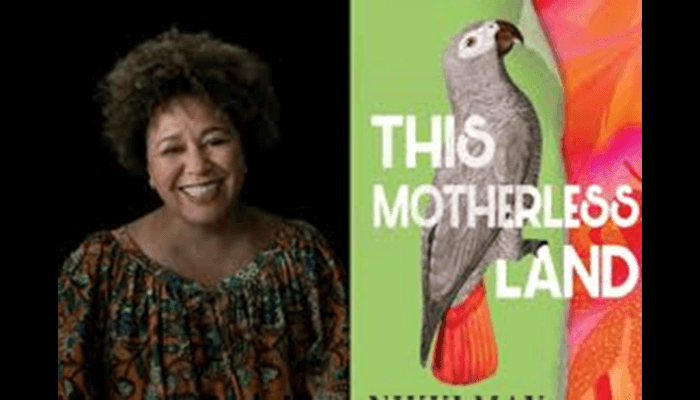
I have to pause here and gush about the cover. The riot of colours, that bold splash of red and orange against the green, and of course, the African Grey Parrot perched front and centre. It’s stunning. But it’s not just a pretty design for design’s sake. The bird is a nod to Billy, the parrot in the novel who spends his days calling out “Hello, Lizzie!” long after Lizzie (Funke’s mom) is gone. It’s a small but haunting detail in the book; an echo of grief that lingers.
I love a cover that doubles as a clue and rewards you with a secret symbol you recognise only after you’ve stepped inside the story.

Read also: The Nigerian Prize for Literature 2025 conversation
And I’ll be honest: I’m not usually the biggest fan of Nigerian literature. Too often, it leans heavily into tragedy; beautifully written tragedy, sure, but still heavy and draining. I’m a sucker for sappy escapism; the kind of book that lets me float away on a fluffy cloud of make-believe and suspend my disbelief, because life is already heavy enough. But This Motherless Land was a refreshing change of pace. Yes, there’s plenty of pain here – death, betrayal, estrangement, indignation – but it doesn’t drown you in despair. Instead, it touches on something healing and quietly satisfying.
And that’s why it resonates. There are truths every Nigerian will recognise regardless of class: the weight of family expectations, inheritance dramas, the scars of loss, and the way parents’ choices ripple down to their children. Funke’s search for belonging, feeling never fully Nigerian and never fully British, reflects the reality of many of us living between identities in one way or another. Liv’s complicated love-hate relationship with her mother is painfully familiar in a culture where tenderness is often sacrificed at the altar of respectability and discipline. Even the superstitions, like the whispered “child of a witch,” will hit close to home if you’ve ever grown up with the harsh, unfiltered gossip that older family members sometimes throw around like fact.
So sure, the stage is set with heirlooms and mansions, but the emotions are the great equaliser. They’re raw, they’re real, and they’re ours. That’s why the novel doesn’t just speak to Nigerians who share its settings; it speaks to Nigerians who share its truths.
• Big Questions the Book Asks: What does it mean to belong when you straddle two cultures? Can love between family members survive betrayal? How do women navigate patriarchal and racial issues?
If you’re the kind of reader who likes books that can both slap and hug you in equal measure, this one is it. I closed the last page and thought, “This deserves a prize.” And while it’s not written for prizes (and I can usually spot those), it feels destined for one. Because what Nikki May has given us is precisely what Nigerian literature needs more of: stories that cross borders but stay rooted, stories that honour our messy, complicated families, stories that shout “we are global” while still saying “we are Nigerian.”
The NLNG Prize for Literature has, over the years, established itself as more than just the most valuable literary award on this continent. It now serves as a beacon for excellent Nigerian writing, highlighting works that combine technical skill with authentic lived experiences. Its past winners range from the intimate to the grand, from the experimental to the traditional. But the common thread binding them is resonance; stories that don’t merely conclude when the book ends, but linger in your heart. In this light, Nikki May’s second novel is an ideal contender: a story grounded in Lagos and Somerset, yet resonant anywhere families face loss, legacy, and love.
This Motherless Land is a stunning, moving, funny, and unforgettable work.
Buy it. Please read it. Lend it out. Snatch it back before your friend “forgets.” And if it does go on to claim the NLNG Prize, you’ll be able to say you knew before the judges did.
Nia Ihuoma Alexxis is a comms professional and creative in Lagos.