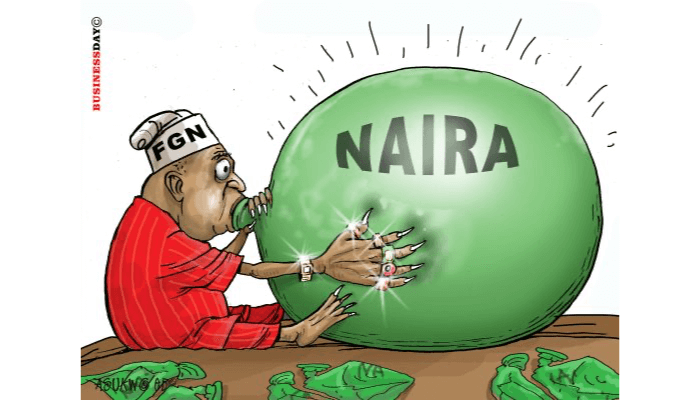
Using the Purchasing Power Parity (PPP) model, the naira is significantly undervalued. The PPP compares the cost of a basket of goods in two countries, estimating what the exchange rate should be to equalise prices. According to a member of BusinessDay’s Board of Economics, who applied the PPP to Nigeria’s current exchange regime, the Naira is undervalued by 23.35 percent (official rate) and 28.11 percent (parallel market). Based on her estimates, the real value of the Naira should be N1,158/$, not N1,551 or N1,611 as seen in the official and parallel markets, respectively.
Yet market exchange rates are not determined by the PPP alone. They reflect supply and demand fundamentals, investor confidence, structural distortions, and geopolitical considerations. In Nigeria’s case, these include heavy import reliance and weak non-oil export base, chronic low Foreign Direct Investment (FDI) inflows, persistent inflationary pressure especially food inflation, rampant forex market opacity and dollar hoarding, dollarization of transactions and its use as a store of value, foreign debt service burden paid in hard currency, low productivity and weak domestic manufacturing capacity, and political interference and corruption in forex administration.
These distortions push the Naira’s market value well below its PPP benchmark, leading many to ask whether the market rate, not the theoretical PPP rate, is the more “realistic” anchor under current conditions.
Between realism and reforms
Some argue that N1,580/$ is simply the price of Nigeria’s macroeconomic choices. Another BusinessDay Board of Economics Board member, estimated a potential value range of N1,200/$–N1,400/$ if revenue-enhancing and monetary reforms are properly implemented. But he warned: without reform, the rate could cross N2,000.

This perspective reflects a pragmatic realism—where exchange rate weakness is a symptom, not the disease. Nigeria’s problem is not primarily mispricing, but policy inconsistency and the absence of sustained structural reform. “If entirely left to market forces,” one analyst noted, “the price would continue to climb upward to levels the economy cannot sustain.”
Indeed, the ongoing debate also touches on deeper concerns: Is the CBN intentionally devaluing the currency to boost exports? Is the lack of a coherent medium-term forex strategy the real issue? Why has the naira continued to depreciate even as net external reserves rose from $3 billion to $23.11 billion as of the end of 2024, according to the CBN data.
These questions underscore the lack of trust in policy direction and communication. As one observer put it: “What really is the game plan for the naira?”
Market dynamics, structural distortions
Current exchange rate dynamics reveal the depth of Nigeria’s structural challenges. As of mid-June 2025, the persistent premium between parallel and official rates reflects deep-seated distortions between formal exchange rate policy and real-world supply and demand. The central bank’s recent unification of official and parallel rates, fuel subsidy removal, and tighter monetary policy reforms have narrowed exchange-rate spreads, yet foreign reserves, though recovering to approximately $38 billion, remain fragile.
The economy’s chronic import dependency spans critical sectors from food to manufacturing inputs, creating what economists term “structural dollar demand.” With 80 percent of Nigeria’s manufacturing inputs imported and politicians and elites holding billions outside banks, the fundamental drivers of currency weakness persist despite policy interventions.

Lessons from elsewhere
Critics argue that currency depreciation alone doesn’t guarantee export competitiveness, citing examples like the UAE, which has maintained a stable dirham while promoting sectors like tourism and logistics. Comparisons with Ghana’s relative currency stability raise further questions: Is it better macro management? More credible institutions? A clearer industrial policy?
Ghana’s more diversified export portfolio, including gold and cocoa, provides multiple sources of foreign exchange earnings.
Additionally, more consistent policy frameworks and reduced political interference in monetary policy have contributed to greater currency stability. The cedi gained 23.68 percent in 2024, according to Trading Economics, after tighter fiscal policies and gold-backed forex interventions, contrasting sharply with Nigeria’s experience.
Whatever the answer, Nigeria must do more than manage optics. Stability cannot be achieved with short-term fixes or ad hoc interventions. As one contributor pointed out, “government intervention to at least provide relative stability in forex is required,” but so is clarity in purpose.
The way forward
If Nigeria is to correct the undervaluation of the Naira, it must deepen non-oil exports and reduce reliance on volatile oil earnings, restore investor confidence through transparency and rule of law, enforce monetary discipline with CBN independence safeguarded, crack down on parallel market abuses and forex leakages, coordinate fiscal and trade policy to support import substitution, and depoliticize the exchange rate conversation with technocratic stewardship.
The near-term ‘fair rate’ should target N1,150/$–N1,350/$, aligning with the PPP and the government’s 2025 budget assumption of N1,400/$. Required actions include institutionalising unified FX channels with enhanced transparency, strengthening reserves via revenue diversification and disciplined fiscal management, and combating FX arbitrage while building trust in the naira through credible oversight.
Value anchored in reform
Ultimately, the naira’s real value is a reflection of national credibility. While PPP provides a helpful lens, only policy integrity and production-led growth can bring about sustainable currency equilibrium. The Naira today is materially undervalued by PPP, yet reflects deep structural weaknesses. With bold reforms, disciplined fiscal and FX policy, and institutional trust-building, Nigeria can anchor the naira within N1,150/$–N1,350/$.
Absent that, market forces risk driving the currency into destabilising territory—triggering further inflation, capital flight, and social stress. The time for theoretical debates has passed. What remains is execution. The naira’s story is ultimately Nigeria’s story—a tale of immense potential constrained by structural challenges that require bold, sustained action.