



In the hierarchy of Nigeria’s GDP contributors, finance has long been one of the top service-sector performers, matched only by trade, real estate, and oil. But the latest GDP data marks a symbolic shift: telecommunications and information services have definitively overtaken financial institutions in their share of economic output. This is more than a statistical milestone; it reflects the fundamental reconfiguration of Nigeria’s growth drivers in an increasingly digital economy.
“The Central Bank’s licensing of Payment Service Banks (PSBs) has further entrenched telecoms’ role as quasi-financial institutions, allowing them to provide banking services and compete directly with traditional financial institutions.”
The numbers tell the story
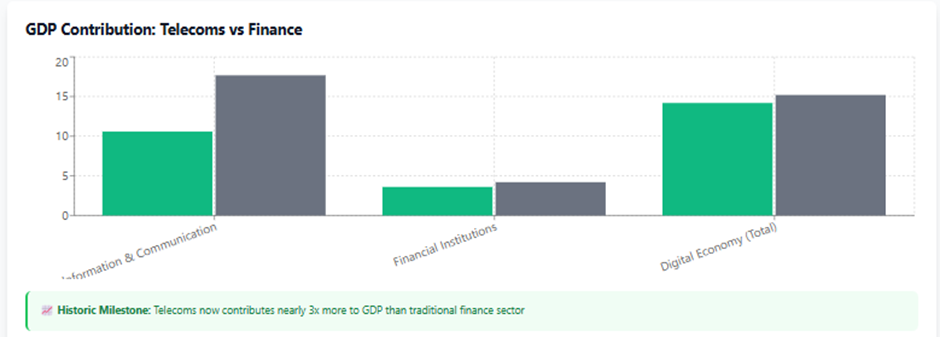
Nigeria’s Information and Communications Technology (ICT) sector contributed 17.68 per cent to Gross Domestic Product (GDP) in Q4 2024, according to the National Bureau of Statistics. More significantly, in Q1 2025, the Information & Communication sector contributed 10.59 percent to real GDP, while the Financial Institutions sector contributed 3.60 percent, cementing telecoms’ position as the fourth-largest sector by GDP contribution. This represents a dramatic acceleration from earlier periods. The telecommunications and information services sector delivered N2.508 trillion in Q1 2023, representing 14.13 percent of GDP, showing a consistent growth trajectory that has now reached historic highs.

From voice to data dominance
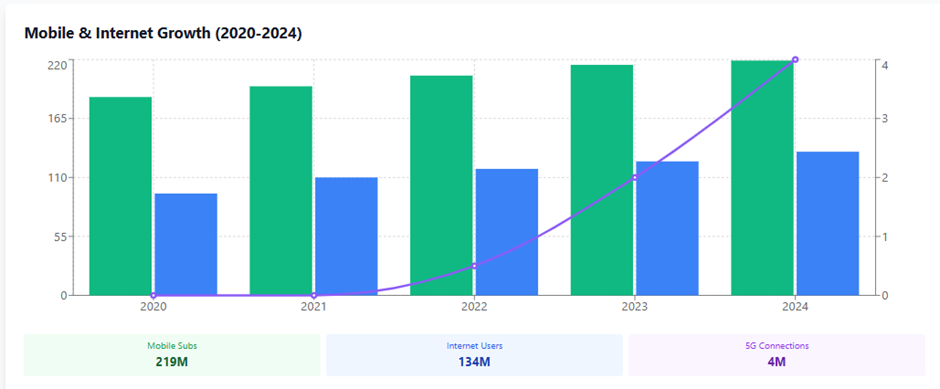
Telecoms’ rise is powered by the explosive growth in mobile data usage. Nigeria had 219 million GSM subscribers in March 2024, with 134,279,501 mobile internet subscriptions recorded in October 2024. The transformation is even more striking when considering network technology evolution. 5G connections in the country increased to 4 million in December 2024, representing rapid adoption of next-generation services. The sector’s infrastructure expansion has been remarkable. What was once a utility-like industry focused on voice calls is now an infrastructure backbone for multiple parts of the economy—from payments to logistics to entertainment. There were 38.7 million active social media user identities in Nigeria in January 2025, equivalent to 16.4 per cent of Nigeria’s total population, indicating the deep penetration of digital services.
The digital economy ecosystem
The digital economy sector contributed 14.19 percent to Q1 2025 GDP, growing by 3.13 percent, with telecommunications forming its largest component. This growth comes despite significant challenges facing traditional players. Airtel recorded a loss of $89 million for its year ended March 2024, and MTN Nigeria’s loss was ₦137 billion for the year ended 2023, both citing naira devaluation, rising inflation, and worsening macroeconomic conditions. The sector’s resilience stems from its recurring revenue model and scalability advantages. The number of smartphone users in Nigeria is forecast to increase by 52.1 million users (+108.75 percent) between 2024 and 2029, providing a massive expansion opportunity.
Fintech integration: Blurring the lines

A key part of telecoms’ edge over finance is its direct integration with fintech. Mobile money platforms, airtime-based lending, and telecom-bank partnerships have made network operators active players in financial intermediation. In rural areas, mobile wallets often serve as the first point of entry into the formal economy, bypassing traditional bank branches. This sectoral convergence means telecoms capture value streams that previously flowed into bank balance sheets. The Central Bank’s licensing of Payment Service Banks (PSBs) has further entrenched telecoms’ role as quasi-financial institutions, allowing them to provide banking services and compete directly with traditional financial institutions.
Economic growth context
Nigeria’s GDP grew by 3.40 percent in 2024, marking an increase from 2.74 percent in 2023, with Q4 2024 hitting 3.84 percent growth driven by the services sector. The ICT sector’s outperformance within services reflects its structural advantages in a cost-conscious, digitally transforming economy. While traditional finance faces headwinds from high interest rates constraining lending and consumer credit growth, telecoms thrive on recurring data subscriptions with relatively low default risk. The sector’s scalability—adding millions of new data customers requires less capital than expanding physical bank branches—provides a structural competitive advantage.
Read also: Beyond coverage: Future-proofing Nigeria’s telecoms industry
Policy and regulatory tailwinds
Government policy has played a crucial enabling role. The National Broadband Plan and spectrum auctions have expanded operator capacity significantly. The NBS reports that the telecom industry was the third-largest contributor to real GDP in Q2 2024, benefiting from supportive regulatory frameworks. The Nigerian Communications Commission’s push for rural coverage has opened new markets where data uptake rises as smartphones become cheaper and more accessible. This rural expansion strategy has proven particularly effective in driving subscriber growth and revenue diversification.
Challenges and vulnerabilities
However, the sector faces significant headwinds. Nigeria lost 24.6 million internet subscribers in one year, with total internet connections dropping by nearly 27 percent, highlighting market volatility despite overall growth trends. The sector remains heavily exposed to foreign exchange volatility, as network equipment, software, and technical expertise are predominantly imported. Energy costs burden operations, with diesel and petrol needed to power thousands of base stations across the country. Policy risks, including potential sector-specific tax increases, could also pressure margins. Urban market saturation poses another challenge, where most customers already possess data-enabled devices. Sustaining high growth requires deeper rural penetration, enterprise services development, and monetisation of emerging technologies like IoT and cloud computing.
Implications for economic strategy
Telecoms’ rise suggests Nigeria’s path to faster GDP growth depends less on traditional sectors like oil, finance, or agriculture and more on tech-enabled service ecosystems. For policymakers, this necessitates rethinking industrial policy to integrate ICT with manufacturing, education, and public service delivery. The sector’s success demonstrates that modern economic infrastructure extends beyond physical assets to include fibre-optic cables, mobile towers, and data centres. Companies controlling these digital assets function not merely as service providers but as fundamental economic enablers.
Investment and future outlook
Mobile internet access penetration in Nigeria is forecast to increase by 9.2 percentage points between 2024 and 2029, suggesting continued expansion potential despite current subscriber volatility. For investors, the lesson is clear: 21st-century infrastructure investment priorities must encompass digital connectivity alongside traditional physical infrastructure. The companies dominating these digital assets will likely drive Nigeria’s economic transformation over the coming decade.
The broader economic narrative
Telecoms overtaking finance represents more than statistical curiosity; it signals an economy where digital connectivity becomes as fundamental as electricity. The sector’s 17.68 percent GDP contribution in Q4 2024 reflects this structural transformation. This shift from traditional financial intermediation to digital-enabled services suggests Nigeria’s economic centre of gravity is moving decisively from the bank branch to the mobile network. In a decade, economic historians may identify Q1 2025 as the inflection point when Nigeria’s services sector fundamentally realigned toward digital-first economic models. The telecommunications sector’s ascendancy demonstrates that sustainable economic growth in modern Nigeria depends on digital infrastructure, data services, and technology-enabled platforms rather than traditional brick-and-mortar financial institutions. This transformation, while presenting challenges, offers tremendous opportunities for inclusive economic development and technological leapfrogging.
Dr. Oluyemi Adeosun, Chief Economist, BusinessDay Media





