There’s something for everyone in the proposed tax reform bills according to Taiwo Oyedele, Chairman, Presidential Committee on Fiscal Policy and Tax Reforms.
In 2023, Joseph Yusuf, a young farmer from Taraba State, struggled with rising production costs, including transportation fees that surged from N800 to N4,000 for a 100kg bag of maize. Coupled with high labour costs, multiple taxes, and low profits, he ran out of capital and was forced to quit farming.
In an interview with Terhemen Festus Swem, Secretary of the Poultry Association of Nigeria (PAN), Benue State Chapter and Lecturer at College of Veterinary Medicine, JOSTUM, he shared that the poultry industry and the agriculture sector at large is being hit hardest by inflation and the economic downturn.
He highlighted how high input costs, transportation, electricity tariffs, and taxes are crippling the agriculture sector, driving many businesses to the edge of collapse. Production now costs four times more than what it used to be before he said.

He also noted that feed mill companies face heavy taxation, driving up feed costs. This, in turn, has caused a shortage of input materials, leading to soaring prices due to supply and demand dynamics.
According to Swem, if the new tax reforms are effectively implemented, they could provide much-needed relief to the agricultural sector. Exempting essential items like food, healthcare, electricity generation, and transportation would significantly ease production costs and lighten the overall burden.
He also emphasized that raising the small business exemption threshold from N25 million to N50 million, or allowing N250 million in assets, along with offering input VAT credits on goods consumed by businesses and reducing the company income tax (CIT) from 30 percent to 25 percent would significantly reduce production costs for both farmers and farm input companies, like feed millers.
Global reviews on agricultural subsidies
Reports show that between 2021 and 2023, approximately $842 billion per year was allocated to support the agricultural sector across the 54 countries of the Organization for Economic Cooperation and Development (OECD).

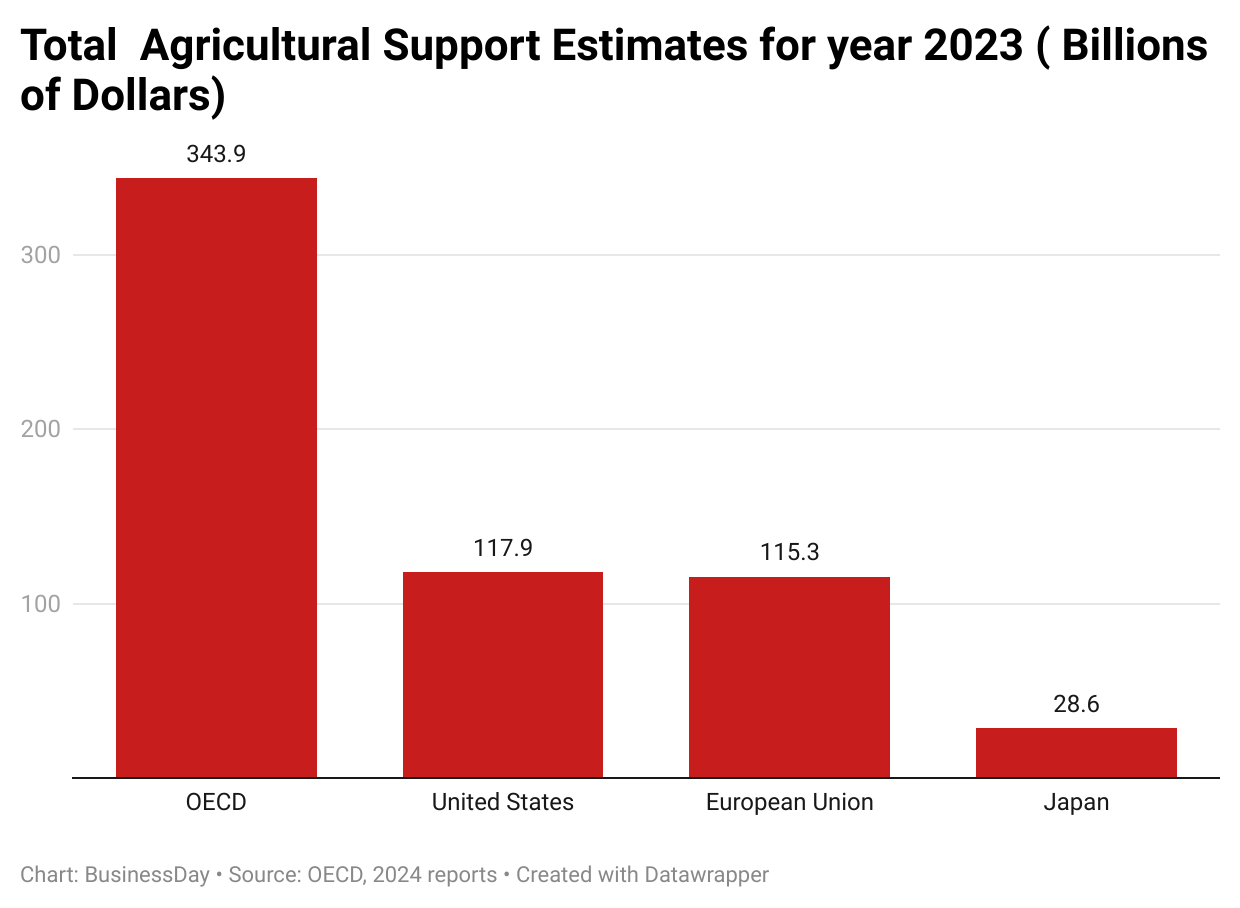
OECD 2023 reports estimate that the United States, European Union, and Japan provided approximately $117.9 billion, $115.3 billion, and $28.6 billion, respectively, in agricultural support for the year as seen below.
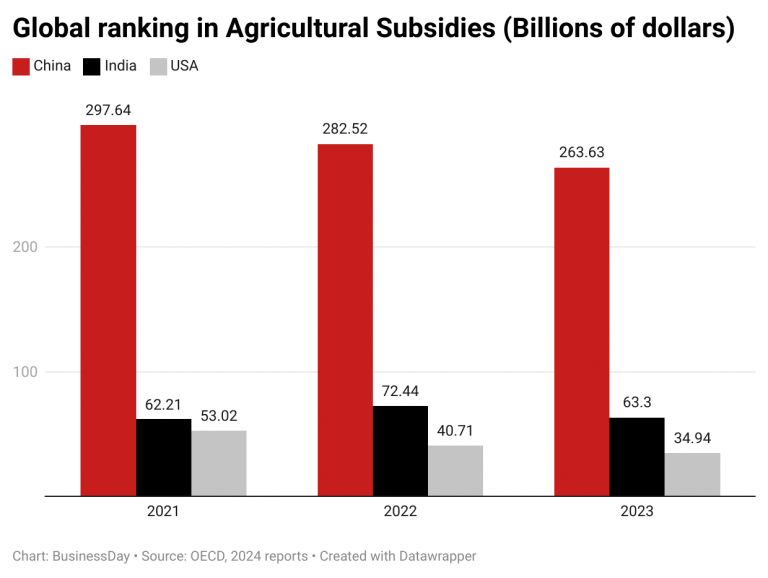
Recent OECD reports show that from 2021 to 2023, China, India, and the United States were the top countries in global agricultural subsidies.
What lies ahead for farmers and the agricultural sector in 2025?
When asked about the outlook for farmers in 2025, Swem stated that if tax reforms support farmers as key players in the food industry, it will lead to increased food supply, lower input and transportation costs, reduced electricity tariffs, and encourage more farmers to return to business.
He stressed that stakeholders must ensure agricultural credit facilities are easily accessible to small-scale farmers. He lamented the difficulty smallholder farmers face in securing credit from financial institutions as only 3.8 percent loans are available for the agricultural sector according to Federal Government’s QCBS 2024 reports.
Swem also emphasized the need for agricultural subsidies to be made more accessible to smallholder farmers adding that most major countries around the world subsidize the agriculture sector.
In 2017, the government allocated N27 billion to support 1.5 million farmers. By 2021, this funding increased to N12.3 billion ($29.9 million), benefiting 2.2 million farmers through agricultural subsidies.
In 2024, the government also introduced a new initiative, offering up to 50% subsidies for agricultural inputs, including fertilizers and wheat seeds, aimed at assisting approximately 280,000 smallholder farmers.
While the Federal Government offers subsidies for input materials through schemes like the Growth Enhancement Support Scheme (GESS), issues such as widespread diversion, elite capture, a cumbersome acquisition process, and the poor quality of some inputs hinder the effective implementation of these subsidies in Nigeria experts say.
Nigeria’s agricultural subsidies are insufficient, especially considering that almost 70 percent of Nigeria’s population rely on farming as their major income source at subsistence level.
Recent IMF reports reveal that agricultural subsidies in Sub-Saharan Africa are generally low, with Nigeria’s subsidy efforts falling short of global standards ( about 18 – 40 percent of total agricultural productivity value) according to the World bank.
Conclusion
In summary, Swem believes that with the right stimulants such as subsidies, soft loans, training, tax relief and media awareness, many farmers are likely to return to farming by 2025, boosting agricultural productivity and sustainability.