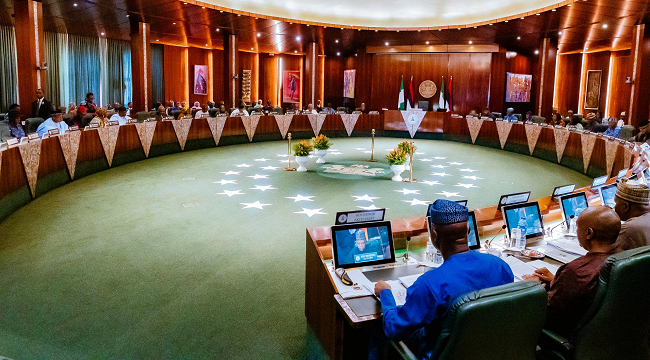
After what seemed like a lull, the issue of restructuring reared its head again mid last week when the Northern Senators’ Forum (NSF), after a two-day retreat that ended on Wednesday in Katsina State, said they were ready to discuss the issue of restructuring if the right cards were put on the table.
Describing restructuring as it is currently being proposed as ambiguous even to “proponents, without clear terms and directions on how to go about it”, the NSF said the North was not afraid of any “sensible and meaningful arrangement, provided it guarantees justice, equity, fairness and the unity of all Nigerians”.
It said the region would, in due course, take a “well-articulated, firm and common position” on restructuring, in collaboration with other Northern members of the National Assembly.
The forum also resolved to map out a Marshall Plan for development of the region, saying the proposition would be carried out in partnership with critical stakeholders, its House of Representatives counterpart and the Northern States Governors’ Forum.

The resolution was contained in a communiqué signed by NSF chairman, Abdullahi Adamu.
This is not the first time voices from the North have spoken out on restructuring.
On July 27, the governors of the 19 Northern states, at a meeting with traditional rulers of the region in Kaduna, said the region was not opposed to the restructuring of the country but that any restructuring should be done within acceptable criteria and must be fair to all component parts of the country.
“It is also my expectation that at the end of this meeting today and, God willing, tomorrow’s meeting of the governors, the forum and our esteemed royal fathers will adopt a consensus position on restructuring of the country that will be reflective of the general overall interest of the people of Northern Nigeria and which will attract popular acceptance,” said Ibrahim Shettima, governor of Borno State and chairman, Northern States Governors’ Forum.
“It is of vital importance to arrive at such consensus position because it is crucial to dispel the erroneous impression created and disseminated by certain interests in this country that the North is opposed to restructuring.

“Secondly, it is important to do so not only to accommodate the mainstream of Northern public opinion, our primary constituency, but to also counter the specific versions of restructuring, which generally seek to place the North in a position of strategic political and economic disadvantage, but portrayed as the only versions that can work for the nation,” said Shettima.
On July 28, the forum constituted a high-powered committee to collate views and comments on the state of the nation, with specific reference to the agitations for the restructuring of the country.
On September 13, the committee set up by the Northern States Governors’ Forum and the Northern Traditional Rulers Council to aggregate the views of Northerners on the restructuring debate agreed to hold public hearings in the 19 states of the region.
Speaking after the inaugural meeting of the committee in Kaduna, Aminu Tambuwal, Sokoto State governor and chairman of the committee, said members had agreed to hold extensive consultations with stakeholders and leaders of thought in member states with a view to coming up with acceptable position that would reflect the view of the entire North.
On September 28, at the North West Zonal Public Hearing on True Federalism held at the Kano State Government House, Northern states of Kano, Kastina, Jigawa, Nasarawa and Benue said they would support restructuring in the condition that there would still be a strong Federal Government.
Governor Abdullahi Umar Ganduje of Kano expressed support for “a strong Federal Government founded on a clear responsibility and sufficient resources to guarantee the development of the federating units”. Governor Aminu Masari of Katsina, while calling for an arrangement that would recognise the peculiar needs of the different federating units, said the powers of the central government must not be weakened in the process of the devolution.
For the records, the call for restructuring and true federalism has been around in the country for a long time. It was part of Chukwuemeka Odumegwu-Ojukwu’s demands at Aburi-Ghana prior to the outbreak of the Nigeria/Biafra war. It was one of National Democratic Coalition’s major demands in the months and years following the annulment of the June 12, 1993 presidential election.
But at no time has it ever been as deafening as recently, with virtually all sections of the country agreeing that it is the only way forward for Nigeria.
Afenifere, a pan-Yoruba social-cultural organisation, has continued to insist that Nigeria needs a devolved structure and return to a parliamentary system of government.
In the South-East, notwithstanding sustained agitations for Biafra in some quarters, prominent political, intellectual and business elite in the region have also continued to demand a new structure where each state or region of Nigeria will be relatively autonomous with powers to largely develop and control its resources.
Individuals in all the regions have also continued to speak out. Yinka Odumakin, spokesman of Afenifere, said restructuring must take place before the next election because to pursue another election on the basis of the current constitution would mean that Nigerians would have signed for another four years under the same dysfunctional constitution.
“If we want to keep this country together, we must restructure Nigeria before we hold another election. The country is falling apart and it is collapsing on everybody’s head. The urgent business of now is to restructure Nigeria, and not holding elections. If you hold any election under this arrangement, you are just fast-tracking the imminent collapse of Nigeria.
“It is those who cannot see, those who lack the mental mindset to understand where Nigeria is headed without restructuring, that are saying that it is not an urgent matter. We can’t afford to move on with Nigeria without restructuring. It is an urgent matter,” Odumakin said in an interview with BDSUNDAY in October.
Balarabe Musa, former governor of old Kaduna State, said the demand for restructuring is constitutional, fair and appropriate, adding, however, the problem was different people have different ideas of how to restructure.
“As far as we are concerned, the restructuring will require, first, reconciliation between Nigerians. Let Nigerians reconcile themselves and agree for an ethnic-free and progressive Nigeria. We don’t want any ethnic sovereignty. Let us unite. I will like a situation where every Nigerian is of Nigeria,” said the former governor.
“The second restructuring we require is political. The 36 states are not viable; we can’t even pay salaries of workers. Let us go back to the 1963 Constitution where we had regional governments. Each one of the regional governments we had then was capable of taking care of itself. Each one of them was economically viable. Let us go back to that arrangement. Each of the current zones would be viable enough without going to government at the centre. And again, let us have a centre which is capable of uniting the country without being too powerful,” he said.
Perhaps the only region where there have been muted objections to restructuring has been in the North, with many in the region fearing that restructuring meant economic emasculation of the North. That Northern elements are becoming more open to discussions on restructuring is a good sign.
By and large, restructuring has been a hot-button issue in the Nigerian polity. The sooner every section of the country joins in the debate and comes up with its position, the better. Anyone under the illusion that discussion on the need to restructure Nigeria will die a natural death had better have a rethink.
CHUKS OLUIGBO