At least 20 people have been killed and 52 others wounded in a devastating suicide bombing during a Sunday mass at a Greek Orthodox church in the Syrian capital, authorities confirmed.
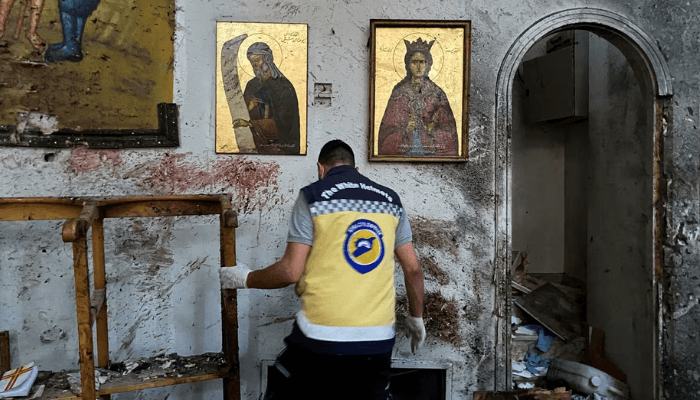
The attack struck the Mar Elias Church in central Damascus while a service was underway. According to Syria’s Ministry of Interior Affairs, a gunman believed to be affiliated with the Islamic State (ISIS) opened fire on worshippers before detonating an explosive vest. The ministry described the incident as a “terrorist attack.”
Graphic footage circulating on Syrian social media platforms showed scenes of carnage inside the church: bodies strewn across blood-slicked floors, shattered glass, and splintered pews in what should have been a sanctuary of peace.
Read also: Trump to lift sanctions on Syria in historic policy shift

Syria’s health ministry said the death toll could rise, with several victims in critical condition. Emergency teams from the civil defence group, widely known as the White Helmets, rushed to evacuate the wounded and secure the scene.
“This was a treacherous hand of evil,” the Greek Orthodox Patriarchate of Antioch said in a somber statement. “An explosion occurred at the entrance of the church, resulting in the deaths of numerous martyrs and causing injuries to many others who were inside or nearby. We offer our prayers for the repose of the souls of the martyrs, for the healing of the wounded, and for the consolation of our grieving faithful. We reaffirm our unwavering commitment to our faith and, through that steadfastness, our rejection of all fear and intimidation.”
There has been no immediate claim of responsibility for the bombing. However, Syrian authorities were quick to attribute the assault to ISIS, which remains active in pockets of the country despite the collapse of its so-called caliphate.
Read also: Nigeria, Venezuela, Syria are losing passport power Investment migration expert
Geir O. Pedersen, the United Nations Special Envoy for Syria, condemned what he called a “heinous crime,” urging all parties to reject extremism and the targeting of religious communities.

“This kind of terror must have no place in Syria’s future,” Pedersen said. “We extend our deepest condolences to the families of the victims and hope for the swift recovery of the wounded.”
International condemnation was swift and widespread. Foreign ministries across the Middle East and Europe—including Turkey, Jordan, Iraq, Israel, Greece, Cyprus, the United Arab Emirates, Qatar, Saudi Arabia, the Palestinian Authority, Yemen, Oman, Bahrain, Ukraine, Austria, Belgium, the Czech Republic, and the Netherlands—issued statements denouncing the attack.
Read also: Syria: A new chapter in the history of the region
Thomas Barrack, the United States’ Special Envoy for Syria, Thomas Barrack, labelled the bombing an act of “cowardice,” stressing that such violence stands in direct opposition to the “new tapestry of integrated tolerance and inclusion that Syrians are weaving.”
Sunday’s attack is one of the deadliest assaults on Christians in Syria in recent years and a grim reminder of the country’s continued vulnerability to sectarian violence, even as large-scale fighting has subsided. It also raises fresh concerns over the security situation in Damascus, a city once considered relatively insulated from the chaos of the country’s decade-long civil war.