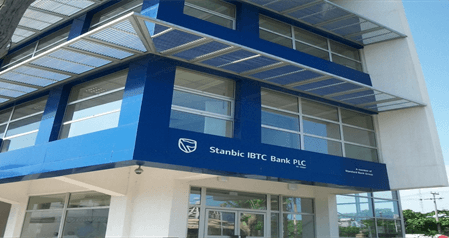
Stanbic IBTC Holdings Plc has continued with its impressive performance amid a myriad of challenges plaguing the banking industry as the lender’s first quarter profit got a boost from growth in non-interest revenue.
Ever since the lender released its financial statement last year after resolving a dispute with Financial Reporting Council of Nigeria (FRCN) over its 2015 results, the Nigerian lender has recorded a double digit growth at both the top and bottom lines.
Stanbic IBTC Holdings has replicated the stellar performance of the previous quarters as net income spiked by 106.20 percent to N16.0 billion in March 2017, from N7.79 billion as at March 2016.
The growth at the profit was underpinned by 18.74 percent upswing in non-interest revenue to N20.10 billion. Gross earnings were up 38.23 percent to N47.0 billion.
Stanbic IBTC Holdings’ net margin, a measure of profitability and efficiency increased to 34.02 percent in the period under review as against 22.0 percent as at March 2015.
Based on BusinessDay calculations, the lender’s profit margins is one of the strongest in the banking industry.
Analysts say with strong profit margins, excellent risk management strategy and a solid assets base, Stanbic IBTC Holdings will climb it way to becoming one of the top five banks in Nigeria.
Already, the lender’s market capitalization of N214.70 billion eclipses Tier 1 lender, First Bank Holdings market value of N123.84 billion as ofMonday.
More still, Stanbic IBTC Holdings and GTBank are the only lenders trading more than book value. The rest are trading less than one time book value.
Analysts are of the view that Stanbic IBTC Holdings impressive results amid a tough operating environment means management’s focus and market penetration strategy has paid off.
Nigerian banks experienced full-blown financial crisis last year as failed fiscal and monetary policies led to a credit crunch.
Continued default by customers especially contractors and oil companies due to an economic downturn battered assets quality of lenders as they had to write off huge loans as irrecoverable.
The bad-debt ratio at Nigerian banks rose to 13.4 percent last year, according to a recent report from the Central Bank of Nigeria (CBN).
The bad-debt ratio at Nigerian banks rose to 13.4 percent last year, according to a recent report from the Central Bank of Nigeria (CBN).
Experts are of the view that the decision of the central bank to adjust the rules governing the operation of the foreign exchange market could be an attraction to foreign investors who had hitherto dumped naira assets.
This means the supply side of the market will be invigorated hence ameliorating the pains of banks that are ensnarled in the dungeon of illiquidity.
Further analysis of the first quarter results of Stanbic IBTC Holdings shows total loans and advances to customers fell by 5.64 percent on the back of difficult macro-economic environment which constrained new loan advances to customers.
The market reacted to the lender’s results as its share price gained 4.98 percent to close at N4.98.
BALA AUGIE