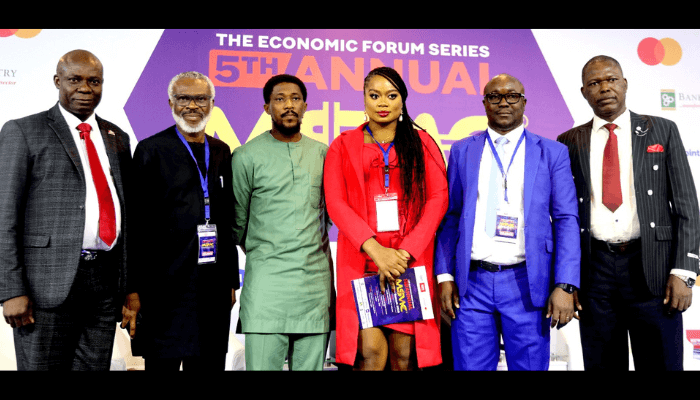
The 5th Annual MSME & Startup Summit hosted by The Economic Forum Series (EFS) brought together stakeholders from banking, business, government, and civil society to address the challenges faced by Nigeria’s informal micro, small and medium enterprises (MSMEs) and startups.
The summit, themed Unlocking Inclusive Growth for Informal MSMEs and Startups, focused on building policies and systems that support financial access and inclusion.
In his opening remarks, Jude NDU, Founder/CEO, EFS, said, “The bold ambition of building a one trillion dollar economy cannot be realised without unlocking the potential of MSMEs. Without support, this goal remains an illusion.” He referenced a report that stated, “Africa has too many businesses but too little business,” underscoring the informal nature of many African economies.
Chizoma Okoli, Deputy Managing Director, Access Bank Group, noted the economic weight MSMEs carry. “Nigeria’s 39 million MSMEs employ over 80% of our workforce and contribute almost half of our GDP,” she said. Yet, most remain unregistered and excluded from financial services. “The financing gap for MSMEs in Nigeria is estimated at over $158 billion,” she added.

Okoli pointed to Kenya, India and Indonesia as examples of economies that have advanced MSME development through technology and inclusive finance. She said, “Kenya’s M-Pesa system has helped MSMEs build transaction histories and access credit. India’s PMMY scheme has delivered $200 billion in loans to over 350 million entrepreneurs.” She explained that Access Bank had adopted a cash-flow-based lending model to support small businesses lacking collateral. “We resource resource-based on willingness. Value is often found in cash flow, not collateral,” she said.
Folasade Femi-Lawal, Country Manager and Area Business Head, West Africa, Mastercard, described the company’s commitment to digital inclusion. “We made a commitment to connect 1 billion people to the digital economy by 2025, including 100 million MSMEs,” she said. Mastercard has developed Tap on Phone solutions, virtual cards and identity systems for small business access. “Digital identity is essential. Without it, entrepreneurs remain invisible,” she said.
Femi-Lawal cited partnerships that are helping small businesses in Nigeria and across Africa, including collaborations with NetPlus, KaiOS, Comni Retail, Aleso, and the African Development Bank. She said, “Digital transformation is not about the tools. It’s about unlocking potential and ensuring that every entrepreneur has a fair chance.”
Chinyere Almona, Director General / CEO, Lagos Chamber of Commerce and Industry, stressed the importance of consistent policies. “The private sector is the engine of economic growth. Government should create an enabling environment and allow the private sector to create jobs,” she said. She warned that unpredictable policy shifts can “shut down an entire sector” and called for “regulatory empathy and coherence.”
Representing the Bank of Industry (BOI), Igbeda Olugbenga, Project Officer, highlighted the need for digital infrastructure to improve access to finance. “MSMEs make up more than 90% of businesses and 80% of employment. Yet, access to finance remains their biggest constraint,” he said. He added that BOI’s digital loan systems and partnerships have improved access for underserved groups.

Ogochukwu Odum, Head, Capital Markets and representative of FairMoney Microfinance Bank, explained the bank’s digital-first strategy. “We created a mobile platform for SMEs to open accounts, access credit, and run their business,” he said. FairMoney uses non-traditional data to determine creditworthiness. “You can apply for a loan and receive funds in less than five minutes,” he said.
Ezekiel Sanni, Senior Vice President, Distribution Sales, Moniepoint, said the firm had invested in rural reach and technology for informal businesses. “We serve over 15 million customers, process over $22 billion in monthly transactions, and operate in all 774 local government areas,” he said. Sanni stressed that trust, not just technology, is vital. “Inclusion is not just access. Inclusion is usage and trust,” he said.