Over the past two weeks, Temitope Ayilara and her partner, Victor, have struggled with network issues on every call.
“Sometimes we spend five minutes just asking, ‘Can you hear me?’” Ayilara said.
This continuous disruption has forced the couple to switch between WhatsApp and regular calls. “The network has been generally bad, especially for WhatsApp calls,” Temitope added.
For Olamide Jacob, a financial analyst, making calls at home has become a frustrating chore. “It is either I make those calls before getting home or just set myself up for frustration,” she lamented.

Ibrahim Olorunfemi, a civil servant, echoed this sentiment: “My network has been bad; making basic calls is a hassle now.”
Read also: Nigeria caps telecom tariff plans to follow India’s lead
Funmi Makinde, a school teacher, added, “My network is okay. It is not great, but it is not terrible. It only gets bad during WhatsApp calls.”
Ayilara, Jacob, Olorunfemi and Makinde are among a growing number of Nigerians who have been grappling with poor network quality in recent months. Complaints have flooded X, formerly Twitter, with multiple users venting their frustrations.
“Is everybody’s MTN network really bad, or is it just mine?” tweeted @Solangette_. Network failed me tonight. Both MTN and Airtel. To get a stable network is a luxury in Nigeria,” @Yantumakii wrote.

“Of all the things that have pissed me off in this country this week, the network connection ranks high. You mean this is the network we have all been using? I can barely make smooth WhatsApp calls or watch a 30 secs Twitter/IG video from start to finish,” added @jemimahh__.
Declining Investments and Growing Demand
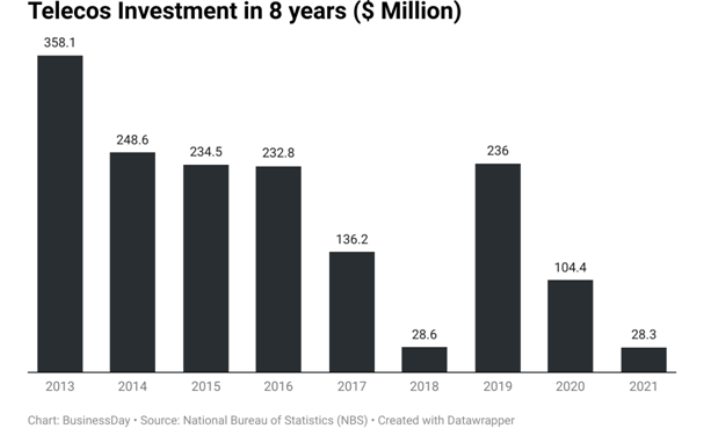
Gbenga Adebayo, chairman of the Association of Licensed Telecom Operators of Nigeria (ALTON), attributed the deteriorating network quality to declining investments in the sector. A decline in revenue and investments has impeded operators’ ability to expand their network capacity, worsening service quality across the country.
According to Bolaji Balogun, chief executive officer of Chapel Hill Denham and a key player in the telecom sector, telcos need to invest $1 billion annually to meet the nation’s growing service quality demands.
However, foreign investments in the telecoms sector fell to a six-year low of $14.74 million in the third quarter (Q3) of 2024 from $11.42 million in the corresponding period of 2018, according to capital importation data from the Nigerian Bureau of Statistics.
MTN Nigeria and Airtel Africa have also reduced network infrastructure investments to manage rising operational costs and foreign exchange (FX) exposure. Between January and September 2024, MTNN’s core capital expenditure (capex) dropped 27.79 percent to N217.64 billion, while Airtel’s capex fell 36.59 percent to $149 million.
Rising Demand Meets Stagnant Investment
This decline in investment comes as demand for telecom services surges. Monthly internet usage surged by 67.91 percent to 870,398.28 terabytes (TB) in October 2024 from 518,381.78TB in December 2022. One industry expert explained, “We cannot expand to meet demand. We’re just managing to keep the lights on. This is a capital-intensive market, and technology evolves daily.”
According to GSMA, the global telecom body, Nigerian telcos are struggling to generate sufficient revenue to sustain the necessary investments. “This results in a shrinking sector which leads to subscribers receiving a poorer quality of service and delays in coverage expansion,” GSMA warned.
Financial and Economic Pressures
This situation is expected to escalate, as Karl Toriola, CEO of MTN Nigeria, described the sector as being in crisis. “Investments will not continue to come. No one will put in a dollar and continue to get 66 cents… We are in a big crisis,” he said.
The situation is compounded by the Central Bank of Nigeria’s (CBN) unification of the FX market and the worsening economic conditions, including record high inflation and the naira depreciation. The naira has weakened from N471/$ in June 2023 to N1,545.10 as of December 16, 2024.
These challenges have led to massive FX losses, with MTNN and Airtel Africa losing N1.29 trillion in 2023. Despite a 33.7 percent growth in service revenue to N2.37 trillion, MTNN posted a N514.93 billion loss between January and September 2024. Airtel Nigeria’s revenue fell 46.9 percent to $755 million in the same period.
The sector’s contribution to the gross domestic product (GDP) has also declined, falling to N2.80 trillion in Q3 2024 from N2.99 trillion in Q2. Average revenue per user dropped 40.87 percent to $1.85 in Q3 2024, compared to $3.12 a year earlier. Rising energy costs, which have surged over 90 percent, further strain operators.
Carl Cruz, former CEO of Airtel Nigeria, stated that increasing operating costs are outpacing revenue growth, causing investors to be cautious.
“This is a critical moment for the industry,” Adebayo of ALTON noted. He pointed out that if necessary steps are not taken, the “industry will likely go in the wrong direction.”
He said, “This will not only damage the interests of investors, many of whom are Nigerian, but also impact the emergence of the innovative services and products that ride on telecoms infrastructure.”
Read also: Four predictions to expect for the tech and telecoms industry in 2025
Telcos are advocating for a tariff increase to offset rising costs. Although their 2022 request to the Nigerian Communications Commission (NCC) is still pending, operators argue that higher tariffs are now essential. “There should be no delusion. If the tariff doesn’t go up, we will shut down,” Toriola of MTNN emphasised.
Adebayo pointed out that while operators are aware of the financial stress Nigerians are facing with inflation at 34.60 percent in November 2024, a price review is imperative.
“We fully understand and appreciate the financial stress that Nigerians are experiencing today. The cost of living is the single most significant factor in most people’s daily lives… We need to find a long-term, sustainable, and manageable solution to this problem. Prices will need to rise, but action needs to be measured through sustainable conversations and partnerships with the government. It is time to address this head-on,” he stated.
In the meantime, operators are adopting cost-saving measures, such as reducing FX exposure and transitioning to renewable energy, which could cut energy costs by at least 30 percent or N17 billion monthly.