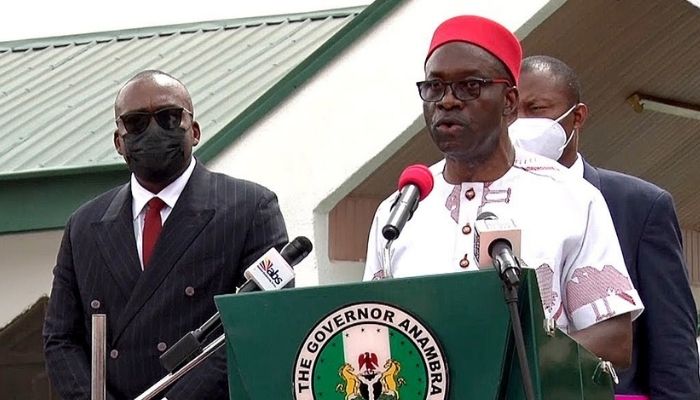
Despite the needless distraction that characterised the inauguration ceremony of Professor Chukuwma Soludo as the new governor of Anambra State, expectations are still high that a new governance bench-mark is in the offing in the state in particular and Nigeria in general.
It would be recalled here that for 16 straight years, Anambra State has been governed by technocrats who moved from the boardroom to government house.
From the Peter Obi era to the Willie Obiano administration, it was clearly a deviation from the period when godfathers effectively dominated the power scene.
During the eras of Chinweoke Mbadinuju to the administration of Chris Ngige, the state knew no peace as the godfathers who presided over the state through proxies held Anambra hostage on various fronts: economically, educationally and socially.

He started off at the CBN with a regulatory joker many Nigerian bankers never expected. As banks were trying to get attuned to the Universal Banking Model then, he came out with his 13-point agenda, which included the thousand-fold increment in capital requirement.…
At a point, before the coming of Peter Obi, the education system completely collapsed to the extent that for one whole year, pupils stayed out of school.
The Mbadinuju days also saw the reign of a deadly vigilance group, Bakassi Boys; a group that dispensed death at whim to those it suspected went contrary to the rules it set.
In the period the immediate past administration lasted, it was also not peaceful as incidences of killings were everyday occurrence. Some unknown gunmen engaged the security agencies in gun duels at various points in time.
A number of prominent indigenes were mercilessly gunned down in a war in which the real cause is yet to be determined or known.
Even, Chukwuma Soludo, the new governor inaugurated last Thursday, March 17, 2022, also tasted the bitter pill of insecurity in the run-up to the gubernatorial election when he was brutally attacked by invading gunmen. He was lucky to escape with his life, but some of his security details were not as lucky.

Before his inauguration, part of the major causes of skirmishes in the state, particularly in places where people do their businesses, was the complaint about too many forms of taxes and local levies imposed on them by the army of revenue drivers, many of whom were self-appointed or formed by some powerful elements that live large on other people’s sweat.
There were other forms of racketeering that prevailed in the past administration in the award and execution of projects, which the new governor has since pointed out.
All eyes are therefore on Soludo to do the magic of ridding the state of the ills that had beclouded its glory, which would have enabled the people have a fresh breath of air.
In view of Soludo’s depositions in the media prior to his inauguration, a lot is expected of the former governor of the Central Bank of Nigeria (CBN). It is indeed expected that his administration will be a departure from the norm.
When he named a 80-member transition committee peopled by eggheads and chaired by Obiageli Ezekwesili, he gave an indication that he was recreating the state.
Borrowing from what IK Muo wrote last week: “First order change is about procedures, second order change is about policies. In 2000, Casey added the third order change, which is about values; rethinking of governance values.
“This is very difficult because it takes a relatively long time and is irreversible. It involves procedures and policies but it is all about culture change. It is very difficult because culture (the way we have always done things) is always at variance and in conflict with change (where we want to be; doing new things in new ways).”
According to Muo, “Soludo on the driver’s seat: A third order change, a big-bang, cometh!
There is nothing more difficult to carry out, nor more doubtful of success, nor more dangerous to handle than to initiate a new order of things, Muo quoted Nicholo Machiavelli, (1532) The Prince; A handbook of power, politics and statesmanship.
As Soludo has said at various fora, covertly and overtly, he is coming to change the status quo and set up a benchmark in governance, with the essence to change from the current state of doing things to the desired future state while minimising negative outcomes.
As an economist who has studied organisation processes, he knows that organisations manage the process of deliberate or imposed changes so as to achieve predetermined objectives, explore and exploit opportunities that occur along the way, and come out better (or at least not worse-off) than they were before.
Many analysts had in their expectations chorused that there is no doubt that Anambra State is in for the type of change probably never witnessed by any state government in Nigeria.
Soludo has already said so emphatically both in his statements and by his body language. He has used the term disruptive change repeatedly.
At the inaugural graduation of ‘School of Politics, Policy and Governance,’ founded by Oby Ezekwesili, on January 29, 22, he spoke on ‘The purpose and price of disruptive change,’ and explained how the post-oil economy required massive disruptive transformations and liberation from rentier politics. According to him, those who expect something for nothing, which he admitted, would be costly and dangerous.
No wonder he said those who have something to give should apply. For him, political appointments are not going to be for patronage, but for those who would add value to the system and to the state.
In his advertisement for expression of interest from problem solvers and partners, more than 20,000 have applied.
He also promised to terminate all revenue contracts, some of which were granted a few weeks ago and resolved to engage those who will perform, even if they are from other nations.
His emphasis on use of locally made products is believed to promote indigenisation of Made-in-Anambra products in particular and by extension industrialise the entire South-East region.
As a result of the belief in “patronising our own,” he has chosen Innoson as his official car and locally-made products – Akwaete clothes, shoes, palm-wine, et al, to show the way.
Opinions are however divided as to whether or not the governor would be able to walk the talk given Nigeria’s peculiar political environment.
Meanwhile, many believe he will be true to his dream because of what he did as governor of the Central Bank of Nigeria from July 6, 2004. In any case and in the light of his previous exposure, he is not enamoured by the trappings of office.
He started off at the CBN with a regulatory joker many Nigerian bankers never expected. As banks were trying to get attuned to the Universal Banking Model then, he came out with his 13-point agenda, which included the thousand-fold increment in capital requirement (from N1bn, which some banks were yet to meet, to N25bn, with full compliance before December 31, 2005), which resulted in consolidation and the reduction in the number of banks from 89 to 25.
Today, the Nigerian banking sector is better for it. If he could do it then, he can still do it again, many believe.
Read also: Obi, Umeh say Soludo ‘ll boost Anambra development
Although Soludo has also openly admitted that what he is about to start is dangerous, especially the cultural shift in mindset among his people – the open display of wealth without clear sources.
However, as it is said, “When there is a will there is always a way.” Since there is the will to do right, we also believe there will be a way for him to implement his agenda, just as he did at the CBN.
We believe the time has come for Onitsha Main Market to regain its lost glory as the biggest commodities market in the whole of South-South and South-East. Awka and Nnewi as the industrial hubs for machinery and fabrications, must move from their current status to that which would make every indigene of the state scream, Eureka!
We wish Anambra State well. We welcome His Excellency, Professor Chukwuma Soludo to the saddle of positive governance he has eloquently exposed. For if Soludo should succeed in his pioneering ventures, who knows, the contagious consequences might be such that the entire Nigeria may be able to tap positively into this novel and positive mental shift.