



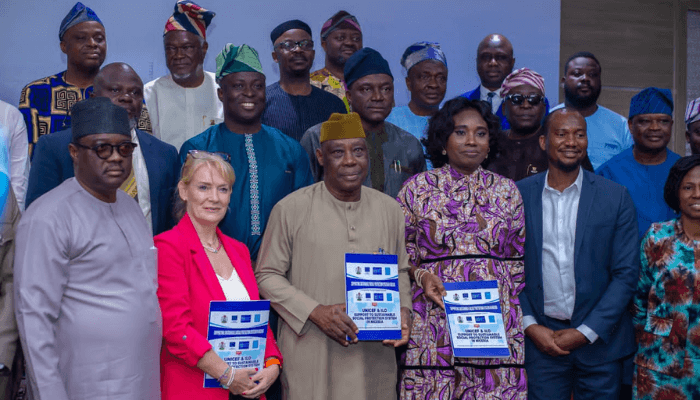
The United Nations Children’s Fund (UNICEF) has stressed that social protection must be treated as a lifeline rather than a luxury, as it launched the Supporting Sustainable Social Protection Systems in Nigeria (SUSI) project in Oyo state.
Celine Lafoucriere, UNICEF chief of Lagos field office, at the event in Ibadan, said social protection is about dignity for families and communities.
Lafoucriere, who represented the UNICEF Nigeria country representative, Saeed Wafaa, at the event, averred that, “When we talk about social protection, we are talking about dignity. We are talking about that mother in a rural community who can send her child to school instead of the farm; families that can access healthcare without choosing between medicine and food; and communities that can weather the storms of economic shocks because they have systems that catch them when they fall.”
She commended the Oyo state government for steps taken through its Social Protection Policy, creation of a Social Protection Coordination Department, the draft Bill awaiting legislative action, and programmes such as free basic education, home-grown feeding, and the Oyo State Health Insurance Scheme.

According to her, these represent hope for children and vulnerable populations in the state.
However, Lafoucriere noted that challenges still exist, with 48.7 percent of the state’s population and 72.7 percent of children between 0–17 years remaining multidimensionally poor, while only 11 percent are captured in the social registry. She added that just two percent of the population currently receives any form of social assistance, stressing that the urgency for improved investment is now.
Read also: Govt must prioritise adequate schools’ funding in conflict zones – UNICEF
She explained that the SUSI project, jointly implemented by UNICEF and the International Labour Organization (ILO) with funding from the European Union (EU), will support governments in expanding social protection coverage and strengthen Oyo state’s shock-responsiveness capabilities.
Muhammad Okorie, programme and social policy manager for UNICEF, said UNICEF had worked with government agencies to identify poor and vulnerable households, making them traceable and captured in the social register.

“We need to increase the number of households on the state social register. By the end of 2026, we expect that an additional 250,000 households would have been included,” Okorie said.
He added that the register would be interoperable, allowing ministries, departments, agencies, and partners to access it to reach those who need services.
Launching the project, Adebayo Lawal, the acting governor of Oyo state, said the initiative would provide a modernised social protection management information system interoperable across relevant agencies.
Lawal added that collaboration with UNICEF, the EU, and ILO would help reduce poverty in the state. “With the continued support of the European Union and other development partners, we are confident that we will achieve greater progress in deepening social inclusion and building human resilience,” he said.
Lawal called on stakeholders, civil society organisations, the private sector, and citizens to unite in advancing the initiative’s objectives.





