
Terrorism dominates the news: abductions, deaths, and kidnappings
From Kebbi to Kwara State and other areas in between, terrorism remains the leading headline news. It began with the abduction of female students in Kebbi State, quickly followed by reports of the interception and execution of a brigade commander and an attack on a church in Kwara State.
The abduction of 25 schoolgirls from a secondary school in Kebbi State has caused immediate and systemic consequences, including a frantic search operation and renewed scrutiny of Nigeria’s ongoing security crisis.
The highlights include

1. Security and rescue efforts. The Federal Government deployed combined teams of soldiers, police, and local vigilantes and hunters. The Chief of Army Staff reportedly ordered “day and night pursuit” of the criminals, asserting that “success is not optional”.
2. Human Impact. Two staff members were killed during the attack. Two abducted girls managed to escape; 24 remain captive. Families are in agony, with one father telling the BBC, “It’s hard to go back home”.
3. Official response. The Kebbi State Governor visited the school and assured efforts to rescue the girls. President Tinubu pledged to “act swiftly,” labelling the attackers “heartless terrorists”.
4. Systemic issues: Residents reported “suspicious movements” to security forces days before the attack, but no action was taken. Analysts attribute the failure to prosecute attackers and corruption as the root causes of insecurity.
5. A Recurring National Crisis: This abduction is part of a devastating pattern. Since the 2014 Chibok girls’ abduction, over 1,500 students have been kidnapped from schools in northern Nigeria. Armed groups have learned that targeting schools is an effective way to gain leverage and national attention.

• Threat to Education: These repeated attacks erode confidence in the education system. As stated by Plan International, they “traumatise families and weaken the confidence of parents in both the education system and the ability of government to protect their children”. This creates a long-term crisis where children, especially girls, are denied their right to education in a safe environment.
Read also: US weighing sanctions, expanded Pentagon role to pressure Nigeria on protecting Christians
2. Press Release: Congressman Moore Meets With Delegation of Senior Nigerian Officials Regarding the Persecution of Christians and Terrorism Threat in Nigeria
Washington, D.C. – Today, Congressman Riley M. Moore met with a delegation of senior members of the Nigerian government, led by Mr. Nuhu Ribadu, National Security Adviser to the President of Nigeria, during the delegation’s visit to Washington, D.C. The meeting allowed for a frank, honest, and productive discussion about the ongoing persecution of Christians and ongoing terrorist threats in Nigeria and opportunities for strengthened cooperation and coordination between the United States and Nigeria to end the bloodshed.
During the meeting, Nigerian officials shared their government’s challenges and concerns regarding counterterrorism, security assistance, protection of vulnerable communities, and ongoing issues involving violence across Nigeria.
Congressman Moore clearly stated that the United States stands ready to coordinate and cooperate with Nigeria, and that, as President Trump made abundantly clear, the United States will not tolerate continued violence against Christians or other forms of religious persecution. President Trump does not make idle threats. Congressman Moore will continue monitoring new developments and pushing the Nigerian government to accept the open hand of cooperation to stop the ongoing persecution and violence against Christians and combat the threat terrorist groups pose to the Nigerian population.
Congressman Moore issued the following statement:
“Today, I had a frank, honest, and productive discussion with senior members of the Nigerian government regarding the horrific violence and persecution Christians face and the ongoing threat terrorism poses across Nigeria. I made it crystal clear that the United States must see tangible steps to ensure that Christians are not subject to violence, persecution, displacement, and death simply for believing in our Lord and Saviour Jesus Christ.
We stand ready to work cooperatively with the Nigerians to help their nation combat the terrorism perpetrated by Boko Haram, ISWAP, and Fulani militants against their population, specifically Christians in the Northeast and Middle Belt regions of Nigeria. The Nigerian government has the chance to strengthen and deepen its relationship with the United States. President Trump and Congress are united and serious in our resolve to end the violence against Christians and disrupt and destroy terrorist groups within Nigeria. I urge the Nigerians to work with us in cooperation and coordination on this critical issue.”
The delegation included:
Mallam Nuhu Ribadu – NSA and Leader of the Delegation
Her Excellency, Bianca Ojukwu – Minister of State for Foreign Affairs
Mr. Kayode Egbetokun – Inspector General of Police
Chief Lateef Olasunkami Fagbemi, SAN – Attorney General of the Federation
General Olufemi Olatunbosun Oluyede – Chief of Defence Staff
Lt. Gen. EAP Undiendeye – Chief of Defence Intelligence Ms. Idayat Hassan – Special Adviser to ONSA
Ambassador Ibrahim Babani – Director of Foreign Relations, ONSA
Ambassador Nuru Biu – Acting CDA, Embassy of Nigeria
Paul Alabi – Political and Economic Section, Embassy of Nigeria
Read also: Terrorists demand N100 million each for Kwara church abductees, families say
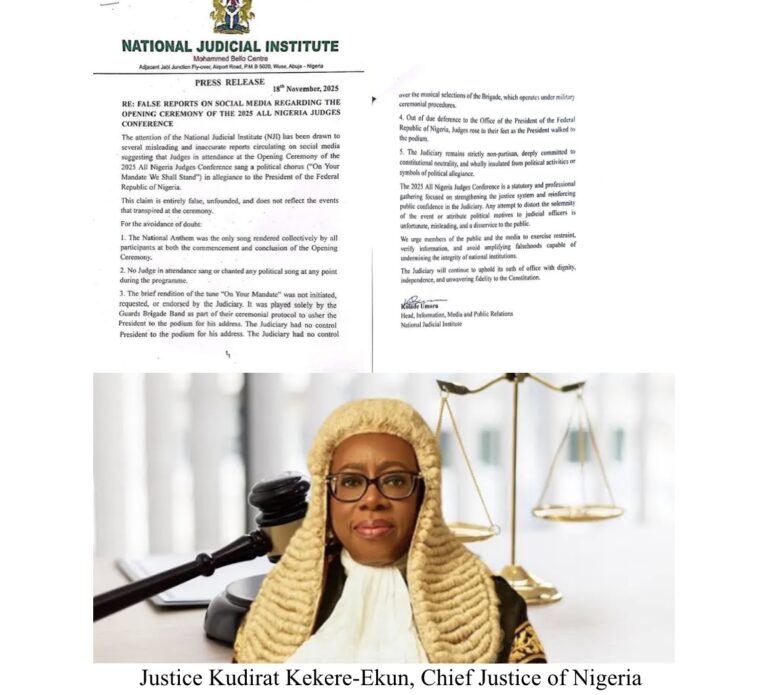
3. Citizens query the judiciary and the military for partisanship in playing Candidate Bola Tinubu’s campaign song at an official event.
The National Judicial Institute rose to defend the Chief Justice of Nigeria, Justice Kudirat Kekere-Ekun, and Nigeria’s top judges following an incident at the Judges’ Conference. As President Bola Tinubu stepped into the hall to open the conference, the military band played the campaign song, On Your Mandate We Shall Stand.
It has caused a storm. Prof Chidi Odinkalu, a former Chairman of the National Human Rights Commission, accused the CJN of corralling the judiciary into the ruling party.
In a statement, the National Judicial Institute denied the allegation. It claimed that
1. Judges stood in deference to the President.
2. The judges did not join in singing or swaying to the song
3. The Judiciary did not authorise or request “the brief rendition” of the song
4. The Brigade of Guards band played the song willingly as the hosts, the National Judicial Institute, had no control over the band.
On Facebook, a citizen queried. “The military should explain to NIGERIANS why the Guards Brigade Band played ‘On Your Mandate We Stand. What’s the standard band play to usher the president to the podium? The concerned military AUTHORITY should be cautioned not to turn the military into politics!”
The PDP Implosion: A Party at War With Itself
The Peoples Democratic Party (PDP), once the dominant force in Nigeria’s Fourth Republic, is now confronting one of the gravest internal crises in its history. Long-simmering rivalries, unresolved leadership tussles, and region-based grievances have converged into a full-blown implosion.
At the centre are competing power blocs—governors protecting their turf, former presidential aspirants nursing old wounds, and national officers struggling to retain relevance. The unresolved fallouts of the 2023 elections continue to haunt the party, deepening mistrust and weakening cohesion.
With defections thinning its ranks and internal organs paralysed by court cases and counter-suspensions, the PDP faces an existential moment: either reinvent itself through genuine reconciliation and structural reform or continue its drift toward political irrelevance.
When a Big Umbrella Finally Tears in the Rain
The PDP, that once-mighty umbrella built to shelter all political wanderers, now resembles a thrift-market parasol—ribs broken, fabric torn, everyone running to avoid the downpour.
The governors want their own version of the party. The presidential hopefuls want their own version of the truth. The national officers want their jobs back. Everybody wants something—except to take responsibility.
Meetings now end before they begin, reconciliations look like wrestling bouts, and every faction claims divine mandate from “the real PDP faithful.” Meanwhile, defectors are fleeing faster than Nigeria’s electricity grid can collapse.
Call it an implosion, call it self-sabotage, or call it the longest political soap opera in Nigerian history—one thing is clear: the umbrella is no longer protecting anyone. Not even itself.
There are two main factions. Oyo State Governor Seyi Makinde leads one, and hosted the Ibadan Convention, while FCT Minister Nyesom Wike leads the other.
The Makinde faction held a National Convention in Ibadan on November 15-16, which proceeded despite court orders to halt it and the absence of INEC officials.
At the Ibadan convention, the faction expelled Nyesom Wike, Ayo Fayose, and others for “anti-party activities”. The Wike-aligned faction subsequently announced the expulsion of Governors Seyi Makinde, Bala Mohammed, and other key members.
The expulsions are not universally supported within the party. Governors Ahmadu Fintiri (Adamawa) and Caleb Mutfwang (Plateau) publicly dissociated themselves from the decision to expel Wike.
Different courts issued conflicting rulings on the convention, with one Federal High Court suspending it and an Oyo State High Court allowing it to proceed, creating legal confusion.