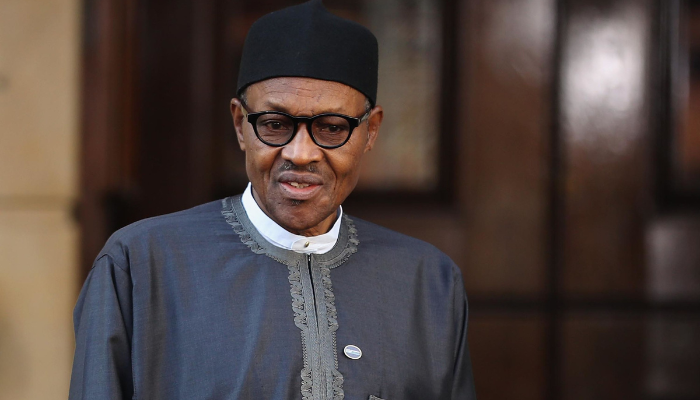
Buhari’s death divides Nigerians.
The death of former Nigerian President Muhammadu Buhari on 13 July 2025 has provoked a deeply divided and emotionally charged response across Nigeria, reflecting his complex legacy.
1. Celebrities and Entertainers: Mixed Tributes and Criticism
Respectful Tributes:

Singer Eedris Abdulkareem framed Buhari’s legacy as “consequences of your deeds” while offering traditional Islamic condolences (Innalilahi wa innalilahi rajuhun).
Big Brother Naija star Tacha acknowledged his historical role: “No matter your views, Muhammadu Buhari was a major part of Nigeria’s story”.
Fuji musician KWAM 1 shared a video eulogy praising Buhari and wishing him to “sleep well”.
Blunt Criticism:
Activist Charly Boy condemned Buhari: “May Karma be his portion” for “frustrating Nigerians”.

Social media influencer Daniel Regha stated: “Buhari’s govts made life difficult for Nigerians; we suffered”.
Sunday Igboho, a Yoruba agitator, referenced a 2021 raid: “The man that sent DSS to kill me… has died”.
2. Political Figures: Commendations and Nuanced Reflections
Governors’ Praise:
Niger State Gov. Mohammed Bago hailed Buhari as an “icon of integrity,” citing infrastructure projects (rail/roads) and anti-corruption efforts.
Nasarawa Gov. Abdullahi Sule called him a “beacon of integrity,” while Adamawa Gov. Ahmadu Fintiri noted his “commitment to national unity. “
Katsina State (Buhari’s home) declared a work-free day for mourning.
The Federal Government instructed a week of mourning and a public holiday on Tuesday, 15 July, his burial date.
Critics criticised the idea of government unilaterally announcing a public holiday (see below).
Vice President Kassim Shettima led a delegation on a condolence visit to Buhari’s family at their London residence.
Opposition Voices:
Activist Omoyele Sowore denounced Buhari as a “tyrant” responsible for “massacres” of Shiites and #EndSARS protesters.
Former presidential aide Gimba Kakanda urged empathy but acknowledged Buhari’s divisive policies.
? 3. Public and Online Reactions: Vitriol vs. Compassion
Social Media Polarization:
Hashtags like #RIPBuhari were countered by tweets like “Gone too late”. Regional grievances flared, with users accusing Buhari of “genocide” in the Southeast and Middle Belt.
Some invoked detained separatist Nnamdi Kanu: “Kanu was right” about marginalization.
Calls for Restraint:
Scholar Farooq Kperogi opposed celebrating death: “We diminish ourselves when we rejoice in another’s demise”.
Cleric Abubakar Sadiq Doka emphasized Islamic teachings against maligning the dead.
4. International Community: Solemn Tributes
The African Union and ECOWAS praised Buhari as a “Pan-Africanist” and “steadfast supporter of multilateral cooperation”.
The U.S. noted his “commitment to restore integrity,” while China highlighted his role in bilateral relations.
5. Legacy Debates: Austerity vs. Hardship
Positive Legacies: Supporters cited his frugal lifestyle, infrastructure projects, and anti-corruption stance.
Criticisms: Detractors highlighted economic decline, security failures (Boko Haram, farmer-herder clashes), and human rights abuses.
Stab at integrity claims: US-based social influencer reproduced portions of Wole Soyinka’s book, You Must Set Forth at Dawn that repeated the allegation of billions that allegedly disappeared into Buhari’s Midland Bank account in the UK
Many critics pointed out the irony of the President spending eight years in office but failing to build a world-class hospital for his treatment. Nigerians noted that another former Head of State, General Abdulsalami Abubakar, was also treated at the same hospital. Citizens across various platforms affirmed that it was shameful.
Buhari’s death has exposed Nigeria’s deep fractures. While some remember him as a humble patriot, others view his administration as a period of institutional decay. As expressed by @Adejubesm: “No matter the office you occupy… all that remains is your legacy”. This polarisation underscores the unresolved tensions defining his eight-year rule.
Still on Jibril from Sudan
By Mayor Ikoroha on Facebook
It’s unfortunate that in this day and age, with widespread enlightenment. and numerous sources of information, the “Jibril from Sudan” narrative remains a topic of debate.
I visited the Facebook page of a Catholic priest, Fada Angelo Chidi Unegbu, based in Germany, who is a “Jibril from Sudan” warrior.
I was dismayed not only by the conspiracy theories he shared with his 50,000+ followers but also by the many supportive comments indicating that they genuinely believe, along with him, that former President Buhari died in 2017 and was replaced by a certain Jibrin El-Sudani.
The “Jibril” narrative was arguably a metaphor for alienation, with some Nigerians feeling disconnected from a president whose policies and limited public engagement fuelled discontent, particularly among the Igbo.
This perspective was plausible during Buhari’s presidency.
However, the persistence of this narrative long after Buhari’s tenure ended is troubling and extends beyond speculation about his death.
The theory is inane, as it ignores the logistical impossibility of orchestrating such a deception in a highly scrutinised political environment.
Its persistence reflects deeper societal issues, such as distrust in governance and the power of social media to amplify misinformation.
This unfounded narrative manipulates public doubt and prospers without scrutiny.
It also highlights a deeper problem: how easily people can be manipulated, the dangers of unchecked misinformation, the risks of unrestrained hero worship, and the difficulty of opening the eyes of those who refuse to see.
Ultimately, the “Jibril from Sudan” theory demonstrates that a potent combination of hero worship and manipulative misinformation poses a grave danger to society.

Nigeria’s Comprehensive Tax Reform: An Analysis of the Four New Tax Laws (2025)
Nigeria’s President Bola Tinubu signed four landmark tax bills into law on 26 June 2025, marking the most significant overhaul of the country’s tax system in decades. These reforms aim to simplify taxation, increase revenue, promote fairness, and foster economic growth. Here is a structured analysis.
⚖️ I. Legislative Framework and Objectives
Nigeria Tax Act (NTA)
Consolidates fragmented tax laws (CIT, PIT, VAT, CGT) into a single harmonised code 1614.
Eliminates >50 overlapping taxes to reduce compliance burdens 214.
Core philosophy: “One Nation, One Tax Standard” to combat multiple taxation.
Nigeria Tax Administration Act (NTAA)
Standardises tax procedures across federal, state, and local governments.
Mandates digital compliance via the Electronic Fiscal System (EFS) for transparency.
Nigeria Revenue Service Act (NRSA)
Replaces the Federal Inland Revenue Service (FIRS) with the Nigeria Revenue Service (NRS), an autonomous agency.
Empowers NRS to collect federal taxes and assist state/local governments (fee-based)..
Joint Revenue Board Act (JRBA)
Establishes the Joint Revenue Board to harmonise federal-state tax policies.
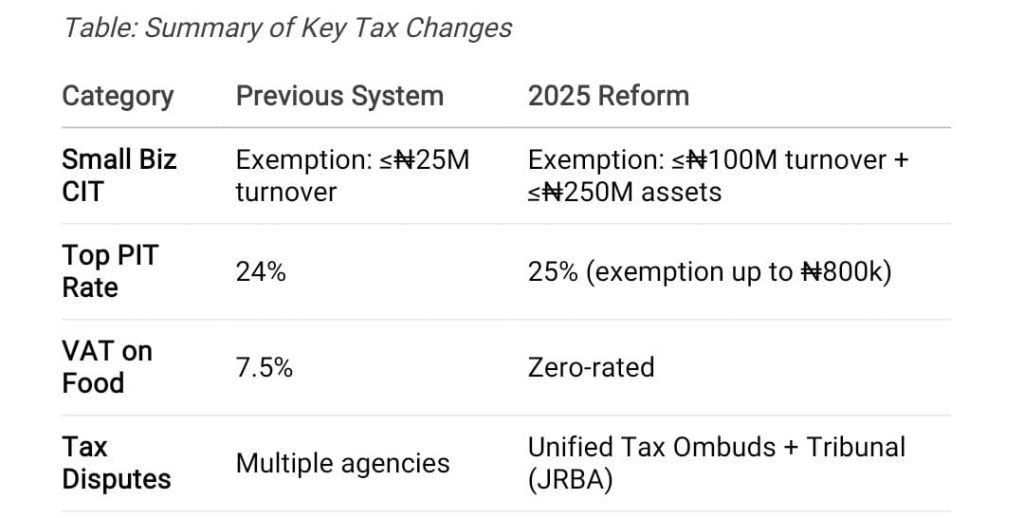
Creates a Tax Ombudsman and Tax Appeal Tribunal for dispute resolution.
? II. Key Reforms and Policy Shifts
A. Direct Tax Changes
Small Business Relief:
Companies with annual turnover ≤₦100M and assets ≤₦250M are exempt from CIT, CGT, and Development Levy.
Professional service firms are excluded regardless of size.
Personal Income Tax:
Exemption threshold raised to ₦800,000/year (from ₦300,000).
Rent relief of ₦200,000 for earners ≤₦1M/year, reducing taxable income.
Corporate Taxes:
CIT rate reduced from 30% to 27.5% (2025) and 25% (2026)
4% Development Levy on assessable profits, consolidating TET, IT, NASENI, and PTF levies
B. Indirect Tax Reforms
VAT Restructuring:
7.5% rate retained, but zero-rated on essentials: food, healthcare, education, rent, power
Input VAT recovery allowed on services. /fixed assets, aligning with global principle
Revised VAT sharing: Federal (10%), States (55%), Local Governments (35%), with state allocation based on equality (50%), population (20%), consumption (30%) 69.
Capital Gains Tax:
The rate increased from 10% to 30% for companies.
Exemption threshold for share sales raised to ₦150M/12 months 1.
C. Novel Provisions
Digital Asset Taxation: Profits from cryptocurrency and virtual assets are now taxable.
Minimum Effective Tax Rate: 15% for multinationals with group turnover ≥€750M or Nigerian turnover ≥₦50B 1.
Economic Development Incentive: Replaces pioneer status; provides a 5% annual tax credit on capital expenditure for 5 years 1.
⚙️ III. Administrative and Compliance Innovations
Digital Transformation:
E-invoicing mandatory for all businesses 16.
Banks/financial institutions must report transactions >₦25M (individuals) or >₦100M (corporates) monthly 69.
Taxpayer Identification:
Mandatory TIN registration for all entities, including non-residents earning Nigerian income 69.
Virtual Asset Compliance:
Virtual Asset Service Providers (VASPs) face penalties up to ₦10M/month for non-compliance 69.
? IV. Stakeholder Impacts
Low-Income Households:
Full PIT exemption for 90% of informal workers 15, plus lower prices on VAT-zero-rated essentials 25.
Small Businesses:
Tax exemptions and simplified returns without audited accounts 214.
Large Businesses:
Lower CIT rates but stricter compliance (e.g., e-invoicing, ETR rules) 18.
Investors:
CGT on indirect share transfers closes offshore loopholes 1.
⚠️ V. Implementation Challenges and Public Response
Key Hurdles:
State resistance to centralized administration (e.g., NRS/JRB oversight) 14.
Digital infrastructure gaps in rural areas 615.
Enforcement consistency: Small businesses fear “replacement levies” despite exemptions 5.
Public Sentiment:
90% support reforms, according to government surveys, but scepticism persists regarding their execution.
Economists warn against “revenue target-driven harassment” by tax officials 5.
? VI. Conclusion: Pathway to Prosperity?
Nigeria’s tax reforms target a tax-to-GDP increase from 10% to 18% by 2026 215 through broader bases (digital assets, luxury VAT) and efficiency gains (digitalization, reduced duplication). Success hinges on:
Transparent NRS/JRB operations to build trust.
Adequate digital infrastructure for nationwide compliance.
Sustained political will to resist subnational fragmentation 1415.
If implemented effectively, these laws could transform Nigeria into a more competitive investment destination while funding critical public services—truly “taxing the fruits, not the seed” 15. Businesses should begin impact assessments now ahead of the January 1, 2026, effective date. For sector-specific guidance, refer to PwC’s analysis