



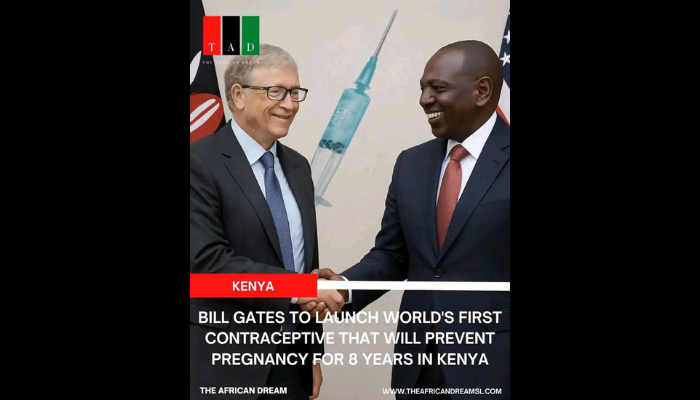
Bill Gates and Africa via birth control
Bill Gates is set to launch the world’s first contraceptive that will prevent pregnancy for 8 years in Kenya and Nigeria.
This makes me ponder the question: why is Africa always used as a testing ground for Western-led medical inventions?
Bill Gates is ready to splash $2.5 billion just to depopulate Kenya and Africa, a motive which he has always made open to the public. This man wants to depopulate Africa, and he is ready to do so even if it costs him his entire fortune (he even said a large part of his fortune will be “given to Africa”). That says a lot about his so-called “humanitarian” mission.

Africa is being used as a testing ground for new drugs, viruses, and medical trials. It’s always Africa first as their testing ground, but never Africa first when it’s to end poverty, terrorism, neocolonialism, imperialism, or roll out vaccines in times of plagues and pandemics. You see the plots?
Why is this not being launched first in China, America or Europe? Why do we always have to be the guinea pigs for their medical trials?
In recent years, this same Bill Gates has poured significant amount of his wealth into genetically modified (GMO) crop projects across Africa, often marketed as solutions to hunger and climate change. In reality, this actually risks placing Africa’s food chain under one man’s control, undermining indigenous farming methods, and creating dependency on patented seeds.
Bill Gates made his fortune building Microsoft, the world’s dominant software company. He is not a medical doctor, biologist, or agricultural scientist, yet his foundation exerts enormous influence over policy and research priorities in Africa.
He has moved from being the tech guy who sold us Windows software to becoming the man who wants to control what Africans plant, eat, and even how they reproduce.

Launching an 8-year contraceptive in Kenya without first implementing it in China, which has close to the number of people in Africa, shows that Gates doesn’t care about Africa.
2. Governor Bala Mohammed brings a Chinese Economic Adviser.

The streets of Bauchi are buzzing over Governor Bala Mohammed’s appointment of a Chinese as his Special Adviser on Economic Matters.
Bala Mohammed named Li Zhensheng during the week. Is it a new paradigm or an excursion into infamy?
Governor Mohammed’s appointment of Li Zhensheng underscores a high-stakes strategy to fast-track Bauchi’s development through global expertise. While it offers opportunities for investment and knowledge transfer, its success hinges on the transparent integration of foreign advice with local needs. The controversy also signals a deeper challenge: Nigeria must bridge the gap between its academic capacity and policymaking execution to harness domestic talent in future reforms
Role and Title:
Li Zhensheng was appointed as Economic Adviser to the Bauchi State Government, with a focus on leveraging international expertise for economic transformation.
Context of Announcement:
The appointment was announced on 15 August 2025, during the signing of a partnership agreement between Bauchi State and the China Global Poverty Reduction Centre (CGPCRC)—an economic research institute led by Li. The agreement was referred to as a “Memorandum of Understanding” (MoU) in some sources.
Strategic Objectives:
Attract foreign investments and stimulate commercial activities.
Enhance sectors such as agriculture, education, healthcare, manufacturing, mining, and trade.
Align with Governor Mohammed’s agenda for job creation, industrial growth, and international cooperation.
Li Zhensheng’s Commitment:
The appointee pledged to utilise his experience and CGPCRC’s resources to foster economic growth in Bauchi State.
Public Reaction and Controversy
Criticism of Foreign Appointment:
Some Nigerians questioned why a non-Nigerian was chosen over local experts. Comments highlighted concerns that Li might prioritise China’s interests and lamented the underutilization of Nigerian graduates and research.
“In the whole state, you didn’t see a competent person. Why not make him a consultant?”.
Defence of Expertise Transfer:
The government positioned the move as strategic for accessing global knowledge and accelerating development through Chinese economic models.
Broader Implications
Subnational Diplomacy:
Reflects a trend of Nigerian states forging direct international partnerships to bypass federal bottlenecks, with China as a key partner due to its poverty-reduction successes.
Economic Experimentation:
Bauchi aims to replicate aspects of China’s export-oriented industrialisation and FDI-driven growth, potentially serving as a model for other states.
Talent vs. Trust Dilemma:
Highlights the tension between the need for specialised expertise and public demand for local empowerment in governance.
Broad overview of benefits and risks.
Benefits of the appointment
Access to the Chinese economic expertise
Potential for increased foreign investment.
Sectoral growth in key industries.
International partnership opportunities.
Controversies and risks
Perceived marginalisation of local talent.
Concerns about foreign influence.
Public scepticism about true motivations.
Implementation challenges in the local context.
Is the Bauchi deal a new route to asset loss to China?
A painful recent history of asset losses and seizures to China by African nations lies behind the concerns about the China deal. Though the Bauchi case presents as a straightforward appointment, citizens are wary.
Yet Nigerians seek and get advisory or executive appointments in other countries. There is no mention of loans in the appointment.
The narrative that African countries have “lost assets” to China through Memoranda of Understanding (MOUs) highlights complex debt dynamics and strategic leverage, although documented asset seizures are uncommon. Here’s an analysis of key mechanisms and cases.
1. Debt Diplomacy and Strategic Leverage
Resource-Backed Loans: China often extends loans collateralised by natural resources (e.g., oil, minerals). Angola, for instance, used future oil production as collateral for $42 billion in post-civil war reconstruction loans. If repayment falters, resource concessions may transfer control to Chinese entities.
Port Access: In Djibouti, $1.4 billion in Chinese loans (75% of its external debt) financed the Doraleh Multipurpose Port and Addis Ababa-Djibouti Railway. Following debt difficulties, China secured a 50-year lease for its first overseas military base adjacent to the port, raising sovereignty concerns.
2. The “Debt Trap” Controversy
Sri Lanka Precedent: Although not African, Sri Lanka’s Hambantota Port lease (2017) influences perceptions. Similar concerns emerged in Africa, although evidence of direct seizures remains limited. Zambia’s 2020 default on $6.6 billion Chinese loans prompted fears of copper mine takeovers, but restructuring avoided asset transfers.
World Bank Warnings: 40% of low-income African nations face debt distress, with Chinese loans comprising 17–25% of external debt in high-risk states (e.g., Congo, Zambia). Loan terms often include waivers of sovereign immunity, enabling asset claims in arbitration courts.
3. BRI-Linked MOUs as Gateways
Infrastructure-for-Resources: MOUs under the Belt and Road Initiative (BRI) enable binding agreements. In Guinea, bauxite mining MOUs resulted in Chinese control over mining infrastructure, with 70% of exports (2023) sent to China.
Connectivity Projects: Railways such as Kenya’s SGR ($4.7 billion, 90% Chinese-funded) connect ports to resource-rich inland areas. Default risks could lead to operational takeovers, although none have happened so far.
4. African Agency and Negotiation Flaws
Asymmetric Bargaining: African governments sign MOUs seeking quick infrastructure but lack the technical capacity to audit the terms. In Congo, a $6.2 billion minerals-for-infrastructure deal (2008) was renegotiated down to $2 billion after outcry over undervalued resources.
Elite Capture: BRI projects in Sudan and Angola involved kickbacks to local officials, enabling unfavourable terms that prioritise Chinese interests over public benefit..
5. Geopolitical Competition
U.S.-China rivalry intensifies asset risks. The DRC’s cobalt reserves (70% global supply) are contested; a 2025 U.S.-brokered peace deal included “mineral rights for the United States,” mirroring Chinese resource tactics.


Why Asset Seizures Are Rare:
Political Costs: China avoids overt seizures to preserve its “South-South partner” image. Debt renegotiations (e.g., Zambia 2024) or extended leases are preferred511.
African Pushback: Ethiopia renegotiated BRI railway terms in 2021; Tanzania cancelled Bagamoyo Port MOU (2020) over sovereignty clauses11.
Conclusion:
Although direct asset losses are exaggerated, strategic control through debt leverage remains definitive. MOUs facilitate Chinese dominance in ports (e.g., Djibouti) and mines (e.g., Guinea), thereby tying African economies to a reliance on resource exports. Transparency is essential for mitigation.





