
Military backs Yerima amid Wike dispute
The Nigerian military leadership has expressed strong support for Lieutenant A.M. Yerima following his confrontation with FCT Minister Nyesom Wike. Key figures, including the Minister of Defence, have commended the officer’s conduct and assured protection for personnel on lawful duties.
Mohammed Badaru (Minister of Defence) supports Lt. Yerima, stating any officer on lawful duty will be “highly protected” and that “he has done well”.
Bello Matawalle (Minister of State for Defence): Called the officer’s action “lawful” and worthy of “commendation,” emphasising he was obedient and respectful.
Tukur Buratai (Former Army Chief) condemned Wike’s action as a “threat to national security” and demanded a public apology to the military and the officer.

Coalition of Nigerian Military Veterans: Condemned Wike’s outburst, warning against any punishment for the officer and stating that disrespect to a soldier is disrespect to the Commander-in-Chief.
Nigerian Social Media & Public: Widely praised Lt. Yerima for his courage, composure, and professionalism in standing up to an influential figure.
Read also: Wike’s outburst and the crisis of character in leadership
Ongoing Investigation and Other Viewpoints
Although military support is strong, the incident is under investigation, and other perspectives should also be considered.

• The Context of the Dispute: The confrontation took place at a contested construction site in Abuja’s Gaduwa district, reportedly linked to a former Chief of Naval Staff, Vice Admiral Awwal Zubairu Gambo (retd.). Lt. Yerima and his team were there under orders to secure the site. The Federal Capital Territory Administration (FCTA), led by Wike, was attempting to enforce a demolition order on the property, which they claimed lacked proper permits or had been acquired illegally.
• Criticism of Lt. Yerima’s Actions: Some legal experts, like Prof. Sebastine Hon (SAN), argue that the officer’s presence at a private construction site was unlawful and an obstruction of the minister’s constitutional authority. They maintain that “obedience to orders does not extend to those that are palpably illegal.” Wike’s aide also questioned the legality of deploying military personnel in a dispute over private land.
• Wike’s Defence and Alternative View: Minister Wike has defended his actions, stating that he could not ignore public officials being prevented from doing their lawful duty. He also claimed that other prominent figures, such as former President Olusegun Obasanjo and ex-Army Chief T.Y. Danjuma, had resolved similar land issues through dialogue, not by deploying soldiers.
• Inspector General of Police Kayode Egbetokun warned the police against involvement in land cases unless there is a court order.
Minister of State For Defence Speaks On Officer/ Wike Imbroglio
“The incident involving Minister Wike and the officer is regrettable. When he arrived, the officer explained that he was acting on orders given to him. Wike should not have exchanged words with the officer; he ought to have raised his concerns through the officer’s superiors.
“He (Wike) is our colleague, and Wike could have reached out to us to resolve whatever issue. The officer’s action was lawful—he was trained to be disciplined, loyal, and obedient to orders.
Therefore, the young officer only carried out his duty worthy of commendation.”
“He did not commit any offence under military regulations; he merely obeyed a lawful order and followed due process. If you observe, he spoke respectfully and conducted himself properly,”
“There is, therefore, no offence under military law for which he should be charged. Wike should not have engaged him in an altercation, especially given the respect due to the uniform he was wearing.
“Anyone who disrespects a soldier indirectly disrespects the President, who is the Commander-in-Chief of the Armed Forces. There is, therefore, no basis for any punishment against the officer,”
“This is not about supporting the military to act disrespectfully toward civilians. The Minister should understand that every officer has superiors. I gathered that he called the Chief of Defence Staff, who advised him to wait for an investigation.”
“However, he did not wait and instead went straight to the site. As a leader, he ought to have exercised patience and waited for the outcome of the investigation,”.
“Wike also contacted the Chief of Naval Staff, who assured him that an investigation would be conducted. Yet again, he did not wait. It was supposed to be a one-day inquiry, but he chose to go there and confront them.”
“Now that the Chief of Naval Staff has visited the area—since it involves a land dispute—the matter will be investigated to know who owns the lawful documents,”
“If the land has been revoked, there are established procedures to be followed diplomatically.”
“We have not received any formal complaint from Wike, but I called him after the video went viral and advised that he should have spoken with me before going there, rather than confronting the officers directly.”
Bello Matawalle, Minister of State For Defence
Read also: Meet Yerima, Navy officer who clashed with Wike
Point-Counterpoint on the land law issues

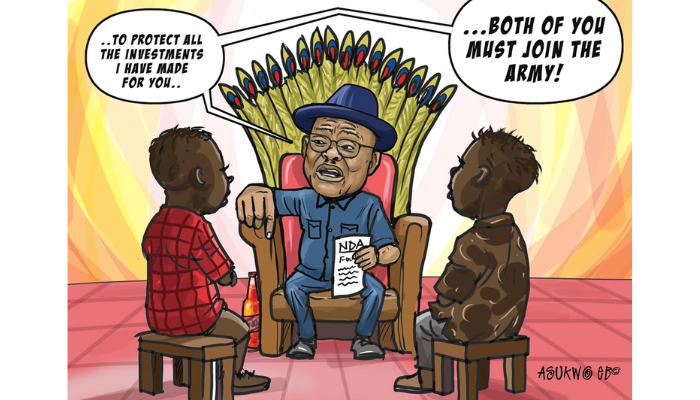
OFFICER YERIMA BREACHED THE LAW IN THAT FACE-OFF WITH NYESOM WIKE
Prof. Sebastine Hon, SAN, (Constitutional Lawyer and Author)
Setting sentiments aside, I hereby condemn entirely the actions of the Naval Officer, A.M. Yerima, who obstructed the FCT Minister from gaining access to that parcel of land, under the pretext of ‘obeying superior orders.’ The duty of a junior officer to obey the orders of his superiors, although strongly upheld in military and paramilitary circles, has its own limits recognised by no other authority but the Supreme Court of Nigeria. I shall establish this shortly.
In the recent case of Onunze v. State (2023) 8 NWLR (Pt. 1885) 61 at 108 SC, the Supreme Court explicitly held, per Ogunwunmiju, JSC, thus:
My Lords, the duty to obey a superior’s orders does not extend to commands that are clearly illegal or obviously unjust. Every military or police officer takes an oath upon commissioning. The oath is not to obey all orders blindly, but to “preserve”, “protect” and defend the Constitution of the Federal Republic of Nigeria against all enemies, foreign and domestic. When an officer follows palpably illegal orders, they become personally responsible for their actions and may face a court martial or other official disciplinary measures for their misconduct.
In the earlier decision of Nigeria Air Force v. James (2002) 18 NWLR (Pt. 798) 295 at 324 SC, Onu, JSC, delivering the lead judgment of the Supreme Court, firmly held that military personnel are subordinate to civilian authority and criticised obedience to unlawful orders, as follows:
Refer to the case of Pius Nwaogu v. The State (1972) 1 All NLR 149, where it was held, inter alia, that “a soldier is responsible to Military and Civil Law and it is monstrous to suppose that a soldier could be protected when the order is grossly and manifestly illegal. Of course, there is the other proposition that a soldier is only bound to obey lawful orders and is responsible if he obeys an order not strictly lawful. ”
The illegality in that order stems primarily from the fact that no service law of the military permits a serving military officer to mount guard at the private construction site of his boss, especially under suspicious circumstances like this. The retired Naval Officer ought, under the circumstances, to have engaged the civil police if he suspected the likelihood of arson or criminal trespass.
Additionally, Barr. Nyesom Wike is the equivalent of a state governor – he is the Minister of the Federal Capital Territory, Abuja. More importantly, all lands in the FCT Abuja, as per Section 297(2) of the 1999 Constitution of Nigeria, as amended, belong to the Federal Republic of Nigeria. By Section 302 of the same Constitution, read in conjunction with other existing Acts of the National Assembly, the President of Nigeria has delegated all powers with respect to land administration in the FCT Abuja to the Honourable Minister. Going by constitutional and administrative law, therefore, Mr Wike stood in loco of the President of Nigeria and Commander-in-Chief of the Nigerian Armed Forces on that fateful day. Consequently, even if the superior officer were still in service, he would not disobey Mr Wike or obstruct him from entering the land. This was an affront to the civil authority of the President.
The Minister’s approach may be seen as brash, but it is legal and lawful in all respects. Rather, it is the officer who obstructed him who has breached not only the Nigerian Constitution but also service and current regulatory laws. For the avoidance of doubt, section 114 of the Armed Forces Act makes military personnel criminally liable for civil offences. This means the officer in question could be brought before a court-martial for obstructing a public officer from performing their official duties, and so forth.
In conclusion, celebrating the humiliation of Nyesom Wike simply because he is a ‘big man’ or because certain persons dislike him overlooks the real issue at hand. Suppose such intolerable conduct by the young officer is not punished or is celebrated. In that case, this may unleash a reign of terror by the men in khaki against hapless civilians, with a grin or boast that ‘we did it to Wike and nothing happened.’
This is not the Nigeria of our dreams! I rest my case here.
Wike was on the wrong side of everything: law, common sense, decorum, & ministerial propriety.
Prof Chidi Odinkalu, former Chairman, Nigerian Human Rights Commission.
For the record, let me be clear:
Nyesom Wike is a Minister of the Federal Republic & an appointee of the President. He is neither a police officer nor a bailiff.
Many people who claim to be lawyers approach this matter with little regard for the law.
Wike was plainly on the wrong side of everything: law, common sense, decorum, & ministerial propriety.
The only thing he had on his side was alcohol.
Wike had no right to be where he was. There is no ministerial right or power to enter land in adverse possession without a court order.
Ideological purists like me may quarrel with it, but a lot of people forget that s. Section 33(2)(a) of the Nigerian constitution grants a right to kill lawfully in defence of property rights & effective possession is an intangible property right.
Wike was a trespasser who used force to enter land in adverse possession without a lawful Court order or warrant. He was on a mission of Ministerial Vigilantism.
He was lucky to come out without injury or worse.
An officer of less discipline or someone who drinks Johnnie Walker for breakfast – like Wike – may have been less careful with a projectile. The Shiites in Zaria did a lot less, and see what happened to them.
I don’t know the amount of trouble this puts Wike in. This affects the authority of the president as C-in-C. The officer corps will be watching closely to see how the C-in-C handles this.
In case anyone wonders who wrote this, my name is *Chidi Anselm Odinkalu*.
This nonsense has to stop!