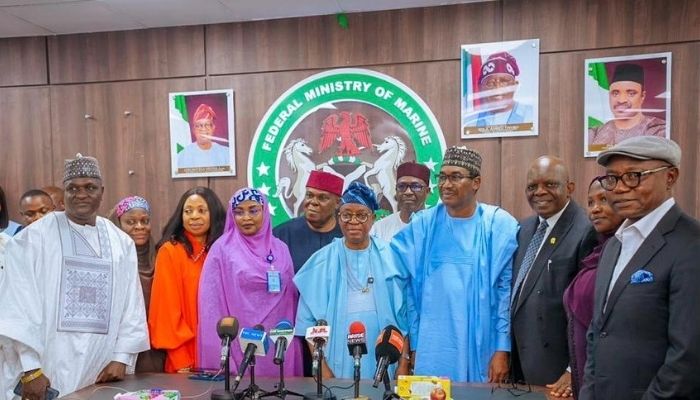
Mu’azu Jaji Sambo, the minister of transportation, has directed the Nigerian Shippers’ Council (NSC) to establish a Port Community System (PCS) before the end of the present administration.
Speaking when he visited the NSC headquarters recently in Lagos, Sambo said Nigeria needs a Port Community System that can compete favourably with its counterpart elsewhere.
The Minister cited the Republic of Benin as a good example of a country with a working Port Community System.
“You are the regulator of all the agencies that have anything to do with the port. The responsibility is on you to ensure we have a port community system. I think it is because we have not placed the responsibility on somebody which is why we have not been able to achieve the PCS. We must have a Port Community System that works for us in Nigeria before the administration comes to an end,” he said.

He urged the NSC to study how the Port Community System in other countries works and replicate the same in Nigeria.
“This is a question of direct procurement. We are not going to circumvent the law of the land. The Public Procurement Act gives us the opportunity to do direct procurement. You need to coordinate as I have given you the role today,” he said.
Read also: NIMASA gives technical support to São Tomé and Príncipe
Earlier, Emmanuel Jime, the executive secretary/CEO of the Nigerian Shippers’ Council, commended the Minister for obtaining approval for the council to implement the Cargo Tracking Note (CTN) and enabling the success of the inland dry port projects being championed by the Council.
“We discussed the need to complete the development of the inland dry port infrastructure, as well as an update on other key transport infrastructure being promoted by the NSC. We accompanied you and the President to deliver on the Dala Dry Port and also to declare Funtua as the port of origin and destination. These are key transport infrastructures that will aid the policy of the Federal Government as regards export,” he said.

Jime pointed out the need to strengthen the legal framework of the NSC to be able to perform its functions and bring about efficiency at the port.
“The funding source of the NSC is completely inadequate. The one percent freight stabilisation levy is the main source of revenue for the NSC and we have never been able to access that revenue,” he said.