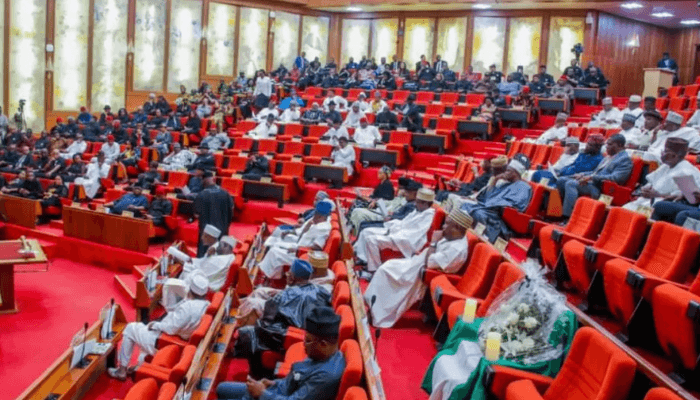
The Senate on Tuesday summoned Tunji Alausa, the Minister of Education and Amos Dangut, the head of the West African Examinations Council (WAEC) over the sudden introduction of a new curriculum for secondary schools, warning that the abrupt policy threatens the readiness of Senior Secondary School 3 (SS3) students slated to sit for the May/June 2026 examinations.
The call came during a plenary session dominated by a motion of urgent national importance sponsored by Senator Karimi Sunday Steve, titled “Need for the Federal Ministry of Education and WAEC to Review Their Policy and Implementation Date on Guidelines for the Change in the Curriculum of Secondary Schools in Nigeria.”
Karimi told the Senate that the new guidelines, originally meant for current SS1 students, were suddenly pushed forward to include SS3 candidates.
“By virtue of the new Guidelines, subjects such as Computer Studies, Civic Education and all previous trade subjects have been removed from the WAEC Senior Secondary School Certificate Examination,” he said.

Read also: No restrictions on subject choices under new senior secondary curriculum – FG
“This is despite years of preparation by the students, leaving them with only six examinable subjects instead of the required eight.”
While acknowledging the introduction of new trade subjects such as Beauty and Cosmetology, Fashion Design, Livestock Farming, Computer Hardware and GSM Repairs, and Solar Photovoltaic Installation, the Senate cautioned against exposing unprepared students to these subjects.
Senator Karimi stressed the potential consequences: “Insisting that students without prior education on these subjects should be examined in May/June 2026 will have negative implications on the students’ exams and the quality of examination results and standards.”
In their various addresses, senators questioned the feasibility of such change and its impact on the students.

Adams Oshiomhole expressed frustration over the lack of preparation, arguing that the Ministry of Education and WAEC acted without adequate planning.
“We wake up and think of an idea and begin to implement it. For a new subject to start, the citizens are well informed to prepare for it.
“So do we have enough teachers to teach? Have we prepared the laboratories? That evidence doesn’t exist,” he said.
Oshiomhole added, “The Minister can’t wake up overnight and say in May/June go and write an exam you are not adequately prepared for.
“We don’t have to plan in a manner that will cause us embarrassment.”
Senator Idiat Adebule also called for a full investigation, noting the statutory role of the National Council on Education.
“I call for a thorough investigation first. There is a Council of Education in Nigeria comprising commissioners of education in the 36 states where major decisions are taken,” she said.
Olamilekan Adeola similarly warned that students must be informed and trained on new subjects before being examined.
“Students have to have prior knowledge of the new subjects before they can be examined on them by WAEC. So, the Minister of Education has some questions to answer,” he said.
Senate President Godswill Akpabio stressed the importance of retaining key subjects while verifying the reports.
“Everything is going digital. So why are we removing computer studies and civic education?
“The children need to know their national anthem and their civic obligations to their nation.
“In any case, we should do a proper investigation to be sure that this information is even correct,” he said.
After extensive debate, the Senate resolved to summon the Minister of Education and the WAEC boss to explain the sudden change and provide clarity on its implementation.
The upper chamber also “directed that the new curriculum should not apply to current SS3 students scheduled for the 2026 examinations.
“Instead, it should commence with students currently in SS1, who are due to write in 2027/2028, to allow for adequate preparation.”