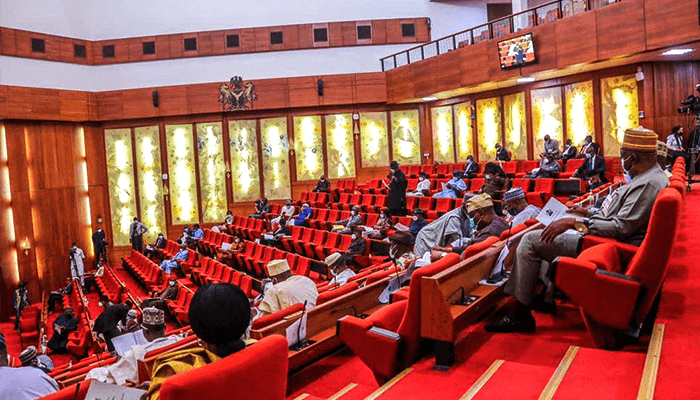
The Senate has expressed concern over the Federal Government’s continued practice of implementing multiple budgets within a single fiscal year, warning that the trend undermines fiscal discipline, erodes public confidence, and complicates economic planning.
The warning was issued on Monday by the Senate Committee on Finance during an interactive session with key economic managers on the 2026–2028 Medium-Term Expenditure Framework (MTEF) and Fiscal Strategy Paper (FSP).
At the session, the committee directed the Federal Inland Revenue Service (FIRS) to raise its projected revenue target for the 2026 fiscal year from ₦31 trillion to ₦35 trillion, as the Federal Government disclosed a ₦30 trillion shortfall in its ₦40 trillion revenue projection for the 2025 budget.
Chairman of the committee, Senator Sani Musa (Niger East), criticised the rollover of unimplemented capital projects from one fiscal year to another, describing it as a recurring anomaly that has become systemic.

Read Also: Tinubu holds closed-door meeting with service chiefs amid kidnapping crisis
Providing context, the Minister of Finance and Coordinating Minister of the Economy, Wale Edun, told lawmakers that while the 2024 budget recorded a relatively strong performance, the 2025 budget had been severely constrained by weak revenue inflows.
“Funding for the capital component of the 2024 budget was achieved through the realisation of the full projected ₦26 trillion revenue,” Edun said.
“However, out of the projected ₦40 trillion revenue for the 2025 fiscal year, only ₦10 trillion has been realised so far, leaving a shortfall of ₦30 trillion. This has forced the Federal Government to roll over about 70 per cent of capital projects captured in the 2025 budget into 2026.”
The disclosure drew sharp reactions from senators, many of whom described the continued implementation of overlapping budgets as unacceptable.

Senator Danjuma Goje (Gombe Central) said the situation was disturbing and called for an immediate end to the practice.
“This ugly situation of multiple budget implementations should end this year. It is not acceptable. Things must be normalised from next year,” he said.
Senator Olalere Oyewumi (Osun West) urged the executive to present only realistic and achievable budget proposals, warning that persistent non-implementation fuels the cycle of rollovers and fiscal overlap.
Senators Victor Umeh (Anambra Central) and Ireti Kingibe (FCT) questioned why revenue gaps were not bridged through borrowings earlier approved by the National Assembly to support budget execution.
Responding, Musa assured lawmakers that steps were being taken to normalise budget projections and implementation timelines beginning from the 2026 fiscal year.
He also disclosed that the committee would constitute a three-member ad hoc team to liaise with the Minister of Finance and the Accountant-General of the Federation to ensure the prompt payment of local contractors for projects executed under the 2024 budget before its expiration on December 31.
On revenue generation, Musa tasked FIRS Chairman Zacch Adedeji to work towards achieving at least ₦35 trillion in revenue in 2026.
Earlier, Adedeji told the committee that FIRS generated ₦20.2 trillion in 2024 and ₦25.2 trillion in 2025, but noted that revenue gains were often diluted by the strain of implementing multiple budgets in the same fiscal year.
Also at the session, the Minister of Budget and Economic Planning, Senator Atiku Bagudu, alongside the Minister of State for Petroleum Resources, Senator Heineken Lokpobiri, defended the macroeconomic assumptions underpinning the proposed ₦54.4 trillion 2026 budget.
The assumptions include an oil production benchmark of 1.84 million barrels per day, an oil price benchmark of $64.85 per barrel, and an exchange rate of ₦1,512 to the US dollar.