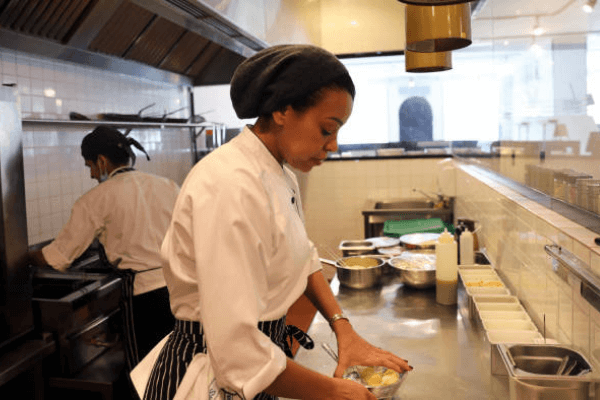
Once Ramah Nassief and her business partner had decided on green marble for the table tops in their new vegetarian restaurant, a trip to the all-male marble factory was required.
“The minute we walked in, people were looking at us like we were aliens,” she said, describing how they stood out as the only women. “We are there arguing and fighting for prices, but sometimes you feel like it’s a bit of a struggle to just put your foot down and make them listen to you. They are not used to dealing with women.”
In a conservative society where women have traditionally faced severe restrictions in their daily lives, Ms Nassief and others like her are making waves. With the blessing of the kingdom’s rulers, they are breaking into the food business and putting themselves at the vanguard of a workplace revolution.
Behind it is Crown Prince Mohammed bin Salman, the kingdom’s de facto ruler, whose leadership is seen by many as paradoxical. On one hand, Riyadh has jailed some of the kingdom’s most prominent female activists in a crackdown on dissent and seen its reputation battered by the killing of journalist Jamal Khashoggi. On the other, it has made getting more women into the workforce a priority as it seeks to create private sector jobs as part of sweeping social and economic reforms.

About 200,000 women graduate from university every year, according to the education ministry statistics. But female employees make up less than 20 per cent of the labour pool, and nearly one-third of women who want to work are unemployed.
The government has identified the food industry as one sector where there is potential for change with a recent survey by a local business group revealing that 87 per cent of restaurant and café staff are foreign.
In February, the government announced plans to double the number of Saudis in the sector by adding 50,000 citizens by 2023 — and it will not be able to do that without women.
Some female entrepreneurs in Riyadh and Jeddah are breaking new ground in more ways than one as they become part of a phenomenon more familiar on American city streets: food trucks.
The women-run mobile kitchens were unthinkable a few years ago in a country that only lifted its ban on female driving last summer. But young Saudis have quickly latched on to the trend, following the trucks on social media to track their locations and find out what is on their menus.

One of them goes by the name Razi’s Truck, a hard-to-miss vehicle painted pastel pink and garlanded with bright lights powered by a small generator (when it is not on the road) in the coastal city of Jeddah.
Bashayer Bahurmoz, a 26-year-old accounting graduate, operates the truck with a friend who came up with the idea of selling mini pancakes covered with toppings like Nutella and pistachios, a dessert that she used to make at home for her family.
She said that sales fluctuated from day to day, but that the real money was made during festivals and events. “We brought in the income of a month in one day during the Mariah Carey concert last month,” she said.
Ms Bahurmoz said that most customers were friendly and supportive, but some made their disapproval clear. “One old gentleman told me: ‘I feel sad when I see girls work in a job like this’,” she said. Given her pride in becoming an entrepreneur, the comment left her baffled. “I don’t understand that. This is my own business,” she said.
Another man who objected to the workplace revolution recorded a video of two women in a food truck in Riyadh last December and posted it on social media. The food truck owner, a young businessman who hired the women to run the truck, said he would sue the cameraman for defamation.
Such reactions reflect the unease of some conservative Saudis who feel increasingly alienated by changes around them that break old taboos, ranging from women appearing in the public sphere, to pop and rock music playing in cafés.
For the majority of Saudis, work has traditionally meant a public sector job that provides a decent salary and security. But with government opportunities diminishing in recent years as the kingdom tightens its belt, many young people have chosen to start their own businesses.
“There is a real hunger in the millennial generation for self-directed work that is more personally fulfilling. This cultural change is being embraced by [the] Saudi government,” said Kristin Diwan, senior scholar at the Gulf States Institute in Washington.
In a country previously dominated by American fast-food chains, the emergence of a new generation of Saudi chefs is also giving customers a wider range of locally developed restaurant styles.
With its exposed piping and red brick walls, the Social Kitchen would not look out of place in Brooklyn or Berlin, but in Jeddah it represents a gamble by its owner Basma Elkhereiji. She initially worried, for example, that customers would not like the proximity of her tables, because many Saudi families prefer to dine in private booths so that women cannot be seen when they lift their veils to eat.
Some people were shocked to see Ms Elkhereiji, who took culinary courses in the UK, donning a black chef’s outfit and running the kitchen.
She said the attitude of the authorities was “go ahead and do it”. But that did not mean the rules and regulations for women were clear.
“The lack of clarity was the most annoying thing: what is allowed and what is not allowed?” she said as she nibbled on small tuna tacos from her menu. “People kept saying: can you actually do this? Well, it’s my restaurant, I think I can.”