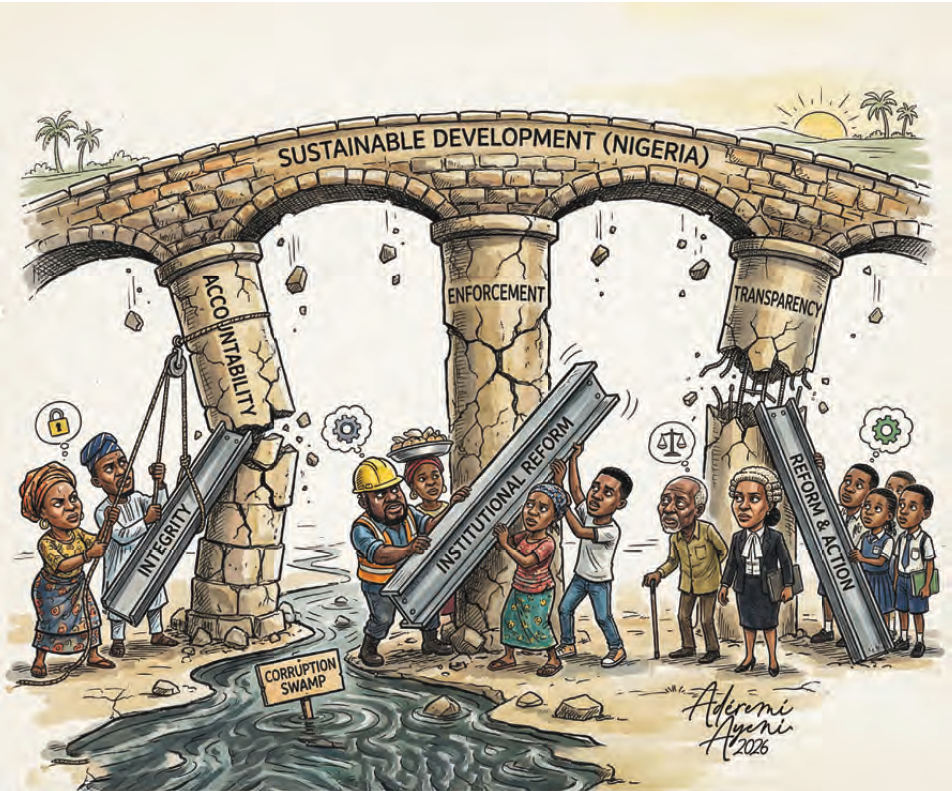
Nigeria’s development crisis is no longer driven primarily by policy failure or institutional weakness, but by the routine normalisation of falsehood and corruption. When dishonesty becomes systemic, governance loses credibility, markets lose efficiency, and citizens lose trust. This erosion cuts across education, public data, elections, business, and everyday state–citizen interaction, constraining productivity and weakening the state’s capacity to plan, deliver, and reform. Left unchecked, it threatens not only economic growth but national cohesion.
The education sector offers a stark illustration. Examination fraud has shifted from isolated misconduct to an entrenched system. Candidates, parents, and officials increasingly collude to manipulate results, turning merit and discipline into commodities for sale. Data from examination bodies such as WAEC and NECO show that thousands of candidates are sanctioned annually for malpractice, while independent education researchers estimate that organised “special centres” account for a significant share of exam irregularities in some states. The consequences are profound: universities admit students who often lack basic literacy and numeracy, while genuinely capable candidates are marginalised. Over time, this erodes human capital and entrenches a culture in which cheating is rewarded and competence devalued.
The consequences extend far beyond schools. Falsehood increasingly shapes public data, including census and population figures, distorting political representation, resource allocation, and national planning. Nigeria has conducted only one national population census since 2006, and repeated attempts to organise another have stalled amid disputes over credibility, funding, and politicisation. Policy decisions therefore rely heavily on projections that command limited public trust. Elections are manipulated, public debate is shaped by manufactured realities, and governance proceeds on unreliable foundations. Dishonesty is no longer an individual moral lapse; it has become systemic.
The broader economy reflects a similar erosion of integrity. Illicit funds circulate freely, extortion is routine, and corruption has evolved into a sophisticated, normalised system. Surveys by Transparency International and the National Bureau of Statistics indicate that millions of Nigerians pay informal fees annually to access basic public services, effectively imposing a regressive tax on households and small businesses. Everyday life carries hidden costs: unofficial payments at checkpoints, inflated school fees, exploitative bank charges, and the proliferation of betting scams and Ponzi schemes that prey on economic desperation. Government projects are too often conceived as avenues for rent extraction, while public officials pursue private gain rather than deliver measurable public value.

Regulatory and oversight institutions designed to protect the public interest increasingly operate as vehicles for patronage and extraction. Security agencies and regulators impose unofficial charges, selectively enforce standards, or redistribute resources among elites. Even schools, religious organisations, and professional bodies are co-opted to reward dishonesty, reinforcing a cycle in which integrity is undervalued and ethical conduct penalised. This environment socialises children and youth into cheating, bribery, and deceit, normalising age falsification, examination malpractice, falsified credentials, and manipulated data, while recognition flows to those who exploit systems rather than demonstrate competence.
Addressing this crisis requires more than rhetorical condemnation; it demands institutional action. The rule of law must be strengthened by prioritising enforcement in sectors where dishonesty has become systemic. Examination malpractice, public procurement fraud, financial extortion, and data falsification should be treated as high-impact offences. Dedicated investigation and prosecution units, public reporting of convictions, and sanctions extending beyond fines to include career disqualification are essential if deterrence is to be credible.
Transparency and accountability must be institutionalised. Public funds, procurement processes, and service delivery outcomes should be routinely audited and made accessible to citizens. Budget implementation reports at federal and state levels should allow Nigerians to verify whether allocations translate into classrooms built, teachers trained, hospitals equipped, and roads maintained. Development policy informed by accurate data is a prerequisite for effective governance.
Civic and moral education must also be revitalised. Schools, media organisations, and community institutions should actively promote ethics, honesty, and civic responsibility. Leadership training for public officials should combine technical competence with ethical instruction, reinforcing the principle that public office is a trust rather than a commodity.
Equally important is reforming incentives. Promotions, scholarships, public recognition, and access to government contracts should be tied to verifiable performance and adherence to ethical standards. Conversely, habitual misconduct and complicity in corruption must carry tangible consequences. Societies change behaviour not only through punishment but through the signals they send about what is rewarded.

Citizen engagement remains critical. Corruption flourishes where apathy or passive complicity prevails. Communities should be empowered to monitor public projects, report irregularities, and participate meaningfully in decision-making. Social accountability mechanisms increase pressure on officials to act responsibly.
Finally, economic policy must align with integrity reform. Payment systems for public services should be transparent and predictable; public sector wages should reflect living costs to reduce survival-driven corruption; and investment in education and human capital must prioritise quality alongside access. Ethical governance and development outcomes are mutually reinforcing.
Nigeria’s crisis of integrity is neither abstract nor inevitable. It is the product of deliberate choices and sustained neglect. As the country navigates 2026 amid fiscal pressures, reform fatigue, and declining public trust, integrity reform can no longer be treated as a moral add-on. It is a central condition for fiscal credibility, institutional effectiveness, and sustainable development. A nation rises only to the extent that it values truth, enforces accountability, and rewards competence. Treating corruption as the core obstacle to national progress is imperative.