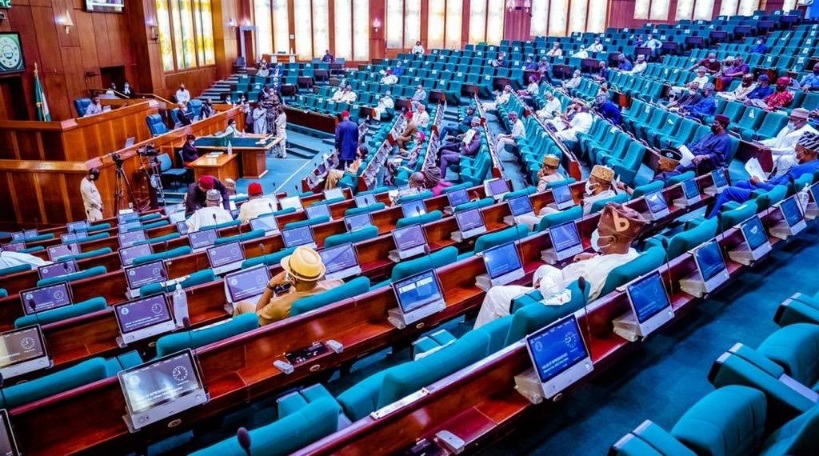
Nigerians are just looking at members of the House of Representatives with the tail of their eyes over the inanities they were uttering with their mouths on Tuesday.
A lot is happening in Nigeria these days. Many citizens’ heads are swirling as they try to make sense of a wholesale rescue of kidnap victims. When did murderous terrorists become benevolent to the extent of letting go of their prey without harm?
Reps’ wild goose chase
While the executive arm of government was busy on Tuesday, plotting how to rescue those abducted in Kwara, Kebbi and Niger states, and while high-level government officials were in various forests “dialoguing” with terrorists to release the victims in their dens, members of the House of Representatives in their chambers were embroiled in activity that could pass off as a wild goose chase.
As if they were just waking up to the burgeoning insecurity and its equally enlarging economy in the country, they were more or less speaking tongue-in-cheek on the need to criminalise ransom negotiation and payment.

Before now, the National Assembly had passed an anti-kidnap law, and there had been heated debates over whether or not the death sentence was appropriate.
In their renewed gambit, they are calling for structured amnesty and criminalisation of ransom negotiation and payment.
Are they saying that people should not take any measures they could take to have their loved ones released in the event they are kidnapped when the system appears incapable of protecting the citizens anymore?
Read also: Big talks, no action: Reps and its promised electoral reforms
The lawmakers, over time, have disappointed those who elected them into power. They pretend to live in denial of the goings-on in society. Shouldn’t they have been interested in knowing how it is possible that over 250 pupils can be abducted from their school in a single swoop? How many trucks did the bandits come with, and why is it that there was no resistance as the criminals had a field day?

It is too simplistic to focus on who offers ransom without looking at the larger picture of how to end the orgy of embarrassing frequent kidnapping. Which other country around Nigeria is experiencing these shameful episodes?
What marching orders, for instance, has the National Assembly given to the President to find a solution to the problem?
In the last ten years, the bicameral legislature has held a countless number of conferences and workshops on security challenges. They all ended in mere rhetoric! But terrorists are all over the place.
They are neither invisible nor invincible. People know where they live and how they operate. The Zamfara State governor, Dauda Lawal, recently said that the bandits were operating freely with little or no challenges. These bandits pose in photo ops with state governors and threaten the government openly.
Is the National Assembly unaware that these dangerous elements are being reintroduced into society and into the security system just because they verbally claim they have “repented”?
Why is the lower legislative chamber trying to hide behind a finger? As usual, they are trying to pull the wool over the eyes of the people.
When they get serious, Nigerians will know.
VIPs and Police Escort
The concern being expressed by many Nigerians is that the presidential directive on withdrawal of Very Important Personalities’ (VIPs) police security may go the way of many others in the past that were met with wrong or partial implementation.
The thinking of many is that these important decisions must not be taken at whim. They must be well thought out and chewed over and over again before they are announced.
Although it is the expectation of Nigerians that these police personnel attached to private individuals may be better needed in other areas, at the same time, the implementation must not be a one-size-fits-all kind of thing.
It is estimated that the Nigeria Police Force has about 370,000 (three hundred and seventy thousand).
The question to ask is, are there some VIPs that really need this special police protection? The reason for the question is to ensure that we do not end up solving one problem and creating another. There are private individuals whose investments are positively and hugely impacting the economy, and if their police protection is removed, their lives could be endangered, and many things could go wrong if such individuals are attacked.
There is a need to critically look at the list of those enjoying such protection and look at what they do with the police personnel. This inventory is very important to avoid dragging the country into the same quagmire that resulted from the ejaculatory “subsidy is gone” pronouncement.
Blind implementation of the withdrawal order could be dangerous.
Read also: Police withdrawal order to upend N108bn VIP security economy
Without a doubt, over the years, many public and private individuals have abused the police security details attached to them. And this has been profusely criticised, particularly those deployed to carry out some ridiculous tasks for their VIP bosses. With a large number of police personnel deployed to guard private individuals, a huge percentage of the nation’s populace is largely unprotected, a situation that may have irked President Tinubu to order a recall.
The directive received applause from many Nigerians. But pushbacks are expected. A few individuals who think they have the power to do and undo would definitely resist the order.
In a country where adherence or obedience to the government’s directives or even to law is dependent on who you know in the corridors of power, it may not be surprising to find out at the end of the day that the president merely acted as a result of the pressure of the moment.
And that the directive is merely all motion and no movement!
Is FG desperate?
Nigerians waxed celebratory on Monday when the news broke that the 38 abducted worshippers in Eruku, Kwara State, had been rescued. Citizens were treated to a video where the victims were shown alighting from a bus.
The next day, Tuesday, there was more rousing news of the rescue of 24 pupils abducted in Kebbi State a few days back. The children, who were seen inside a bus, were beside themselves with happiness, beaming with smiles.
In the Eruku rescue incident, reports had it that a non-kinetic approach was applied. In other words, there were some forms of negotiations. Whether ransom was involved or not has remained a state secret. But the bandits knew what transpired.
While Nigerians celebrate the return of the abducted, the circumstances surrounding the manner of their rescue may have opened a new chapter of concern. That raises a pertinent question: Has payment of ransom become an official policy?
If the release of the victims was effected through payment of ransom, the Federal Government may have unwittingly provided enough oxygen for the criminals to up their murderous campaign.
South West governors and kindred spirits
In Yorubaland, it is commonplace to hear someone being addressed as “Omoluabi”—a person born of good character. It could be stretched to describe a people with kindred spirits (sharing similar interests and values, among others).
When it comes to the issue of security and the good of the Southwest, all governors, irrespective of the political platforms they were elected on, are on the same page.
Read also: South-west governors launch regional security fund, say state police can no longer be delayed
That kindred spirits came alive on Monday when the governors met in Ibadan, Oyo State capital, on issues that bind them together.
Governor Seyi Makinde, who hosted the meeting, is of the People’s Democratic Party (PDP). Yet, the proceedings went on in the spirit of brotherhood.
In such meetings, party affiliation is never brought into play. This is in line with the words of Julius Caesar, “What touches us ourselves shall be last served.”
They were in Ibadan to review the progress of the Western Nigeria Security Network with its outfit, Amotekun, officially established on January 9, 2020. The meeting became very necessary with the escalating activities of terrorists advancing toward the zone.
This brotherly affinity is quite different from what is found in the Southeast, where allegiance to political platforms has not helped matters. Several attempts have been made over time to float a workable security outfit for the troubled zone, but individualistic politics have buccaneered the efforts.
On August 31, 2019, Major-General Obi Umahi (rtd) was appointed by the South East Governors’ Forum as chairman of the South East Security Committee to help draft a framework for the establishment of a South East joint security outfit to cater to the security needs of the zone.
The governors had in April 2021 verbally announced the formation of Ebubeagu at Owerri. Two months after the formation, General Umahi resigned.
Funds to run the outfit were not available, and there was infighting among the governors. Political interest has continued to clog the collective progress of the Southeast. But kudos to the South West governors!