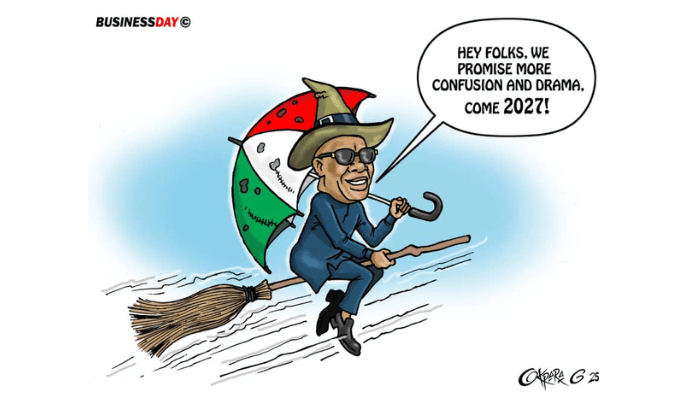
Several years ago, Martin Luther nailed his 95 theses to the church door in Wittenberg. He did this to prove he was no coward in defending the discoveries he was making in Scripture. The 360 members of the House of Representatives may need to prove that the path they have chosen in the constitutional amendment was noble. Many Nigerians are perplexed that the Senate has been turned into an entertainment theatre…for horror cinemas. What does Jandor want as he desperately begins to sandpaper the rough edges of bruised relationships?
Reps, nail your thesis to the wall…
If you ask many Nigerians, they would tell you that the major problem of the country today is the politicians.
The Nigerian political class has so lowered itself in the estimation of many right-thinking members of the society to the point that whatever they say is taken with a pinch of salt.
It is in this light that many close watchers of the Nigerian political space have argued that the constitutional amendment exercise being embarked upon by the nation’s bicameral legislature is not in good conscience. The thinking is that the exercise must be geared towards achieving certain ulterior motives.

The House of Representatives on Tuesday announced that thirty-nine constitutional amendment bills have scaled second reading in the green chamber of the National Assembly.
The bills cut across various sectors, including judicial reforms, electoral matters, security and policing, inclusive governance, legislature, and many others.
A few of them will suffice here: A bill for an Act to alter the Constitution of the Federal Republic of Nigeria, 1999, to provide for the establishment of state police and local government police; a bill for an Act to alter the provisions of the Constitution of the Federal Republic of Nigeria, 1999 (as amended), to provide that general elections to the office of the president, state governors, National Assembly, state Houses of Assembly, and local government area councils shall be conducted simultaneously on the same date to be determined by the Independent National Electoral Commission in consultation with the National Assembly.
A bill for an act to alter the Constitution of the Federal Republic of Nigeria, 1999, to make the Court of Appeal the final appeal court in governorship, national, and state Houses of Assembly election petitions.
A bill for an Act to alter the Constitution of the Federal Republic of Nigeria, cap. c23, Laws of the Federation of Nigeria, 1999 (power of proclamation of new Assembly by Clerk or NASS/Clerk of House Assembly) and to make provision for the Chief Justice of Niger to make proclamation on the inauguration of the National Assembly.

A bill for an act to alter the provisions of the Constitution of the Federal Republic of Nigeria, 1999, to establish the FCT House of Assembly.
A bill for an act to alter the Constitution of the Federal Republic of Nigeria, 1999 (as altered), to provide for special seats for the physically challenged persons in Nigeria’s federal, state, and local government areas and legislative houses.
A bill for an act to alter the Constitution of the Federal Republic of Nigeria 1999 to permit public servants to engage in healthcare education, production, and services beyond farming and related matters.
A bill for an Act to alter the Constitution of the Federal Republic of Nigeria 1999 cap. c23 Laws of the Federation of Nigeria, 2004 to establish and empower the political parties registration and regulatory commission to register, regulate, and monitor the organisation and operation of political parties.
A bill for an act to further alter the Constitution of the Federal Republic of Nigeria, 1999, to provide for the determination of all appeals arising from election petition tribunals prior to the swearing-in of the president-elect, vice president-elect, governor-elect, deputy governor-elect, and members-elect of the national and state assemblies.
A bill for an act to alter the provisions of the Constitution of the Federal Republic of Nigeria, 1999 (as amended) to vest the Independent National Electoral Commission (INEC) with the power to conduct local government area council elections.
A bill for an act to alter Sections 68(1)(g) & 109(1)(g) of the Constitution of the Federal Republic of Nigeria, 1999 (as amended) to require the official resignation from a political party before defection by members of the national assembly and state house of assembly.
A bill for an Act to alter the Constitution of the Federal Republic of Nigeria, cap. c23, Laws of the Federation of Nigeria, 2004, to establish the national local government electoral commission as an independent body responsible for organising, conducting, and supervising elections into the offices of chairmen and councillors of all the local governments across the federation, including the area councils of the Federal Capital Territory.
Embarking on a constitutional amendment is long overdue given the deafening calls from various quarters to tinker with the constitution if a brand new one is not feasible for now.
The only challenge is that many Nigerians do not think that the crop of the people at the National Assembly at the moment is capable of delivering a reliable amended document.
A critical look at the 39 proposals showed that many of them are just wishy-washy. Imagine national lawmakers proposing that the Federal Capital Territory should have its own House of Assembly. The question to ask now is, does the FCT deserve such when it is designated a “unifying” territory? In other words, should no state have ownership of Abuja?
The proposal for the INEC to be the organiser of the local government election is neither here nor there. By the same token, the suggestion that the major elections should be held the same day does not prevent the desperate politicians from carrying out their electoral heist. By the way, it is the same people that are making these laws that are responsible for electoral malfeasance.
Before the 2023 general election, effort was made by the 9th Assembly to amend some select provisions of the Electoral Act, 2022, which sought to improve the efficiency and integrity of the electoral process and promote greater transparency in the elections. Indeed, the amendments were carried out.
But facts are everywhere to prove that the reasons why the amendments were carried out were never achieved. The provisions were rather carried out in the breach.
Even some of the provisions that were inserted to help the process, particularly as touching the transparency of the process, were not observed. The courts’ judgements on the disputes that arose from the elections gave fillip to the impunity and disregard for the letters of the Electoral Act.
It is safe to say that the 2023 general election did not enter the country’s history books as the worst organised election by Professor Mahmood Yakubu because of lack of enabling constitutional provisions; it did, simply because the actors saddled with the responsibility of rendering service to their fatherland decided to do the contrary.
Here we are talking about a constitutional amendment, championed by a group, some of whom ordinarily should not be at the National Assembly if the laws were potent!
An important question that has arisen since the news went public is ‘Whose idea is it?’ The question became very necessary since it has become apparent that the 10th National Assembly may not be having its own soul or carrying out its functions on the basis of its own convictions but appears to be being teleguided by powers outside the precinct of the chambers.
Does Nigeria need a new constitution or an amended constitution? The answer is capital YES; but must Nigerians be deceived on this score and the wool pulled over their eyes all in the name of constitutional amendment? Observers are indeed worried!
Senate’s house of horror
Hammer House of Horror is a British horror anthology television series produced in Britain in 1980. It was created by Hammer Films in association with Cinema Arts International and ITC Entertainment.
As the name implies, it is a film that is not for the faint-hearted. The film is harrowing, disturbing and sinister. In the name of entertainment, images of capitulated human beings litter everywhere. Human beings-turned vampires feasted on people, even while pretending to be close friends.
Close to two months now, the highest law-making chamber of Nigeria’s National Assembly, the Senate, has become an entertainment theatre where those who want to kill boredom go to have a good laugh.
From what started as a disagreement over seating arrangements to a grave allegation bordering on sexual advances to now “everything goes” in the chamber.
A lot happened on Tuesday around the Natashagate. The Independent National Electoral Commission (INEC), in an unmistakable tone, told certain individuals from Kogi State who submitted what could be termed “half-truth” to go back and tidy up their plots.
Some persons who claimed to have come from Kogi Central, being represented by Akpoti-Uduaghan, had claimed that they had passed a vote of no confidence in her and wanted to recall her.
The group, led by one lady, Charity Omole, had claimed that the names and signatures needed to recall the senator had been collected and collated. But critics said that the plot was beyond Omole and her group, but a situation that is akin to the voice of Jacob and the hands of Esau.
That same day in Abuja, Justice Obiora Egwuatu of the Federal High Court Abuja recused himself from the case filed by the senator representing Kogi Central District because the Senate president alleged bias.
To seal the drama, Onyekachi Nwaebonyi, representing Ebonyi North Senatorial District, seized by the overzealousness to prove he loves the Senate President, lowered his “distinguished” appellation. He was everything but “distinguished” as he yelled, shouted and employed some words that no one could imagine a senator could use anywhere in the world on a live camera.
While Nwaebonyi kicked, Oby Ezekwesili appeared measured in her use of words, although visibly disappointed that a senator could be so dramatic.
Nwaebonyi has been vocal in defending the Senate president to the point that many people are asking, “What is the motivation?”
While public perception of the Senate is flagging as a result of the handling of the Natashagate and some other behaviours that are unbecoming of such a hallowed chamber, Senator Nwaebonyi said he was not concerned about public perception. He blamed the opposition for whatever has happened at the Senate.
The Senator Godswill Akpabio-led Senate has an enormous job to do to change the public perception of the federal lawmakers and whatever they are doing in the chamber, regardless of whatever the personal view of the likes of Nwaebonyi.
What is most concerning is that while many Nigerians are being killed across the country by the insurgents and bandits, while many are trapped in the abyss of poverty, while many are languishing in the various correctional centres for no just cause, and while many are planning to flee the country over the excruciating pains they go through on a daily basis, those who should make good laws to enthrone good governance are busy chasing shadows and engaging themselves with too many irrelevant things.
Jandor’s ‘all is fair in war’ chant
Political ambition in Nigeria can be likened to a person on opium. While the heat is on, the individual is consumed in self-conceit and over-bloated ego. When ambition is not moderated, it results in “had-I-known.”
A few days ago, the 2023 governorship candidate of the People’s Democratic Party (PDP) in Lagos State, Abdul-Azeez Adediran, popularly known as Jandor, dumped the umbrella association.
To make a show of it to the whole world, he rushed to the seat of power in Abuja to present himself to President Bola Tinubu, like a prodigal son that returned home after a wasteful, rudderless ‘journey.’
While he was on “heat” shortly before the 2023 general election, he had called the All Progressives Congress (APC) all sorts of names and had also won the hearts of many members of the broom party, who thought that the sound of bitter kola when it is being eaten connotes how sweet it is.
Jandor, who served as the former governor of Lagos State, Babatunde Fashola, owes whatever he is today to the political family in Lagos before he began to nurse the ambition to become the governor of the state.
He was able to garner sympathisers who were not happy about the way Lagos had been cornered by one man, which was also his major grouse. At every meeting, he reminded attendees of the need for the state to be detached from the apron string of the oracle in Lagos.
But when his ambition crumbled, he ran back to the same person he had serially accused of pocketing Lagos! Such an attitude can only be indicative of a man that is not patient enough to learn the ropes but wants to lead sharply.
Do not forget that he pursued the governorship mandate to the Supreme Court against Babajide Sanwo-Olu.
Also, not wanting to sit down to hone his trade by studying why his ambition could not sail through and tarry awhile in the opposition camp, he felt that the best option for him was to go back to the people he had bad-mouthed and traduced so viciously.
To make the party that offered him the platform to look like leprosy, he began to latch on to the familiar refrain that many defected politicians in Nigeria always anchor their desperation on – division in the party!
When he appeared on Channels Television recently, he justified the attack on the APC while he was in the PDP fold, saying that “all is fair in war.”
He is now saying that the PDP was not a stable party at the time he came into the party and that he was ready to win for the PDP, but the party was not ready to win for itself.
Jandor emptied himself into the APC in a suspicious manner that some observers have alleged that he may have been a mole in the PDP ab initio.
The questions many people have not found answers to are: why did he have to visit every known politician to announce his exit? Was he thinking that such politicians would constrain him to remain in the opposition under a favourable bargain?
So, what on earth was the reason for visiting Vice President Atiku Abubakar, former President Ibrahim Babangida, former Head of State Gen. Abdusalami Abubakar, the presidential candidate of the Social Democratic Party (SDP) in the 2023 general election, Adewole Adebayo, among other prominent national leaders?
Since he presented himself to President Tinubu, he has been doing everything possible to show that he has really and truly aligned with the Jagaban and is straying back to the APC fold.
The other day, he ran into Folasade Tinubu-Ojo, daughter of President Tinubu, and had a photo op with her and had the same published. Many asked, What is the news here?
On Tuesday, he condoled with the Lagos State APC Chairman, Cornelius Ojelabi, over the death of his wife.
It may seem that he has been accepted back with open arms, but he may soon be handed a poisoned chalice, just the way David Bwala is perceived.
Only time will tell, and Nigerians will watch as events unfold.