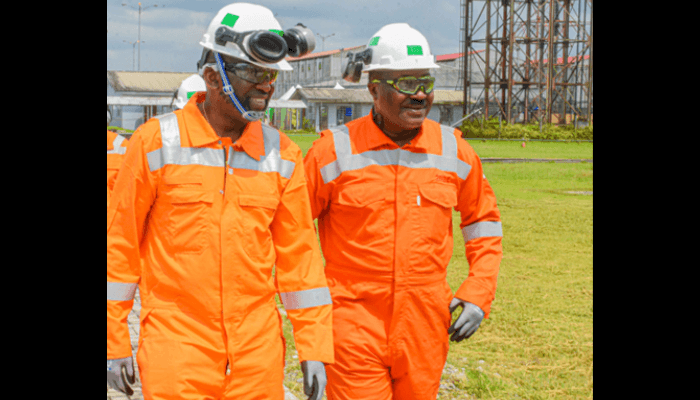
Renaissance Africa Energy Company Limited has commissioned its Southern Swamp Associated Gas Solutions Project in Delta State, a facility capable of delivering approximately 100 million standard cubic feet of gas daily to Nigeria’s domestic market while eliminating routine flaring from its Tunu Node operations.
The infrastructure, located in oil mining leases 35 and 46 south of Warri, represents a strategic shift toward associated gas utilisation in Nigeria’s coastal swamp region. The project taps into reserves estimated at 820 million barrels of oil equivalent, establishing what the company describes as anchor infrastructure for future development in the area.
“This milestone marks a significant achievement in our commitment to delivering sustainable energy solutions,” said Tony Attah, managing director and chief executive officer of Renaissance. The volume of gas being injected into the domestic market could power approximately 6,700 Nigerian households annually when used for electricity generation, with expected multiplier effects across the gas supply chain.
The SSAGS project addresses a longstanding challenge in Nigeria’s oil industry: the routine flaring of associated gas from oil production. By routing production through four flow stations at Tunu, Ogbotobo, Benisede, and Opukushi, the facility eliminates flaring while evacuating oil via the Trans Ramos Pipeline to the Forcados Export Terminal.

Mesh Maichibi, Renaissance’s chief production officer, said the project will contribute over 30 percent to the domestic gas network. Gas from the facility flows primarily to the Escravos-Lagos Pipeline System, with an alternative route to Nigeria LNG’s Bonny facility to ensure continuous operations if the primary domestic route becomes unavailable.
Since operations began, the project has exported approximately 158 billion standard cubic feet of gas cumulatively—98 billion scf to the domestic network and 60.1 billion scf to Nigeria LNG. The dual-route design provides operational flexibility while prioritising domestic gas supply, a key objective in Nigeria’s energy policy.
Read also: How local content supports Renaissance Africa’s long-term plan
The project represents significant local content development, with over 90 percent of work completed in-country, according to Attah. This approach has enabled the upskilling of Nigerian technical expertise and created employment opportunities in host communities.
Jacob Ogbolo, the Amanana-Owei of Egbemo-Anagalabiri domain, praised the employment impact. “Anytime we come in here, we see indigenes of host communities and non-indigenes working together peacefully,” he said at the inauguration.

The facility addresses two critical objectives in Nigeria’s energy sector: reducing gas flaring, which has environmental and economic costs, and increasing domestic gas availability for power generation and industrial use. Nigeria has struggled to convert associated gas from oil production into usable energy, often flaring billions of cubic feet annually.
Renaissance’s project arrives as Nigeria seeks to boost industrialisation through improved energy security. The company emphasised that the infrastructure is designed to support future discoveries within the Tunu Node, positioning the facility as a long-term asset rather than a standalone project.
Attah described the inauguration as “just the beginning” for Renaissance under its current identity, signalling further investments in gas infrastructure and associated gas solutions across the company’s Nigerian operations.