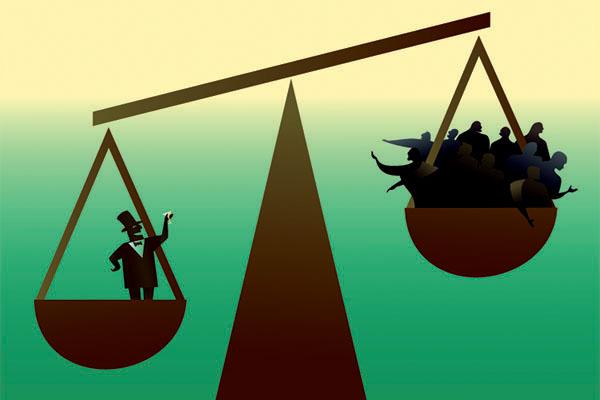
One of my most impactful realisations about life as an adult was realising how limited and somewhat overstated the role sheer hard work plays in achieving success, particularly in Nigeria. In Nigeria, every work is hard, and it seems that the lower you descend the economic ladder, the harder the work becomes. It sounds backward, because it is. Look around, the evidence is everywhere. The woman frying akara in the scorching heat of Oshodi market earns less in a week than the procurement consultant in a government office, who spends most of his time forwarding emails. The bricklayer who builds luxury apartments in Lekki can barely afford a decent room in a nearby slum. The security guard, who risks his life watching over the car of a wealthy politician, earns less in a month than that politician spends on a single Saturday brunch. This is the labor pyramid: a structure built on the sweat and silence of the many. To avoid sounding utterly naive, I acknowledge that economic models often justify this reality by citing the scale of impact and scarcity of skills to explain the disproportionate earnings at the top. The logic is that, for example, a tech CEO creates a product used by millions, thus generating immense revenue, while a surgeon possesses a rare skill that saves lives. However, this rationale, while acknowledging the role of scale and skill, fails to account for the essential value of all labour and the systemic inequalities that perpetuate the pyramid. Systemic inequalities that are arguably more extreme and pervasive in Nigeria than in almost any other part of the world.
To understand how we got here, we have to look back. The roots of this inequity go deep, reaching back to colonial rule, when British administrators created a structure where they extracted labour and resources while Nigerians did the hard, physical work. Our ancestors farmed, carried, built, and dug. They were taxed for the privilege. The colonizers sat at the top of the pyramid, collecting revenue, setting rules, and enjoying the view. It was a system of exploitation, and when independence came, we hoped the pyramid would be dismantled. Instead, it was inherited.
Post-independence, the Nigerian elite replaced the colonial administrators. They inherited not just power, but the architecture of inequality. Government became a gateway to wealth, not service. Those at the top no longer needed to produce value, they just needed to control its flow. Following this, the effects of some programs in the 1980s and 90s, which gutted public services and pushed millions into the informal economy. While these policies were intended to stabilize the economy following the oil windfall from the 60s and 70s, they had profound adverse effects on the Nigerian populace. The devaluation of the naira led to increased prices for imported goods, exacerbating inflation. Trade liberalization exposed local industries to international competition, resulting in factory closures and job losses. Privatization often transferred public assets to individuals with political connections, reinforcing existing inequalities. Most notably, the reduction in public spending severely impacted essential services like healthcare and education, eroding the social safety net that many Nigerians relied upon. The message was clear, the state would no longer protect you. You were on your own.
So Nigerians, with their characteristic resilience, adapted. They hustled with fierce determination. They forged new economies out of necessity: informal transport services, like the iconic okada and keke; skilled technicians, boldly transitioning from the shrinking formal sector into personalized retail services; and a generation ingeniously learning design on YouTube They work long hours, multiple jobs, often with no benefits or security. Yet still, the reward remains out of reach. The more they labor, the further comfort seems. Why? Because labor in Nigeria is not what brings wealth, Proximity is. Proximity to power, to privilege, having the right surname or being a member of the right inner circles.

We are often told, “Work hard and you will succeed.” However, reality shows something else. In Nigeria, working hard often just keeps you tired. The people who earn the most are not the ones lifting, cleaning, building, or fixing. They are the ones collecting rent, not only on properties but entire industries, running rackets exploiting loopholes and political connections, or passively sitting on oil blocs, while others tweet about “monetizing your network” while a generator hums in the background.
This is not just about income. It’s about dignity. In the labor pyramid, those at the bottom are invisible. We do not see them in economic plans or startup pitches. They are not featured in TED talks about innovation. Without them however, the system would collapse. The informal worker, the artisan, the domestic staff are the ones holding up the pyramid. The tragedy is that they do so while remaining poor or even destitute.
This inversion of effort and reward is not accidental, it’s structural. The modern Nigerian economy, like many post-colonial systems, rewards ownership over output. To own land, capital, or networks is to command income without labor. Ironically, to possess only your body and your time is to earn little while giving much. And over time, this message seeps into the national psyche: real wealth doesn’t come from hard work; it comes from escaping it.
How about the middle you might ask? The middle is burning out. These are the salary earners, the freelancers, the young professionals with Canva portfolios and multiple streams of stress. They are not at the bottom, but they can see it clearly. They are not at the top, but they are aspiring to perspire. They live in rented apartments with Pinterest dreams. They go on LinkedIn and see posts that say, “While you sleep, I earn.” They go to church and hear, “Your miracle is coming.” Then they go home, open NEPA bills that threaten to bankrupt them, and remember that, in Nigeria, the biblical prince of Persia, in the form of systemic challenges and infrastructural failures, is a powerful and persistent force.
I hesitate slightly as I write this, because I don’t want to paint an entirely bleak picture, as that’s not the full story. The encouraging truth, the vibrant counter-narrative, is that Nigeria thrives on the sheer brilliance, the unwavering grit, and the boundless resourcefulness of its people. Every single day, millions of young Nigerians are rewriting the rules of what’s possible. They’re not just adapting; they’re innovating. They’re transforming okadas into agile logistics startups, connecting communities and delivering goods with speed and efficiency. They’re wielding their phones, not just as tools for communication, but as powerful engines of commerce, building businesses and reaching customers across the country. They’re channeling their pain, their frustrations, their experiences, into powerful poetry, into music that moves us, into art that challenges us to see the world differently. They are not simply hustling to survive; they are actively creating, relentlessly building, boldly imagining a new Nigeria.

How do we make this imagination of a few become the freedom of the many? Firstly, we need to rethink what we value. We need to stop calling some work “unskilled” when it requires strength, precision, and patience. We need policies that protect labor, reward effort, and provide basic dignity. We need a culture that stops gaslighting the poor with divine and economic justifications for their situation while exploiting their labor for our ease and prosperity.
We must interrogate our obsession with ease, with wealth without work, because when labor is systematically devalued, society becomes unsustainable. Innovation thrives not when the few extract from the many, but when the many are empowered to create.
Pyramids, by design, serve the top; their very structure necessitates a base that bears the weight. But what if we stopped building pyramids altogether, these monuments to inequality? What if we dared to imagine a new shape, probably a circle, where value flows not in a single direction, but in a continuous, interdependent cycle. A circle where no one has to be diminished, no one has to sacrifice their inherent worth, just to belong. Because ultimately, our shared humanity isn’t a hierarchy; it’s a network of interconnectedness, and it’s time our economic and social systems reflected that truth.
Eyesan Toritseju is a graduate of Civil Engineering from Covenant University turned serial entrepreneur and corporate strategist. Passionate about society and the cultural ideologies that shape us, he explores how these forces propel or inhibit progress through his writing. In his column, Cosmopolitan Nigeria, Eyesan examines how young Nigerians navigate the complexities of culture, religion, and identity in a rapidly evolving world.