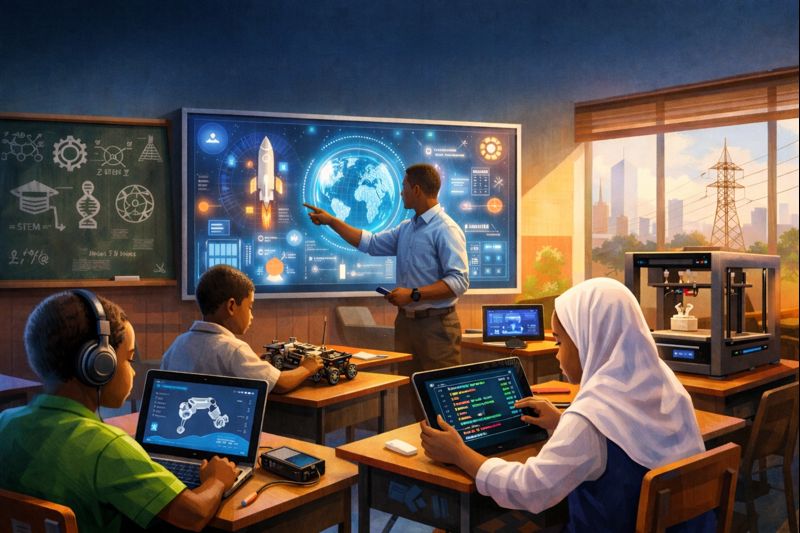
Nigeria’s persistent struggle to translate its demographic strength into technological and industrial advancement is no longer a question of potential, but of preparation. With one of the world’s youngest populations, abundant natural resources, and a visible culture of ingenuity across informal engineering, digital entrepreneurship, and creative industries, the country should already be positioning itself as a serious technological contender. Yet, Nigeria remains largely dependent on imported technologies and external expertise. At the centre of this contradiction lies an education system that has failed to evolve with the demands of a modern, innovation-driven world.
For decades, Nigeria’s education curriculum, from primary school through university, has remained anchored to a colonial-era logic that prioritised clerical competence and white-collar employment over production, experimentation, and problem-solving. That framework may once have served an imperial economy, but it is profoundly unsuited to a global order now defined by artificial intelligence, automation, advanced manufacturing, and digital infrastructure. While other countries continuously redesign education to match their development ambitions, Nigeria’s system has stagnated, and in some respects deteriorated, producing graduates increasingly disconnected from national economic needs.
Countries that achieved rapid technological transformation did so by treating education as strategic infrastructure, rather than a social amenity. South Korea, poorer than Nigeria in the 1960s, deliberately aligned schooling with industrial policy, emphasising mathematics, science, and applied engineering. Singapore embedded technical competence, discipline, and continuous skills upgrading into its national identity. Finland prioritised inquiry-based learning and problem-solving from early childhood, while Taiwan integrated universities into its industrial strategy, particularly in semi-conductors and advanced manufacturing. These outcomes were not accidental; they were the result of deliberate policy choices.
Nigeria’s education system, by contrast, remains overwhelmingly ‘examination driven’. Students are trained to memorise rather than to design, test, or build. Success is measured by certificates rather than competence. Science is taught as content rather than as method, and assessment rewards recall over reasoning. This approach produces graduates who can pass examinations, but struggle to apply knowledge to real-world problems, whether in energy, manufacturing, agriculture, or digital systems. The result is an economy that consumes technology, rather than produces it.
In countries such as China, children at basic education levels are already building drones, solar systems, and simple electronics as part of structured learning. In the United States, science and technology fairs are embedded in school calendars, enabling pupils as young as 10, to demonstrate functional innovations. In Nigeria, practical exposure remains the exception rather than the rule, particularly in public schools where laboratories are poorly equipped or non-existent.

This gap is compounded by neglect of technical and vocational education. Nigeria’s preference for university degrees has marginalised technical skills vital to industrial growth. Countries such as Germany and Singapore elevated vocational training into respected pathways. Nigeria, by contrast, has allowed polytechnics and technical colleges to decay, depriving industries of skilled technicians, essential for infrastructure and production.
Universities remain underutilised as engines of innovation. Despite housing capable scholars, many are disconnected from industry and national priorities. Promotion systems favour publications over patents or problem-solving, research funding is weak, and industry collaboration is limited. Universities must be incentivised to solve real economic and technological challenges if they are to drive development.
None of this can succeed without teachers. Education systems that underpin technological advancement invest heavily in teacher quality, training, and status. Singapore treats teaching as a high-prestige profession, with rigorous selection, continuous upskilling, and clear career progression. In Nigeria, teachers, particularly in science and mathematics, are poorly paid, undertrained, and often demoralised. Continuous professional development in emerging fields such as artificial intelligence, renewable energy, and biotechnology remains rare. An education system cannot produce technological capability, if those tasked with delivering it are neglected.
Equally troubling is the absence of alignment between education and Nigeria’s own resource base. Countries that succeeded technologically built education around national realities. Nigeria has similar opportunities in renewable energy, agro-processing, pharmaceutical production, and materials science linked to its mineral wealth, yet these priorities are rarely reflected systematically in curricula or research agendas.
This reform imperative also raises an uncomfortable, but unavoidable issue: the governance of Nigeria’s education sector itself. Education is too consequential to be treated as a reward for political loyalty. Every appointed Minister of Education, and head of institutions must be competent, and fired immediately, if proven otherwise. Proposals to weaken requirements such as mathematics for university admission reveal a disconnect from a technology-driven economy. No innovative nation dilutes core competencies. Nigeria needs educational leadership grounded in pedagogy, skills formation, and development strategy, not convenience.

Nigeria’s demographic window is narrowing. A youthful population can be an engine of growth or a source of instability, depending on how it is prepared. An education system that produces graduates without practical skills, problem-solving capacity, or technological confidence, risks turning demographic advantage into liability. Reforming education is therefore not a sectoral concern, but a national emergency.
Re-engineering the Nigerian classroom requires political seriousness. It demands competence in educational leadership, clarity about national development priorities, and the courage to abandon outdated models. It also requires recognising that science, technology, humanities, and social inquiry are complementary, not competing, foundations of progress, requiring defined levels of priority. Nigeria’s technological future will not be imported. It will be taught, tested, and built. And it will begin in classrooms deliberately re-designed to serve the nation’s future, rather than its past.