Africa’s fintech sector has matured into a vibrant landscape of innovation, entrepreneurship, and investment, with certain cities firmly establishing themselves as continental leaders.
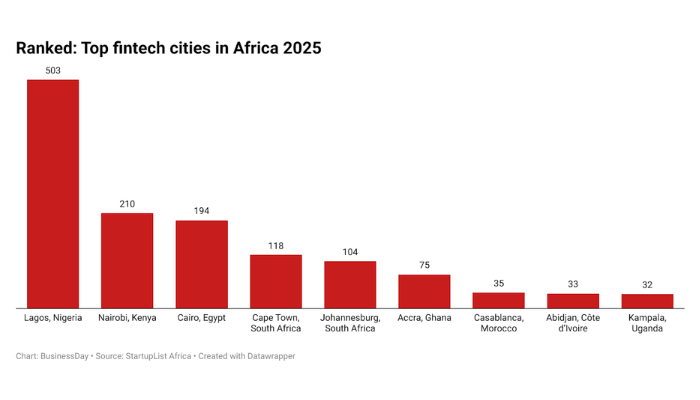
According to an analysis by StartupList Africa of more than 1,300 fintech startups surveyed, nine cities represent Africa’s most dynamic fintech ecosystems, with Lagos, Nairobi, and Cairo leading the pack.
Lagos, Nigeria
Lagos has firmly established itself as Africa’s fintech capital, boasting 503 active startups—more than twice the number in any other city on the continent. Since 2020, 256 new startups have emerged, reflecting a sustained wave of innovation, while 78 companies have scaled to 50 or more employees, signalling a maturing ecosystem.

With 116 funded startups raising a combined $6.03 billion and strong regulatory backing through the Central Bank of Nigeria’s sandbox framework, Lagos has cultivated a powerful concentration of talent, capital, and policy support. This synergy continues to attract entrepreneurs and investors, reinforcing the city’s position at the forefront of Africa’s digital finance revolution.
Nairobi, Kenya
Nairobi has solidified its status as East Africa’s leading fintech hub, with 210 active startups thriving in an ecosystem shaped by Kenya’s pioneering role in mobile money. Since 2020, 77 new startups have launched, reflecting sustained entrepreneurial momentum.
The city is home to 41 companies with over 50 employees, indicating strong scalability, while 59 funded startups have collectively raised $4.64 billion. Nairobi’s fintech growth is further supported by deep mobile money penetration, progressive regulatory frameworks, and a mature payments infrastructure that makes it an ideal testing ground for innovative financial services.
Read also: Africa’s fintech boom needs talent, not just startups — CEO Intreensic

Cairo, Egypt
Cairo ranks third with 194 fintech startups but leads the continent in funding concentration, with $10.07 billion raised across 49 funded companies, representing the highest average funding per startup among Africa’s major fintech hubs.
Since 2020, 91 new startups have launched, and 50 companies have scaled to over 50 employees, matching Nairobi’s growth trajectory. Cairo’s strategic location, bridging Africa and the Middle East, along with access to both regional and international capital markets, continues to fuel its fintech ascent.
Southern Africa
Cape Town and Johannesburg are harnessing South Africa’s well-established financial sector to drive fintech growth. Cape Town, with 118 startups, benefits from a strong university talent pipeline, 27 scaled companies, and $2.95 billion raised across 35 funded ventures, while Johannesburg hosts 104 startups and 11 scaled firms and has attracted $3.81 billion in funding across 26 startups—further supported by strong corporate partnerships with traditional banks.
West Africa’s Emerging Centres
Accra has established itself as West Africa’s second fintech hub with 75 startups, benefiting from Ghana’s interoperability regulations and growing digital adoption. The city has attracted $1.66 billion in funding across 22 funded startups.
Abidjan represents Francophone Africa’s fintech potential with 33 startups and $264 million in funding, supported by Côte d’Ivoire’s new startup legislation offering tax incentives.
North and East African Expansion
Casablanca serves as a gateway between Africa and Europe, with 35 startups and $152 million in funding, while Kampala builds on Uganda’s high mobile money penetration with 32 startups and $212 million raised.