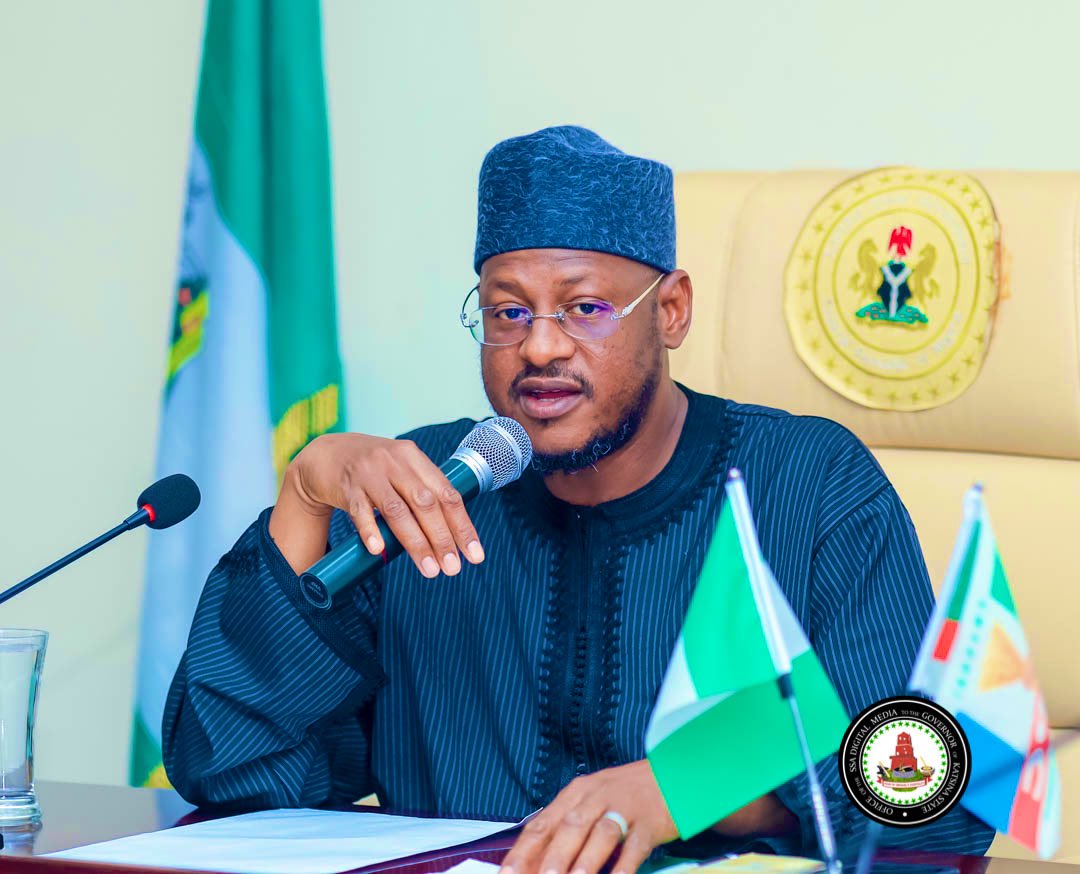
Governor Dikko Umar Radda of Katsina State has reaffirmed his administration’s commitment to breaking the cycle of child poverty through evidence-based governance and strategic social protection interventions.
Speaking in Katsina on Monday while declaring open a two-day capacity-building workshop for all 34 local government chairmen, Radda described the initiative as a critical step toward improving the welfare of children and vulnerable families across the state.
The workshop, themed “Reducing Child Poverty through Social Protection and Using Data for Transformative Evidence-Based Governance,” was organised by the Katsina State Bureau of Statistics in collaboration with the United Nations Children’s Fund (UNICEF).
Radda said the training underscores his administration’s conviction that governance must translate into tangible improvements in people’s lives, particularly for children, whom he described as “the very soul and future of the state.”

“Good governance is not only about policies and projects but about improving the quality of life of every citizen,” he said. “Child poverty remains one of the most pressing challenges facing Nigeria today. It goes beyond lack of income—it includes deprivation in education, health, nutrition, and opportunity. That is a cycle we must break.”
Citing the National Bureau of Statistics’ 2022 Multidimensional Poverty Index, Radda noted that about 65.4% of children aged 0–17 in Katsina State live in multidimensional poverty, with 1.46 million children under five facing multiple deprivations across nutrition, health, education, sanitation, and housing. He added that over 61% of children live in monetary poverty, 51.3% are stunted, 41% are immunised, while 33.3% of primary school-age children are out of school, according to UNICEF Nigeria (2024).
“These figures highlight the urgent need for coordinated, data-driven action to reduce child poverty and improve human development outcomes,” the governor said.
Radda urged local government chairmen to leverage their proximity to grassroots communities in identifying vulnerable households and ensuring that interventions yield measurable impact.
“Social protection is not an act of generosity, it is an instrument of social justice and stability,” he said. “It cushions economic shocks, promotes inclusive growth, and builds resilience. Local governments must therefore utilise their resources judiciously to address local challenges.”

The governor noted that Katsina State has recorded measurable progress in partnership with the Federal Government and development partners through initiatives such as conditional cash transfers, school feeding programmes, skills acquisition for women and youth, and community empowerment schemes.
However, he stressed the need to consolidate these gains by strengthening social protection systems at the local level, not only through benefit distribution but by “building livelihoods and supporting families to transition from dependence to productivity.”
Read also: Radda presents ₦897bn 2026 budget proposal to Katsina Assembly
Radda said the administration’s “Building Your Future” strategic blueprint aligns with the Sustainable Development Goals (SDGs), particularly Goals 1 (No Poverty), 2 (Zero Hunger), and 10 (Reduced Inequalities).
Earlier, Prof. Saifullahi Ibrahim, the State Statistician-General, said the workshop marks an important step in using data to address child poverty.
“Katsina has made significant progress in collecting and analysing data. With the right evidence-based policies, we can design interventions that effectively reach the most vulnerable children,” he said.
The training is expected to enhance the capacity of local government chairmen to apply data for decision-making and ensure that social protection programmes across Katsina State are targeted, efficient, and impactful.