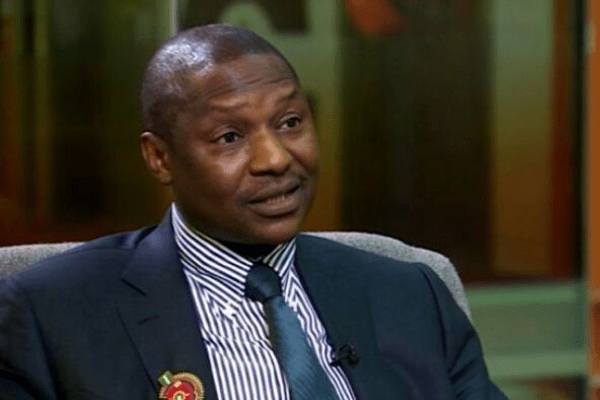
Minister of Justice and Attorney General of the Federation, Abubakar Malami, said on Wednesday that 3,768 inmates had been freed across the country in the last two years in an effort to decongest Nigerian prisons.
Malami, who was speaking in Abuja while addressing journalists on the proposed national workshop on the effective implementation of the provisions of the correctional service Act, 2019, said the Federal Government had achieved so much in the area of prison decongestion, adding that no fewer than 3,768 inmates in 34 prisons across 16 states of the federation has been set free.
“The Attorney-General and Minister of Justice in October 2017, constituted a Presidential Committee on Prisons Reform and Decongestion Chaired by the Honourable Chief Judge, High Court of the Federal Capital Territory, Honourable Justice I.U Bello to fast-track the Decongestion of prisons.
“The Committee has since its inauguration visited and appraised about 34 prisons in 16 states. A total number of 3,768, have been so far released during these visits via payment of fines for convicts for minor offences with the option of fine who are unable to pay the fines, general review of peculiar cases and advocacy overtures to relevant authorities,” he said.

The AGF in addition said the Committee also wrote letters of appeal to several state government executives to act on some special cases encountered during the visits to various prisons in their states on the need to exercise their powers of clemency in deserving cases or commute to life sentence those condemned to death.
Read also: Prisons Service asks for seven days to carry out comprehensive medical check-up on Maina
He noted that in line with the vision of transforming the prisons into correctional centres, a standard Skill Acquisition Centre at Keffi Correctional Centre would be established in December, which will be replicated in Correctional Centres across the federation.
“This will enhance the focus on corrections and promotion of reformation, rehabilitation and reintegration of offenders as provided by the Act.
“It is on this note, that my office in collaboration with the Presidential Committee on Prisons Reform and Decongestion of Prisons and the Nigerian Correctional Service will be hosting a three-day Strategic Workshop in the Month of November, 2019, with the theme, “Towards Effective Implementation of the Correctional Service Act, 2019”.

According to Malami, the purpose of the National Workshop is to sensitise stakeholders especially Justice Sector Institutions on the provisions of the Act particularly the provisions regarding non-custodial services which is newly introduced.
He added that the workshop would provide a veritable platform for the overview and comparative analysis of Correctional Service Act, 2019.
He said the signing into law of the Correctional Service Act, 2019 by President Muhammadu Buhari in August this year was a major turning point in Prisons Reform and Justice Sector delivery in the country.
The recently passed Act, according to the AGF, has some innovative provisions that will address major issues that have been of concern to stakeholders in the Justice sector.
He said the guiding principles that ran across the Act would ensure compliance with international human rights standards and good correctional practices, provide enabling platform for implementation of non-custodial measures, enhance the focus on corrections and promotion of reformation, rehabilitation and reintegration of offenders and to establish institutional, systemic and sustainable mechanisms to address the high number of persons awaiting trial.
The AGF disclosed that the Federal Government has approved the contract for the installation of the Virtual Automated Case Management System to fast track the decongestion of prisons in Nigeria.
The minister said the Federal Government was to formulate strategy; legal framework as well as infrastructure that would help rehabilitate and reintegrate victims of drugs and other social vices in the country.
Also, Chief Judge of the High Court of the Federal Capital Territory (FCT), and chairman of the prisons reform commission, Justice Ishaq Bello, who described illegal detention centres for drug addicts as a “child of necessity,” disclosed that the FCT has already commenced move to establish standard rehabilitation centres that would see to the needs of drug addicts and other social misfits in the FCT.
According to Bello, parents were compelled to send their wards with drug issues to such illegal detention centres because of the absence of standard rehabilitation centres in the country.
“If there have been states’ institutional arrangement system, parents will not hand over their children to such centres,” he said, “parents are compelled to do that because of lack of standard rehabilitation centres.”