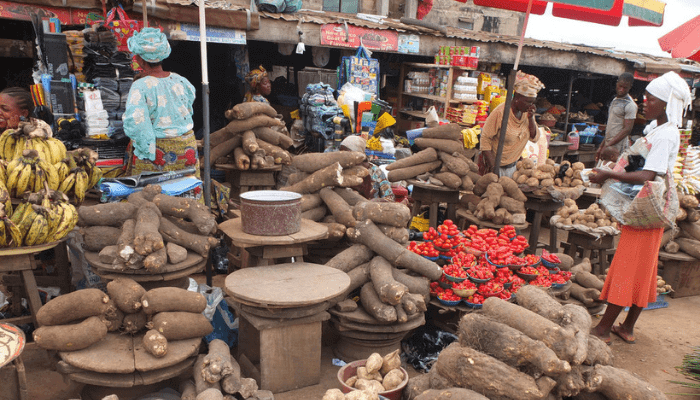
The prices of cassava stem in various markets across the country have declined by 67 percent as demand for the product continues to nosedive.
The product which was sold for N1,200 per bundle few months ago currently sells for N400 per bundle, showing a 67 percentage point decline, according to data from the International Institute of Tropical Agriculture (IITA).
Last year and earlier in 2017, prices of cassava roots and its derivatives such as garri climbed to an all-time high as demand outstripped supply.
Monsurat Kassim, farmer selling cassava stems in South-West Nigeria said there has been more demand for cassava stems than previous years. “More people are buying the stems this year than they did last year… I think the rise in price of cassava products is part of the motivation,” Kassim said in a statement made available to BusinessDay.

Kassim stated that the prices are dropping now as demand is also declining.
According to the Food and Agricultural Organisation (FAO), in 2014, about 7 million hectares of Nigeria’s arable land was planted with cassava.
“Most of the varieties planted to cover this hectarage were from the informal sector,” said Peter Kulakow, cassava breeder with IITA who is also working on the cassava seed systems project.
In Nigeria, the cassava seed system is not well structured, experts say. But the Building an Economically Sustainable Integrated Seed System for Cassava (BASICS) is trying to correct the country’s cassava seed system.
Farmers usually obtain planting materials from previous field, cut them in lengths of about a meter and tie them into bundles comprising 50 stems each and sell.

Certification from regulators is still rare but the Nigerian Agricultural Seed Council (NASC) is working with BASICS to set standards and begin the certification of cassava planting materials.
Nigeria is the largest producer and consumer of cassava in the world with production capacity of 42 million metric tonnes per annum (mtpa) and demand of 53.8 million mtpa, putting the demand- supply gap at 11.8 million metric tonnes per annum, according to the Federal Ministry of Agriculture.
Cassava has major industrial products like industrial starch, ethanol, flour, glucose syrup, sweeteners amongst others. These products are also raw materials to numerous Industries with limitless domestic and export market potentials.
Josephine Okojie