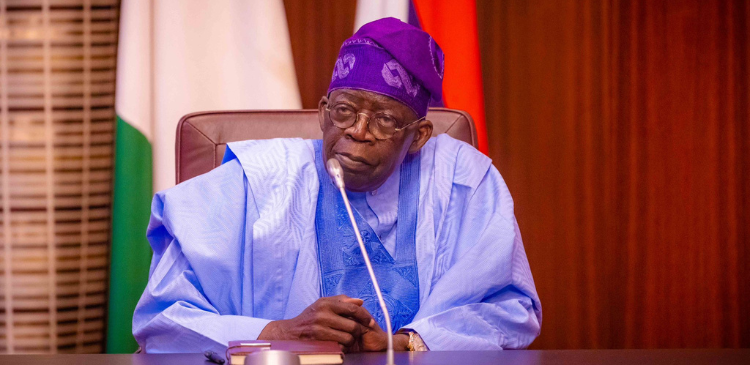
President Bola Tinubu’s latest ambassadorial nominations have drawn criticism, with diplomats and policy experts warning that political loyalty, not professional merit, appears to be the driving force behind several key appointments.
The inclusion of high-profile political actors which represents 70% of the nomination has become the flashpoint of a debate over whether Nigeria’s foreign service is being reshaped to reward allies at the expense of competence and international credibility.
Ogbole Amedu-Ode, former Nigerian Ambassador to Singapore, described some of the nominees as “political jobbers” whose careers have been defined more by partisan advocacy than diplomatic grounding.

Speaking with BusinessDay, Amedu-Ode argued that their appointments reflect political patronage rather than the rigorous standards expected in diplomatic practice.
He referred to their emergence as “angribo,” a term in diplomatic circles used for politically imposed appointees, and noted that while such inclusions are not unprecedented, they raise concerns about the dilution of Nigeria’s professional diplomatic corps.
But critics say the controversy extends far beyond individual names.
For some experts, the nominations further expose the weaknesses in Nigeria’s foreign service structure, ranging from prolonged leadership vacuums in embassies to chronic underfunding that has diminished the country’s influence abroad.
John Paul, an International relations expert warned that Nigeria’s two-year absence of ambassadors in several top missions has already eroded the nation’s diplomatic standing.

“For two years, Nigeria did not have ambassadors representing the nation in key missions. That is not good at all. When a country does not have an accredited ambassador, it takes away a lot of credibility in diplomatic relations”, he said.
Paul clarified that nominees for strategic countries such as the United States, United Kingdom and France were selected as non-career envoys due to their specialised backgrounds in intelligence, diplomacy and government service.
Paul highlighted a structural challenge that predates the current administration: the chronic underfunding of the Ministry of Foreign Affairs.
“Diplomacy is an expensive practice. Whether a country is hungry or not, it must not appear hungry before other nations,” he said.
He lamented that the ministry often receives less budgetary allocation than the National Youth Service Corps (NYSC) despite managing 109 foreign missions.
This, he said, limits Nigeria’s ability to project power, provide quality consular services, and maintain global presence. He proposed dedicating 1% of crude oil revenue to diplomatic operations.
Read also: Vacant embassies stir calls for strong, smart ambassadors
Raymond Enoh, a Public affairs analyst, said the appointments reflect a long-standing pattern of rewarding loyalty over merit.
“For Reno Omokri (one of the nominees), it only means there is a reward for all the noise made around the country. People see him as a rabble-rouser, but this is politics. The system rewards loyalty”, he argued.
He urged the new nominees to shift from domestic political activism to the discipline of diplomacy, adding that Nigerians expect them to “do the needful and stop the press they are doing on social media.”
Despite the pushback, analysts acknowledge that President Tinubu retains full constitutional discretion in appointing ambassadors, guided by recommendations from Yusuf Tuggar, Minister of Foreign Affairs.
While critics fear that increasing political appointments may weaken the diplomatic service, some argue that non-career diplomats, if competent can offer valuable experience and strategic networks.
Meanwhile, here is what to know about some of the key nominees
OLUWAFEMI FANI-KAYODE
Oluwafemi Fani-Kayode, born on 16 October 1960 in Lagos, is a Nigerian politician, lawyer and author with a long history in public service and political activism.
His early political career began in 1989 when he became a member of the Nigerian National Congress (NNC), rising that same year to become the party’s national youth leader.
By 1990, he had been appointed Chief Press Secretary to Chief Tom Ikimi, the first national chairman of the National Republican Convention, and in 1991 he served as Special Assistant to Umaru Shinkafi, a former head of the Nigerian Security Organisation.
During the repressive years of the Sani Abacha regime, Fani-Kayode left Nigeria and joined the National Democratic Coalition (NADECO) in exile, where he actively participated in the pro-democracy struggle.
He returned to Nigeria in 2001 and soon became a close political associate of President Olusegun Obasanjo. By 2003, he had joined the president’s campaign team for the general elections and, after Obasanjo’s victory, was appointed the first-ever Special Assistant on Public Affairs to the President.
In 2006, Fani-Kayode was appointed Minister of Culture and Tourism before being redeployed later that year as Minister of Aviation, a position he held until the end of the Obasanjo administration in May 2007.
After leaving office, Fani-Kayode returned to legal practice and private business, while remaining an outspoken participant in national politics. Once a fierce critic of Tinubu and the ruling APC, he eventually left the Peoples Democratic Party (PDP) and joined the very party he had long opposed, becoming one of the President’s allies. In fact, he worked vigorously as one of Tinubu’s spokespersons and key defenders during the 2023 presidential election.
RENO OMOKRI
Reno Omokri, born on January 22, 1974, is a Nigerian author, lawyer, political activist, and social media strategist known for his strong public presence and conservative social commentary.
He was born, raised and educated in Sokoto, where his mother worked as a civil servant and his father, Justice Jean Omokri, served in the Sokoto State Judiciary before rising to the Court of Appeal.
Labeled a “political jobber” by critics and many Nigerians, Omokri first rose to national prominence as Special Assistant to President Goodluck Jonathan, where he became one of the earliest presidential aides to strategically deploy social media for public engagement, opinion polling, and the promotion of government programmes.
Outside politics, he is a well-known Christian author and media personality, hosting the faith-based television programme Transformations With Reno Omokri.
He has also worked internationally as a Vice President for the U.S.-based political consulting firm Joe Trippi and Associates.
Since 2015, Omokri has remained an active voice on governance and national issues, consistently shaping public debate through his writings, advocacy, and online commentary. He was a vocal critic of President Tinubu during the 2023 general elections, aligning himself with Atiku Abubakar, Tinubu’s main rival. However, after Tinubu emerged victorious, Omokri later shifted his support to the new president.
MAHMOOD YAKUBU
Mahmood Yakubu is an academic, administrator and Nigeria’s immediate past chairman of the Independent National Electoral Commission (INEC), completing a decade-long tenure between 2015 and 2025.
Born in Bauchi State, he graduated with a B.A. in History from the University of Sokoto (now Usmanu Danfodiyo University), before earning an M.Phil. in International Relations from the University of Cambridge and a D.Phil. in History from the University of Oxford.
His academic career began at the University of Jos, after which he became a professor and expert in military history, guerrilla warfare, terrorism, and counter-terrorism at the Nigerian Defence Academy.
He also served as Executive Secretary of the Tertiary Education Trust Fund (TETFund) and contributed significantly to educational development.
Yakubu was appointed INEC chairman in 2015 and reappointed for a second term in 2020, becoming the first chairman to serve two full terms.
Yakubu was appointed INEC chairman in 2015 and reappointed in 2020, becoming the first person to serve two full terms in the commission’s leadership. His tenure spanned two electoral cycles marked by reforms, technological upgrades, and the introduction of the BVAS accreditation system. However, he faced intense criticism over the conduct of the 2023 general elections, which produced President Bola Tinubu, amid widespread logistical failures, delays in uploading polling-unit results to the IReV portal, reports of voter intimidation, and inconsistencies in result management that undermined public confidence in the process.
He stepped down in November 2025, handing over to National Commissioner May Agbamuche-Mbu in an acting capacity. President Bola Tinubu honoured him with the national title of Commander of the Order of the Niger for his service to the nation.
ERELU ADEBAYO
Erelu Angela Adebayo is a leader in Nigeria’s real estate, corporate and philanthropic sectors. She earned a BSc in Social Science from the University of Ibadan, an MBA from the University of Lagos and an MPhil in Land Economy from the University of Cambridge.
Her public profile rose significantly during her time as First Lady of Ekiti State and expanded further through major roles in the corporate world.
She has served as Chairman of Afriland Properties Plc and made history as the first female chairman of the Board of WEMABOD Estates.
Erelu Adebayo sits on the boards of the Aliko Dangote Foundation, Meyer Paints Plc and the Women at Risk International Foundation (WARIF).
She is also a Council Member of the Nigerian Stock Exchange and has been deeply involved in real estate development across the country.
Through the Erelu Adebayo Foundation and the Erelu Adebayo Children’s Home, she remains a strong advocate for social welfare and vulnerable children.
IFEANYI UGWUANYI
Lawrence Ifeanyi Ugwuanyi, widely known as “Gburugburu,” is a Nigerian politician who served as Governor of Enugu State from 2015 to 2023. Born on March 20, 1964, he represented Igboeze North/Udenu Federal Constituency in the House of Representatives from 2003 to 2015.
During his time in the legislature, he chaired the House Committee on Marine Transport for two terms and served as Deputy Chairman of the House Committee on Pensions, contributing to the enactment of the Pension Reform Act of 2004.
After winning the PDP gubernatorial primary in 2014 and defeating a legal challenge from Senator Ayogu Eze, Ugwuanyi was elected governor in 2015 and re-elected in 2019.
His administration focused on infrastructure, investment promotion and grassroots development. His global outreach included participation in an investment summit in Dublin, which earned him the Metro Eireann International Outstanding Leadership Award in 2016 for his contributions as a legislator.
Ugwuanyi left office in May 2023 after completing two terms.
TASI’U MUSA MAIGARI
Tasi’u Musa Maigari, born on 25 April 1966 in Fiwuni, Zango-Daura, is a Nigerian lawmaker and political leader who has represented Zango Constituency in the Katsina State House of Assembly since 2015.
He served twice as the constituency’s elected representative before emerging as Speaker of the Katsina State House of Assembly in December 2018.
Before becoming Speaker, he chaired the House Committee on Health, where he contributed to legislative improvements in the state’s health sector.
His political journey reflects steady advancement through grassroots engagement and state-level leadership.
NORA DADUUT
Professor Nora Ladi Daduut, born on 10 May 1953, is a Nigerian academic and politician who became the first female senator from Plateau State.
Elevated to the rank of professor in 2018 by the University of Jos, she distinguished herself as a scholar before venturing into politics.
Read also: Absence of ambassadors exposes Nigeria to diplomatic row
She contested the 2020 Plateau South Senatorial District bye-election on the platform of the All Progressives Congress (APC) and won with 83,151 votes.
She served in the Senate from December 2020 to 2023, contributing to national legislative debates and representing the interests of the Plateau South constituency.
OTUNBA PEDRO
Otunba Pedro, born on 29 January 1955, is a Nigerian economist, banker and politician best known for serving as Deputy Governor of Lagos State from 2003 to 2007 under Governor Bola Tinubu.
Before entering public office, Pedro was co-founder and Chief Executive Officer of First Atlantic Bank, later known as FinBank, establishing himself as one of Nigeria’s leading private-sector executives.
He continued to influence national development as Chairman of the Small and Medium Enterprise Development Agency of Nigeria (SMEDAN) between 2018 and 2022 and as the founding chairman of the Lagos State Sports Trust Fund.
He currently chairs the Business and Government Relations Committee of the Chartered Institute of Bankers of Nigeria.
In October 2022, he was appointed to the Lagos State Governor’s Advisory Council (GAC), the highest decision-making body of the APC in Lagos.
A holder of the chieftaincy title “Otunba,” Pedro remains a prominent voice in Nigeria’s financial and political spheres.
(This is a developing story, details coming later)