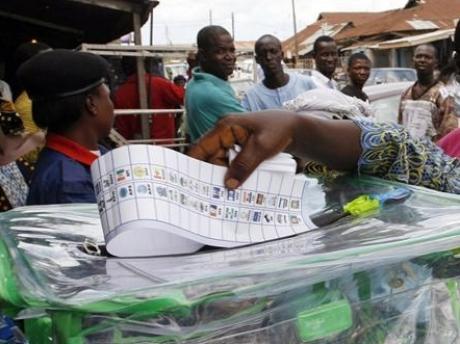
It would have been thought that the two main political parties and their candidates would have shrugged off the disappointment of the postponed elections and returned to campaigning to sway voters to their sides and encourage massive turnout on February 23. It would also have been thought that with the signing of the peace pact by the candidates and their political parties, they would have eschewed violence or any act that might in any way jeopardise the collective vision of a free, fair, transparent and credible election.
But no, the parties and leading candidates, including the president, are doing the exact opposite. They have been showing unusual desperation in the way they accuse each other and the electoral umpire, the Independent National Electoral Commission (INEC), of attempts to rig the elections. They have also engaged in unusually fierce and belligerent rhetoric which is heating up the polity and increasing the likelihood of voter apathy.
The bigger picture, which has escaped all the parties and candidates in their desperation to win the election, is the negative image they are giving the country. The accusations and counter-accusations and the impugning of the integrity of the umpire is showing Nigeria to the world as a country without mature institutions and one that cannot be trusted to carry out a routine task as simple as conducting elections.
INEC had on February 16, few hours to the commencement of voting, announced the postponement of the elections by one week due to what it said were logistics and operational difficulties and also subtly hinted at sabotage. Many INEC personnel in some states confided in journalists that there was practically no way elections could have held simultaneously in all parts of the country due to the late or even non-arrival of sensitive election materials in some states.

Investigations by a national daily also showed that the postponement of the polls late in the day was a result of late ordering of the production of some sensitive electoral materials due to the plethora of court cases, their late arrival to the country, lack of capacity on the part of the Nigerian Air Force to evacuate them on time, poor weather conditions in some parts of the country, the mysterious setting ablaze of sensitive electoral materials in some states, and the movement of presidential aircraft necessitating the closure of some airports.
Almost immediately, the two main political parties began trading blames, accusing INEC of working in concert with the other to disrupt or rig the polls. But while the opposition PDP had gradually warmed up to the reasons given by INEC for postponing the polls and is showing more understanding with the electoral umpire, the ruling APC has doubled down, accusing INEC of playing the script of the opposition PDP and even threatening to boycott the elections in about three states (Abia, Akwa-Ibom and Cross River) unless the resident electoral commissioners are changed.
Adams Oshiomhole, APC national chair, insisted that INEC must be prevailed upon to immediately reshuffle state RECs, whom he alleged had been compromised. Oshiomhole went as far as accusing INEC of alerting the PDP of the intending postponement of the elections even before it was announced.
The APC found an ally in President Muhammadu Buhari, its presidential candidate. The 76-year-old on Monday could barely conceal his irritation with the electoral umpire for postponing an election that was only six hours away.
In further making the point that he would not allow anyone rig the elections, the former military ruler ordered the military and police to administer jungle justice on election riggers or those who may want to snatch ballot box.

The president did not mind that his orders contravened the provisions of the constitution for a fair trial for all accused persons, the Electoral Act that stipulates only a two-year jail term for convicted ballot-box snatchers, and INEC’s guidelines that prohibit all security agencies, including the army and police, from shooting at polling booths.
Many fear that with this carte blanche, the military and police could be influential in the election as they could lend themselves to the services of politicians to instigate violence, thus suppressing voter turnout.
The PDP, on its part, has accused the ruling APC of deliberately sabotaging the election and wanting the electoral body to proceed with the elections in spite of the fact that elections would not be taking place in all states of the federation. Uche Secondus, its chairman, alleged that having failed in scuttling the elections by burning down INEC offices in some states and destroying electoral materials to create artificial problems, the ruling party “had to force INEC to agree to a shift in the election or a staggered election” like it did in Osun State, which could give room for voter suppression and result manipulation in the rerun election.
Just on Tuesday, Atiku Abubakar, PDP presidential candidate, accused the APC of training operatives in China to hack INEC’s smart card readers to slow them down in key opposition strongholds while allowing them to work faster in the ruling party’s strongholds.
The smart card reader is an innovation introduced by INEC during the 2015 elections and is used to authenticate the permanent voter cards without which a voter won’t be allowed to cast his/her votes.
Christopher Akor