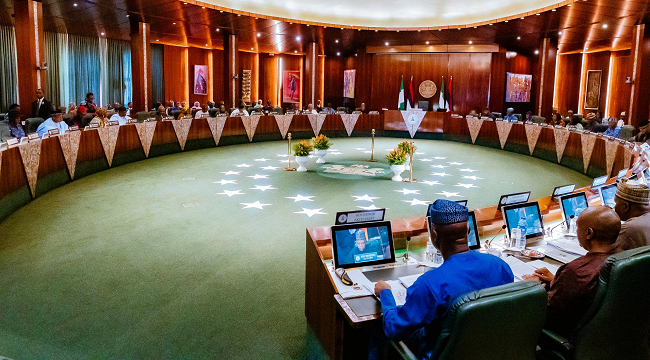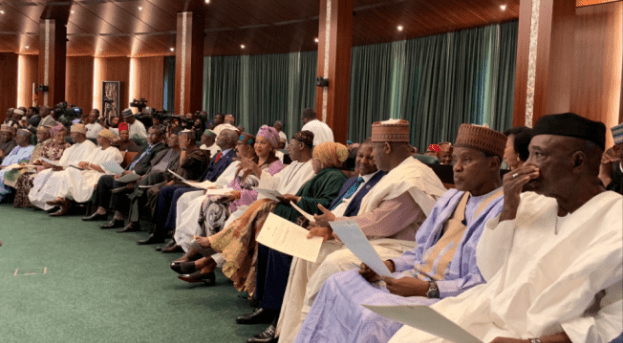
With the long awaited allocation of portfolios to the ministers last week, it is now very obvious that a competent economic team is urgently needed to complement the ministers if we are serious to rescue Nigeria from current and escalating socio-economic and political crises. Of the 43 members, there is no thoroughbred economist. Only two have basic B.Sc degrees in economics — Gbemisola Saraki now Minister of state for Transport and Clement Agba, Minister of state for Budget and National Planning. Moreover, based on the qualifications, experiences and previous impacts of the 43 ministers, it is difficult to call them the first class cabinet that Nigeria desperately needs. We are talking of an economy facing multi-faceted socio-economic and political crises with all key indicators of economic growth heading south- poverty, inequality, unemployment, insecurity, FDI, GDP per capita, ease of doing business, rule of law, regulatory quality and government effectiveness.
With such dire socio-economic situation, what is required of President Buhari is to quickly assemble a competent economic team made up of some members of his cabinet and others selected purely on merit. A suggestion will be to include immediate past three CBN governors, six renowned academic economists chosen from one top university from each of the six geo-political zones and three members from the Organized Private Sector (OPS). It can be described as a Council of Economic Advisers and headed by a robustly trained economist with an unconvincing inclination for home-grown solutions. Just as our problems are clear, the solutions are not farfetched. All that is required is a focused, courageous, committed economic team and leadership with proactive, innovative solutions to our problems.
Given the current state of our economy, the immediate tasks of the team are clear. First is to comprehensively and critically review the Next Level plan to give it clarity and direction. As earlier cautioned, the Next Level plan is a mere campaign document lacking depth, conviction and synergy to create what can be described as “Associational Economy” that Nigeria immensely needs.
With a critical review of the Next Level plan, the second focus of the economic team is to deeply examine if Nigeria is socio-economically better as it is now or in a restructured form. Even if the federal government is reluctant for proper restructuring of the country irrespective of its overwhelming benefits and urgency, the economic team should properly review the items on the exclusive and concurrent lists to ascertain if we are better with more items on the concurrent list or better with more on the exclusive list as it is presently.

The third focus of the economic team in collaboration with the heads of all the security agencies is to critically review, craft and quickly implement an effective strategy to address the escalating insecurity situation across the country bearing in mind the negative consequences it is having across all facets of our economy and country.
The fourth focus of the economic team is our increasing and unsustainable debt burden. With a debt burden of over $81 billion and more borrowing on the table, the task of the economic team is to critically innovate on how best to reduce our debt burden, avoid a fiscal crisis and sustain economic growth and development. They need to decide whether NNPC should be sustained or fully privatized and whether fuel subsidy should be continued or removed.
Fifth is to proactively work with CBN to clearly agree on what constitutes CBN monetary policy functions and the ones that are fiscal policies of the government. A situation as it is the case presently where the CBN seem to be executing both the monetary and fiscal policies of the government is inappropriate and confusing. Also important is to properly rethink if the current CBN foreign exchange management is the best for Nigeria. With a falling foreign reserve and oil price, increasing contingent liabilities, the key question is if the continued protection of the naira through regular dollar injections is the best and sustainable. This is also the case with the current federal revenue sharing approach where dollar receipts are replaced most of the times with freshly printed naira before sharing to the three tiers of government.
With over 22 million Nigerians unemployed, the sixth focus of the team is to craft and implement short-term policies that can create over 20 million jobs in four years. This might look unrealistic but it is very achievable through a deliberate rethinking of abundant job creating opportunities all over Nigeria. These include reforming of our vocational and apprentice system, partnering with the private sector to change our sports and housing sectors through innovating solutions to reduce our 16 million housing units’ deficit, upgrading our postal system and constructing of artificial lakes to revolutionise agriculture and even address the farmer-herdsmen crisis and support ranching even in very dry regions of Nigeria.
Seventh is to think and clearly identify Nigeria’s areas of comparative advantage. As Nigerians in diaspora contributed over $25 billion in 2018 and set to contribute higher in 2019, there is a need for a strategic rethinking of how to effectively harness and expand the opportunities from diaspora especially with the increasing global demand for skills and talents.

The eight focus is on AfCFTA. With our unprepared signing, it will be very important for the economic team to critically review our (un)preparedness and clearly map out strategies that will ensure that we are not disadvantaged. With Ghana voted to be the headquarters of AfCFTA and Africa’s aviation hub, it is clear that we are already losing out. However, with issues such as the rules of origin and non-tariff barriers yet to be resolved, the economic team must ensure that our big market size of about 200 million people is not further exploited.
As a holistic examination of the above issues and more are beyond the remit of the cabinet and must be urgently addressed to avoid a fiscal crisis, the need and urgency for an effective economic team cannot be over-emphasised.
FRANKIN NNAEMEKA NGWU
Dr. Ngwu is a Senior Lecturer in Strategy, Finance and Risk Management, Lagos Business School and a Member, Expert Network, World Economic Forum.