“Money is not Nigeria’s problem, but how to spend it”—this statement is famously attributed to General Yakubu Gowon, Nigeria’s military head of state from 1966 to 1975. It captures a critical truth about Nigeria’s economic trajectory: abundance without direction leads to missed opportunities.
In a New York Times article dated 16th March 1975, titled “Nigeria is Struggling over Control of Her Wealth,” it was revealed that Nigeria’s workers and professional classes felt entitled to a larger share of the country’s booming prosperity. However, the federal authorities were ill-prepared for the discontent driven by these rising expectations and the inflationary pressures plaguing the nation. Labour unions were divided, with no effective machinery in place to mediate negotiations or maintain order.
This situation epitomised a broader issue: the managers of Nigeria’s economy—both military leaders and civil servants—were not adequately equipped to handle the extraordinary wealth that flowed from the oil boom of the early 1970s. Even as the country completed its Second National Development Plan (1970–1974) and prepared to launch another five-year plan (1975–1980), the focus remained inward, with self-interest overshadowing long-term strategy.
The International Bank for Reconstruction and Development (IBRD) in 1962 optimistically predicted that Nigeria’s 1962–1968 Development Plan would bring the country to self-sustained growth and economic independence.

Yet, this promising trajectory was derailed by poor management and a lack of discipline in adhering to economic planning principles.
As a result, nations that once lagged behind Nigeria in terms of economic growth and per capita income have surged ahead, leaving the country and its people in the dust.
The Divergence: A Tale of Two Economies
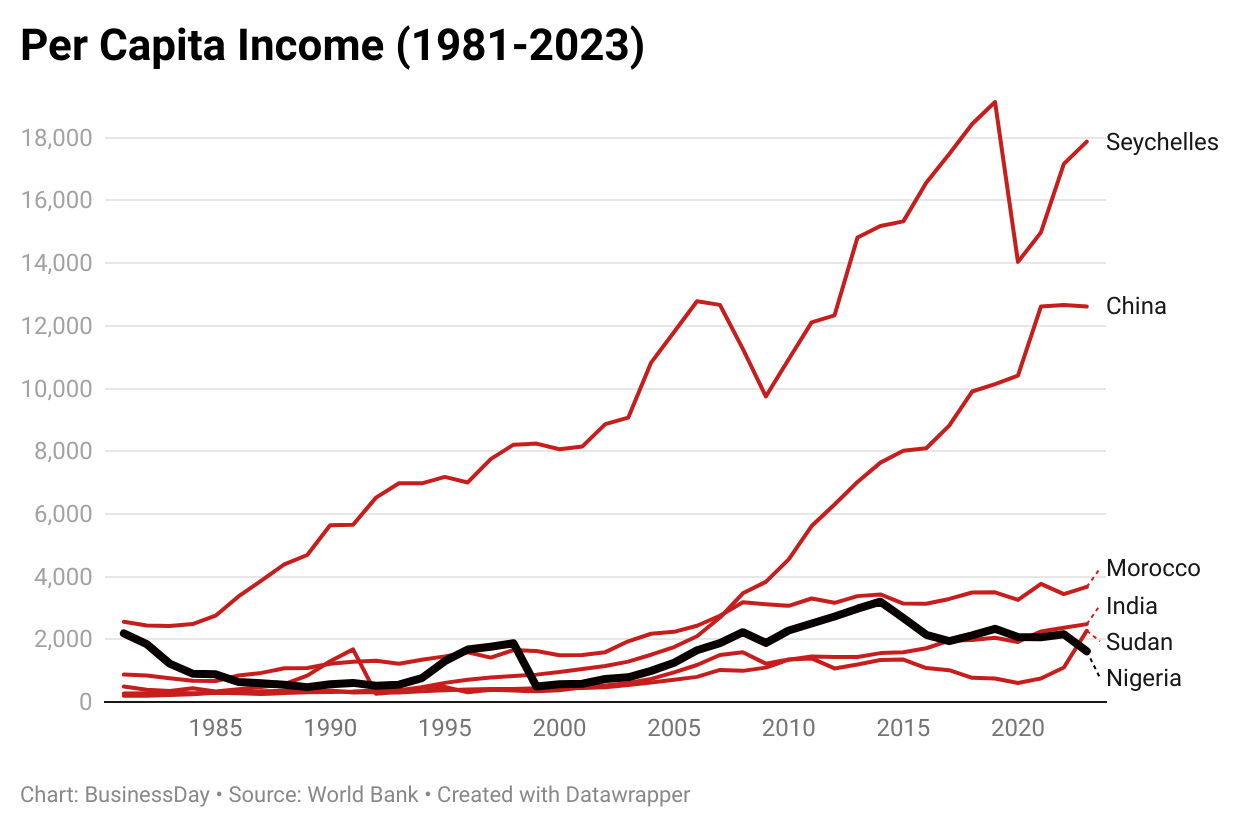
In 1981, Nigeria’s per capita GDP was ahead of countries like India, Morocco, and even China—and only 15 percent below that of Seychelles. Fast forward 42 years, and while Nigeria stumbles, some of these nations have emerged as industrial hubs. China, in particular, is a striking example of how disciplined planning can transform a nation.
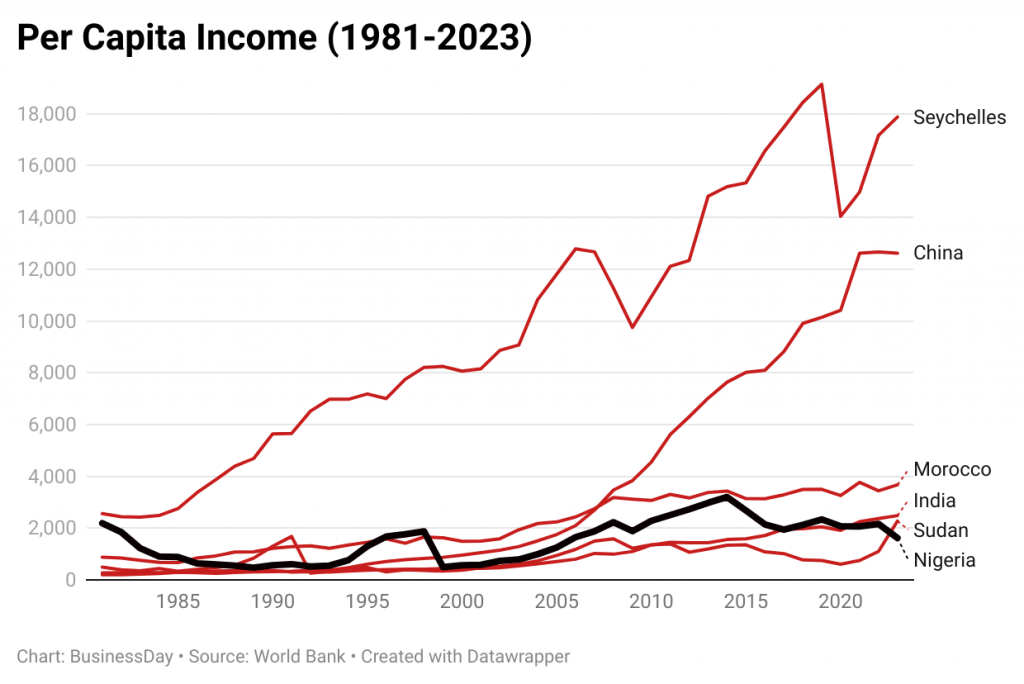

Between 1981 and 2023, China’s per capita GDP skyrocketed, far surpassing Nigeria’s. What enabled China to lift 800 million people out of extreme poverty by 2022 is not just economic growth but the country’s unwavering commitment to its National Development Plans, which began with the First Five-Year Plan (1953–1957). China is now on its 14th Five-Year Plan (2021–2025), having consistently adhered to development planning for over 70 years.
Meanwhile, Nigeria’s approach has been fragmented and inconsistent. Despite numerous ambitious plans, including the most recent 2021–2025 National Development Plan (NDP), a lack of policy continuity and a failure to execute long-term strategies have hampered the country’s progress.
Inconsistent Implementation and Missed Targets
The 2021–2025 NDP is the latest in a long line of development frameworks aimed at addressing Nigeria’s structural challenges. Like Vision 2020 and the Economic Recovery and Growth Plan (ERGP) before it, the NDP sets out to unlock Nigeria’s economic potential by focusing on critical sectors such as infrastructure, agriculture, and manufacturing. Yet, history shows that these plans often fall short due to ineffective implementation.
For example, Vision 2020 sought to position Nigeria among the world’s top 20 economies by 2020. Instead, the country only improved marginally, moving from 30th to 27th in global GDP rankings.
In stark contrast, China’s Five-Year Plans have consistently delivered results. From its first plan in 1953, China has not only formulated clear development strategies but also implemented them with precision. The country’s transition from an agrarian economy to an industrial powerhouse is a testament to the meticulous execution of its plans, enabling broad-based economic transformation.
In contrast, Nigeria’s grand ambitions have repeatedly been derailed by external shocks—most notably, fluctuations in oil prices—and poor governance.
Failure to Diversify the Economy
Both Nigeria and China were once largely agrarian economies. Yet, while China quickly diversified into manufacturing and technology, Nigeria remains stuck in a mono-economy, heavily reliant on oil.
The current NDP highlights the importance of diversifying away from oil and focusing on sectors like agriculture, digital economy, and manufacturing. However, efforts to diversify have been slow and inconsistent.
China’s investment in education, research and development, and technology has propelled it to global leadership in industries like telecommunications, renewable energy, and consumer goods. Nigeria, despite having the potential, continues to fall back on oil revenue as its primary economic driver.
Job Creation and Poverty Alleviation: China’s Success vs Nigeria’s Struggles
The Nigerian NDP sets ambitious targets to create 21 million jobs and lift 35 million people out of poverty by 2025. Yet, these goals echo similar targets from previous plans, most of which went unmet due to inconsistent economic growth.
China’s poverty alleviation story, by contrast, is a global success. Over four decades, the country lifted 800 million people out of poverty, contributing to three-quarters of the “global reduction in extreme poverty” according to Yu Weiping, Vice Minister of Finance, China.
This was achieved through deliberate alignment of social policies with economic growth strategies—investments in education, healthcare, and infrastructure created opportunities for inclusive growth.
China’s rural revitalization strategy is a crucial part of its efforts to sustain poverty reduction and promote long-term development in the countryside.
After successfully lifting millions of people out of poverty, the focus shifted to ensuring that rural areas could continue to grow and develop, preventing any return to extreme poverty.
This strategy revolves around boosting the rural economy by developing local industries, such as agriculture, while improving access to education and healthcare.
In essence, rural revitalization is about modernising rural areas and creating better living conditions to maintain the progress China has made in poverty alleviation.
Governance and Institutional Weaknesses
One of the most critical factors that separate Nigeria from China is the strength of its institutions. Nigeria’s NDP acknowledges the need for institutional reforms to improve implementation, yet weak governance, corruption, and political instability have continually undermined these efforts.
China’s centralised governance system allowed it to efficiently execute development policies and meet targets. Strong institutions enabled China to manage large-scale projects, stimulate industrial growth, and reduce poverty on a massive scale.
Nigeria, by comparison, struggles with even basic infrastructure projects due to weak institutions, delays, and frequent cost overruns.
Monitoring and Evaluation: The Missing Link
A significant flaw in Nigeria’s development planning has been the lack of effective monitoring and evaluation (M&E) systems. While the current NDP promises a more rigorous approach to tracking progress, Nigeria’s history of weak M&E has often rendered plans ineffective. Vision 2020 and the ERGP set ambitious targets but failed to meet them due to a lack of accountability and real-time adjustments.
By contrast, China’s Five-Year Plans are underpinned by robust M&E frameworks. The Chinese government continuously measures progress, making necessary adjustments to ensure targets are met. This commitment to tracking and execution is key to China’s unprecedented success in economic development and poverty reduction.
Without strong political will to enforce M&E, Nigeria’s NDP risks following the same pattern as its predecessors—ambitious on paper, but underwhelming in delivery.
Nigeria’s path forward depends on its ability to learn from the lessons of successful economies like China. Development is not just about creating ambitious plans—it’s about executing them with precision. Without consistency, robust governance, and effective monitoring, Nigeria risks being permanently left in the dust by nations that once looked up to it.