



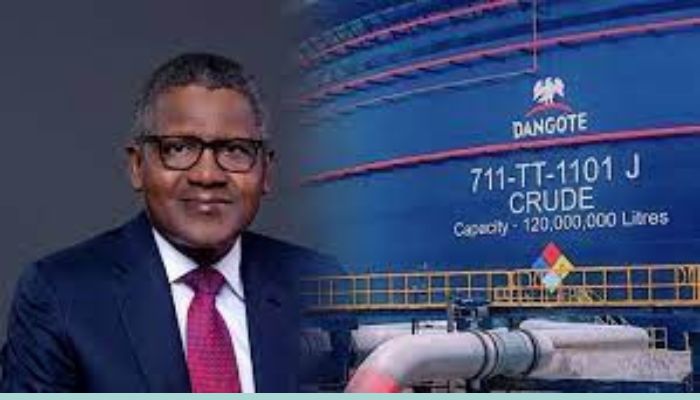
Nigeria’s reliance on imported petrol dropped significantly in the first quarter of 2025, with the country’s petrol import bill crashing by 54 percent year-on-year, according to data from the National Bureau of Statistics (NBS).
The sharp decline follows the increased domestic supply from the Dangote Petroleum Refinery, which has begun operating at near-full capacity, reducing Nigeria’s dependence on foreign fuel imports.
Dangote Refinery Drives Import Reduction
The latest NBS report shows that Nigeria spent $1.2 billion on petrol imports in Q1 2025, down from $2.6 billion in the same period last year.
This marks the lowest quarterly import bill since 2020 and reflects the growing impact of the 650,000-barrel-per-day Dangote Refinery, which started full-scale production in late 2024.

Industry analysts attribute the sharp drop to the refinery’s ability to meet a significant portion of Nigeria’s petrol demand, which stands at around 50 million litres per day.
Read also: Dangote plans major “shakeup” of Nigeria’s downstream oil sector
Before the Dangote Refinery came online, Nigeria imported nearly 90 percent of its petrol, exposing the economy to foreign exchange volatility and supply chain disruptions.
Data from the country’s statistics bureau (NBS) revealed that Nigeria spent N1.76 trillion on petrol imports in the first quarter of 2025, indicating a 46.68 percent decrease from the preceding quarter.
Year-on-year analysis showed that bringing in the product from other countries dropped by 33.14 percent from N2.63 trillion in the first quarter of 2024 to N1.76 trillion in Q1 2025

Energy analysts had anticipated that the recent start of operations at the Dangote Refinery and the emergence of multiple modular refineries would lessen the nation’s dependency on imported petrol.
“They are importing a lot less, and traders are making up the shortfall from offshore Lome” one trader told Platts, referring to the nearby transshipment hub off the coast of Togo where traders blend product.
In February, Dangote refinery stated that it would covering as much as 60 percent of the Nigeria’s domestic petrol demand as it has crept towards its full capacity, according to company estimates.
Speaking to Platts in late January, a Dangote Group executive said that the refinery was producing over 30 million litres per day of petrol, reporting that the site had surpassed 85 percent utilisation.
Equating to roughly 200,000 barrels per day (bpd), that output would cover the bulk of roughly 350,000 bpd petrol demand in Nigeria estimated by S&P Global Commodity Insights analysts.
Petrol imports plunge by 30 million litres
The Nigerian Midstream and Downstream Petroleum Regulatory Authority (NMDPRA) said the importation of petrol into Nigeria reduced by 29.9 million litres in over eight months.
Farouk Ahmed, CEO of NMDPRA, stated that the country’s daily petrol importation decreased from 44.6 million litres in August 2024 to 14.7 million litres as of April 13.
He attributed the drop in imports to increased contributions from local refineries.
Nigeria is making more of its petrol
Nigeria is importing much less petrol from other countries because local refineries are making more. Daily imports dropped from 44.6 million litres last August to just 14.7 million litres by mid-April, a huge decrease of 29.9 million litres.
At the same time, local petrol production has jumped by 670 percent, meaning Nigeria is making about 7 times more of its petrol than before.
This significant increase happened because the Port Harcourt Refinery started working again in November 2024, and small local refineries across the country are producing more.
Local refineries now produce 26.2 million litres of petrol per day, a big change from August 2024, when they weren’t producing anything meaningful.
Even with fewer imports, Nigeria still has enough petrol. The government says the country needs about 50 million litres per day. The total supply (local production plus imports) has mostly stayed above this level, though it’s been dropping lately.
In November 2024, supply reached 56 million litres per day, then 52.3 million litres in February 2025, followed by 51.5 million litres in March, and recently dropped to 40.9 million litres in early April 2025.
Ahmed called for everyone to help protect Nigeria’s oil and gas facilities. He said security agencies, political leaders, traditional rulers, young people, and oil companies all need to work together to keep these important assets safe.
“It takes all of us, government, traditional institutions, companies, and the youth, to collaborate and resist criminal activities that threaten our infrastructure,” he said.
He also stressed that the NMDPRA is committed to being transparent and accountable in how it regulates the oil industry.





